Saturday, July 10, 2010

Canoeing in the Massasauga Park and Sharing it with Black Bears, July 07-14, 2009 and September 25-28, 2009


Wreck Island, July 07-14, 2009 


The Massassauga Provincial Park, stretching along the coast of Georgian bay from Parry Sound to the Moon River, takes in hundreds of windswept islands as well as inland forests and lakes. My first canoeing visit to this park was in 2008 and it was such a good trip that I decided to come back, this time taking a more ambitious route, albeit without any portaging. It is one of the few parks which offers plenty of prolonged canoeing trips, allowing the paddler to sit IN the canoe ON the water, as opposite to WALKING on land UNDER the canoe (i.e., portaging!). Needless to day, I much prefer the former! Our camping destination was Wreck Island and its lone campsite #325. Miraculously, it was not even very difficult to reserve it since not too many people are willing to cross open waters of Georgian Bay—and perhaps they’re right, as we were to find out later.

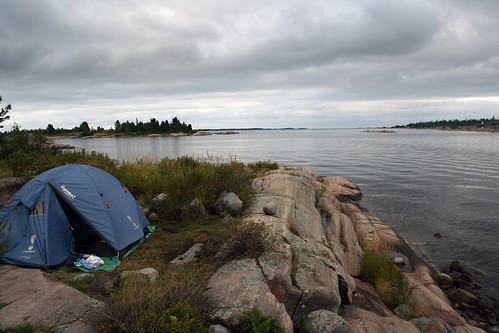
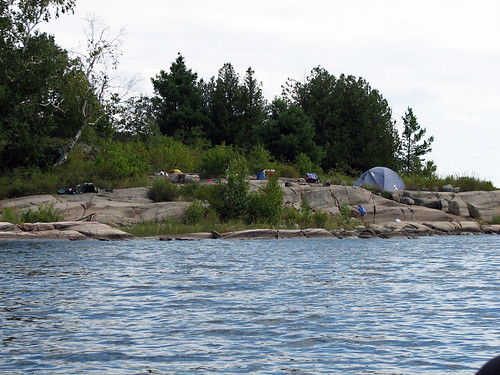
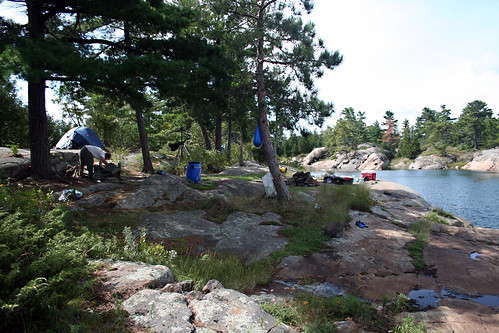
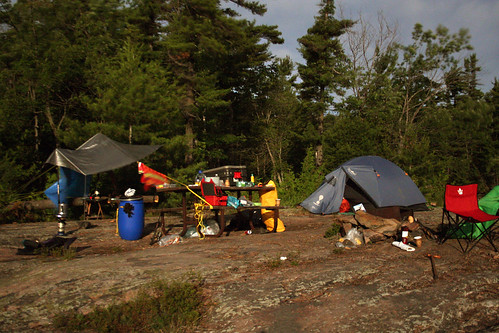
Our campsite on Wreck Island

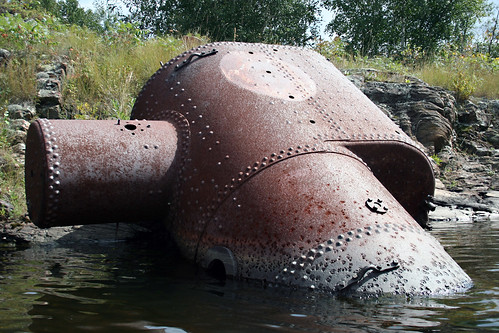
Wreck Island is also associated with a well-known ship, the Waubuno, which transported passengers and freight between Collingwood and Parry Sound in the 1860s and 1870s. On November 21, 1879, the ship left the town of Collingwood for Parry Sound; it had been trying to leave that town for 3 days, but due to snow and fierce winds it was kept in port. Since it was likely the last voyage the ship could make before ice made future trip impossible until the following Spring, the captain must have decided to tread dangerously and get the ship to Parry Sound. The ship, with 24 crew and passengers, was last spotted afloat by the lighthouse keeper at Christian Island. When it failed to turn up at its destination, a search was commenced and many scattered articles belonging to the missing vessels were found, but no bodies. Other parts of the ship have been recovered over the years. A hull which is though to be that of the Waubuno can be seen in the waters near Wreck Island.
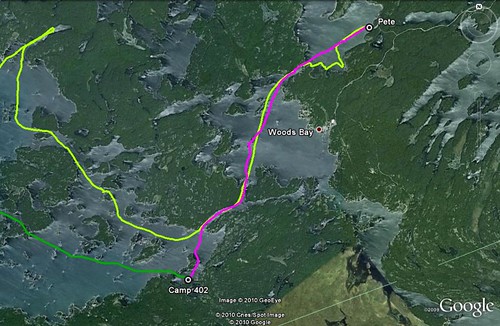

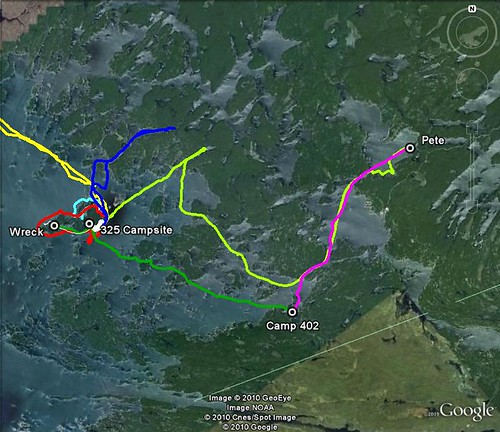
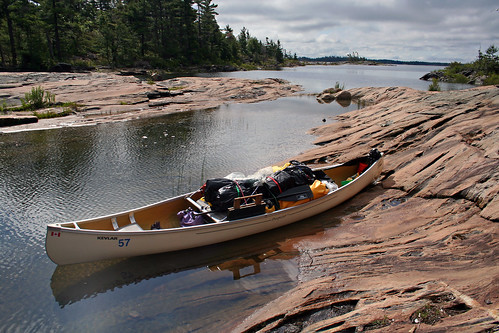
After departing Toronto on July 07, 2009 and a 3 hour drive, we arrived at Pete’s Point Access Point. It was quite windy—the waves on Blackstone Harbour did not appear to subside at all—to the contrary, I had a feeling they were getting bigger by the minute. However, we bravely got into our packed canoe and started to paddle towards the channel connecting Blackstone Harbour with Woods Bay. During a calm weather it should take us about 4.5 hours to reach Wreck Island, but we soon realized it would be impossible to get there today at all—we were paddling against the wind and even though we were still in a relatively sheltered bay, the canoe proceeded very slowly forward, rocking up and down on the waves—we could only imagine what would happen out on Georgian Bay! With some difficulty we traversed Woods Bay and reached the calm waters of Captain Allan Straits, even contemplating staying on one of the many campsites located on the shores. Yet we decided to paddle on and reach campsite number 402, where we had camped for several days in 2008.

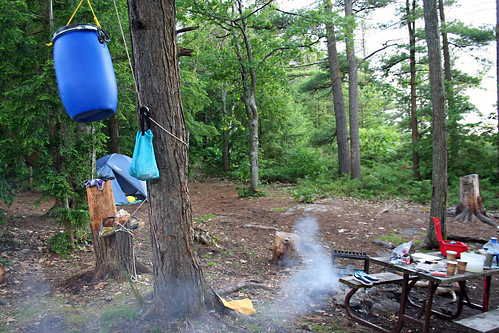
Bearproofing was a good idea, as there was at least one bear on the island!
The campsite, located in a bay and sheltered from the main channel by islands, was very nice and had not changed since last year. Because we were only supposed to spend one night on this campsite, we quickly set up our tent and started the fire.


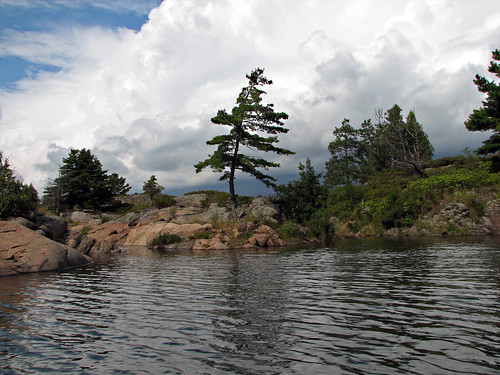
The weather greatly improved the next day, so we packed our stuff and quickly got on the water. After passing Pleasant Island on our right, we entered very picturesque and rocky passage through a cluster of islands (Sharpe, Omar). Soon, Wreck Island came into sight; led by my trusty GPS, we slowly paddled into a small bay... and there it was! The site was breathtaking! We had our ‘private’ bay, with a ‘private’ island, as well as an awesome view of Georgian Bay and several islands. Although there were several tent pads in the forest, we set up our tent on the flat rocky hill so that it was close to the fire and offered an unobstructed view of the area.

Wreck Island... a perfect bay, a perfect campsite!

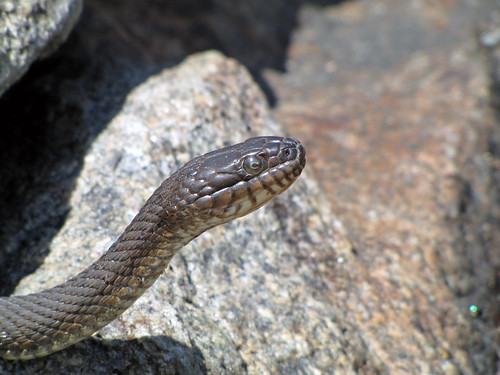
The small island, which was accessible by foot, turned out to be a great fishing and swimming spot—as well as a very convenient place to have our meals. We noticed plenty of water snakes swimming around the island—they lived in many crevices of the island.

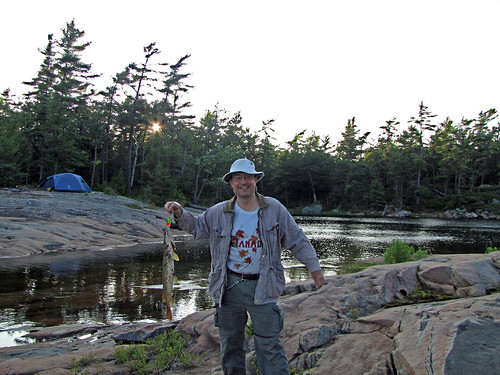
...and perfect fishing!

Soon, when we had our meals, we could see up to 6 snakes’ heads protruding from cracks or slithering on the rock and getting into the water. Of course, those snakes are harmless and never interested in attacking humans, but if threatened, they can be quite vicious and bite with their sharp teeth.


Although not venomous, their saliva contains anticoagulant which may cause profuse bleeding lasting for up to 9 hours; in addition, it can also bring about nasty infection requiring medical attention.

Garpikes. Many years ago a friend of mine caught a few garpikes and insisted on eating them. He saw they had a lot of bones and very little meat, which was not very tasty

My paddling partner, oblivious to the dangers, would do a daily swim around the bay. The snakes would come out patrolling as soon as she hit the water, their heads held up like periscopes, as if ready to fire off a torpedo into an unsuspecting victim. It was surreal.! I tried my luck with fishing and during our stay I caught two pikes, 2 and 4 kg., which turned out to be delicious!

There were plenty of water snakes on our campsite!

Besides camping on Wreck Island, we also paddled to Henry’s Fish Restaurant, a very well-known place. It made the top 100 in Saveur magazine; its fish and chips are supposedly one of the best in the world! Its fame is so widespread that people from many countries made the point of visiting this place—including some famous locals, like Goldie Hawn and Kurt Russell. Since it’s located on an island (appropriately called Frying Pan Island), the only way is by water or by air. It’s possible to take a Cessna float plane from Parry Sound and after a 10 minute flight over the 30,000 islands, land on the water and step in for a very original dinning experience! Frying Pan Island was north of Wreck Island, about 2 hours away by canoe—but since we had to paddle on unprotected and open waters of Georgian Bay, we decided to take advantage of the calm and relatively windless weather and paddle there the next day, July 09, 2009. By the way, we had a marine radio with us and listened to marine weather forecast which were very accurate, at least for the next 12 to 24 hours.

Our canoe trip to Fryingpan Island, to the famous Henry's Restaurant

The paddle went off without any problems—after making a semi-circle to the left, we were again paddling on the open waters of Georgian Bay. We passed Alice Island to our right, through a passage between Saville Island and Barnicke Island, then between Isabel Island and Florence Island and were slowly approaching the sizable Frying Pan Island. As we were nearing the shore, a peculiar and rather familiar looking sign caught our attention. “Is it what we think it is?”, we wondered.

Frying Pan Island
Yes, the LCBO store on an island! We would make a lot of purchases in this store during our canoe trip in following years

Indeed, as we approached the building, we were right—it was the ‘famous’ LCBO sign! (for those not living in Ontario: government-owned LCBO stores are generally the only stores allowed to sell hard liquor in Ontario).


It was impossible to pass such an opportunity—after all, the only other LCBO store in the Massasauga Park was at the Moon River Marina, about 5 hours from Wreck Island! Two employees on the dock helped us to moor the canoe, although they were generally accustomed to helping secure bigger motor boats. The store sold a lot of stuff, including, of course, LCBO-related supplies. We opted for cold beer and coolers; then paddled for a minute or so to a small island vis-à-vis the store, where we relaxed and gulped the drinks while observing the arriving flotilla of a variety of vessels whose owners were mainly in need of cold beer. My partner even managed to snag a cup of ice for a real "on the rocks" experience. Well-rested, we embarked for our final destination. When approaching the restaurant’s dock, we felt a little uneasy, seeing all the big, expensive and luxurious yachts, cabin cruisers and float planes at its dock—our canoe was much smaller than their dinghies—yet we still got a royal treatment from the two employees on the dock, a.k.a. parking attendants.
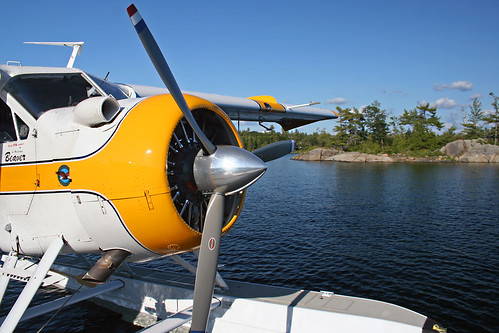

Henry’s Fish Restaurant was quite large and rustic, offering an assortment of fish dishes. We decided on an ‘all you can eat’ special (at $24.99 per person, not cheap) and in no time were served plates of battered fried fish, coleslaw and French fries. While we were eating, another float plane landed nearby, discharging several people, as well as a water taxi from Parry Sound arrived with yet more hungry visitors. We asked the waitress about tips. “Do you think there is a correlation between the amounts of tips AND the size of the customers’ boats?”, I asked. Then I pointed to the smallest vessel moored at the dock (i.e., our canoe) and said, “this is our watercraft, by the way”.

Yes, it's our canoe-we were the only crazy customers to arrive by canoe! All the others had arrived by motor boats, yachts and planes
Yet generously tip we did; after all, we’d like to come there again! Following our feast, we had an opportunity to meet and chat with the restaurant’s owner (although his name was not Henry— he bought the place years ago from the original owner). Then we hopped in the canoe and almost sunk due to the excess weight (just kidding!)... and paddled back home! The weather was still perfect, no wind. We maneuvered among the myriads of islands and stared at the boundless waters of Georgian Bay on our right. Had the weather taken a turn for a worse just a little, we’d have had to remain on Frying Pan Island for a while... well, not such a bad prospect, after all! It must have been the food, because the paddle back to our campsite took us just 1.5 hours.

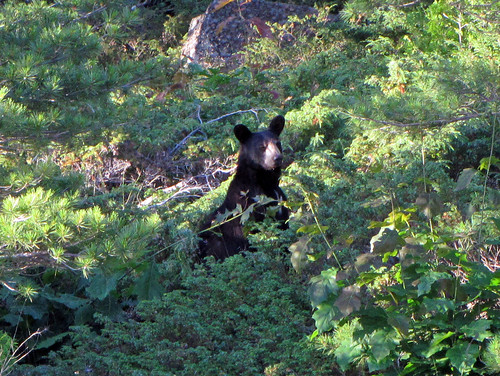
A friendly bear apparently occupied "our" island!

When we were entering into ‘our’ bay, on the right, just opposite our campsite, a small black bear appeared on the shore. I managed to take a couple of photos, but it soon disappeared in the bush. We saw it again in a couple of days, but otherwise it did not bother us and ostensibly didn’t desire our company—or rather our food; well, the latter we religiously packed in a barrel and hung on a tree overnight and each time we left our campsite.
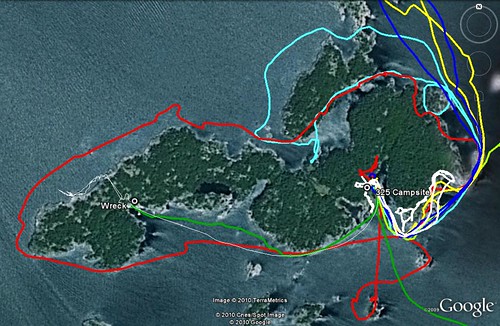

It was our intention to return to Toronto on Saturday, July 11, 2009, yet the winds picked up and it was simply impossible to paddle across those long open stretches of water. So, here we were, stuck on an island, with at least one black bear, a bunch of water snakes and a school of lurking garpikes! Fortunately, the weather still allowed us to paddle around and near the island. On the south-west end of the island there was the 1.5 km. Wreck Island hiking trial. The trail was short—but the scenery was just amazing! I’m not a geologist, but let me quote a few passages from “Wreck Island Trail” by Ontario Parks:

Geologists believe that the rocks in this area have experienced a mid-continental collision beginning some 1.1 billion years ago. Mountain building was followed by millions of years of erosion. Some 450 million years ago a marine sea flooded this area leaving deposits of limestone, yet non of these thick deposits have survived the subsequent erosion on Wreck Island.


Glaciation has also contributed to sculpting the park’s landscape. Continental glaciation finished the job of removing the last traces of soft limestone. The last sheet covered the Wreck Island area approximately 60,000 years ago, however, it was 14,000 years ago that an event far to the north of Hudson Bay would leave a lasing record on the island. A catastrophic release of glacial meltwater occurred, releasing a huge quantity of debris-laden water with “nowhere to go”. Ice still covered this part of Georgian Bay, including Wreck Island, as the water rushed southward. It traveled beneath the ice under tremendous pressure. The water was able to push up the base of the glacier and travel along the ground. The rushing torrents was filled with sharp grit, cobbles and boulders. This torrent attacked the rock surfaces of Wreck Island much like a giant sand blaster, resulting in the erosional processes evident today. Percussion Boulders Fourteen thousand years ago a catastrophic release of glacial meltwater occurred, releasing a huge quantity of debris-laden water with “nowhere to go”. Ice still covered this part of Georgian Bay, including Wreck Island, as the water rushed southward. It traveled beneath the ice under tremendous pressure.

The percussion boulder

The water was able to push up the base of the glacier and travel along the ground. The rushing torrents was filled with sharp grit, cobbles and boulders. This torrent attacked the rock surfaces of Wreck Island much like a giant sand blaster, resulting in the erosional processes evident today. The large, black boulders is one of those rocks which were bouncing along under the ice hammering the rock surfaces. These rocks are known as percussion boulders, they were swept along in a high speed sheet of water under tremendous pressure. Geologists think this incredible flow may have been short lived, lasting anywhere from only a number of hours to several days. We know that these percussion boulders have traveled a long distance; this black boulder looks very different than the bedrock on which it sits. The boulder is gabbro from far north of here and contains green epidote.
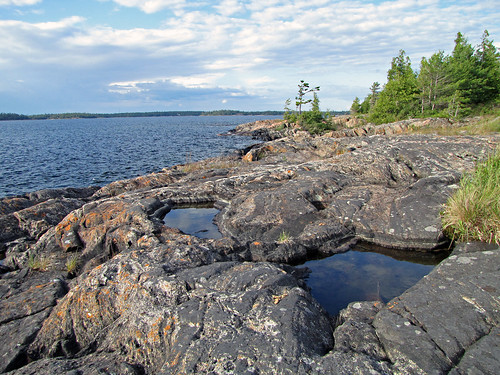

For me, that part of Wreck Island was a photographer’s paradise! If only I were able to take better photos... Waiting for the weather to improve, we paddled north-east to Doll Island and Bowery Bay. However, while paddling back to the campsite, the weather suddenly changed, catching us by surprise and we had to paddle very steadfastly to make it to the safety of the sheltered bays near our island. Another day we paddled around Wreck Island, just south of Bradden Island (where the Waubuno wreck could be seen). Everything was fine in the protected waterway between the islands, but once we entered the open and windy waters of Georgian Bay, our canoe was tossed left and right, up and down so much that at one point it was getting difficult to keep it from capsizing. We realized it would be impossible to continue circumventing Wreck Island and we decided to turn left, go around Bradden Island and paddle back to our campsite. Even turning the canoe 180 degrees was a little risky, as at one point the canoe became parallel to the waves, swaying left and right. Eventually we made it to shore of Bradden Island and decided to portage over a very narrow and bushy part of the island instead of paddling around it. The portage was short and once we were on the south side of Bradden Island, it became calm and peaceful and we slowly made our way back to the campsite.
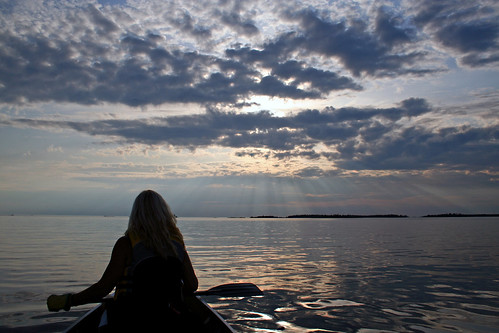

Even though Wreck Island belongs to the Massasauga Provincial Park, some of its land remains private and cottages are a common sight. From our campsite we could see two islands with cottages. Once we paddled around one of them and had a chat with a very nice gentlemen, originally from Czechoslovakia. It turned out that his cottage (and presumably other cottages as well) had electricity thanks to an underwater cable, so he even offered us ice! Considering that cellular towers were everywhere and cell reception excellent, living on one of such islands was not such a lonely prospect!


It was only on Monday, July 13, 2009, that the weather forecast called for a better and calmer weather the following day. However, it was so windy at night that we had to tie the tent to several big rocks; otherwise it could have been blown away! Indeed, on July 14 the wind subsided. Within 2 hours we were packed and hit the water. On our way back we even explored some other islands in the are and visited Carlson Bay. Once we got to Blackstone Harbour, the wind picked up again and paddling the last couple of hundreds of meters, just before Pete’s Point, was exhausting. 

Blackstone Harbour & Moon River Falls, September 25-28, 2009

The July trip must have been—indeed, it was—very enjoyable, because we, along with another couple, went there again on September 25, 2009. This time we stayed on campsite # 509, just a 30 minute paddle from Pete’ Place. The September weather turned out to be above average, at least in terms of temperatures. We had seen this campsite during our July trip and we liked it—without a doubt, it was a nice spot, with three tent pads, plenty of trees to string tarps and unobstructed view of Blackstone Harbour. 

After setting up our tent and a very small tarp, we canoed for a while. I tried my fishing skills—alas, in vain, but at least I was in a good company, judging upon the number of other anglers, enjoying the same success, or rather lack of it. Since we were warned that the area had been frequented by some cheeky bears, we had to hang our food on a tree. It’s easier said than done—I tried for over an hour to throw the rope over many tree branches, but eventually gave up and hung the barrel on the tree just on the water. Nothing ever disturbed it, so it was probably sufficient.

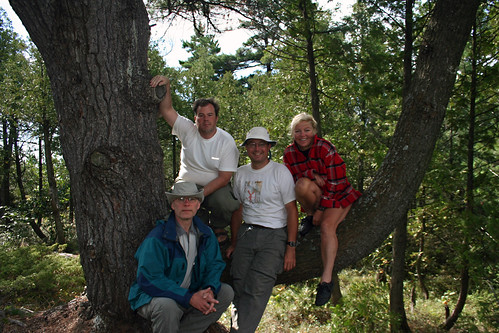
Campsite 509: Lynn, Wayne and Catherine. We would camp on this very campsite many times in following years

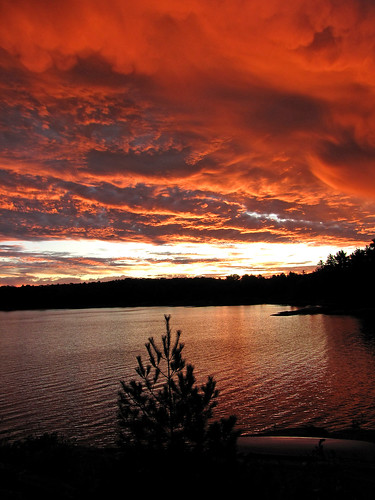
Considering that I love sitting around the campfire till past midnight, I’m not usually an early riser (and thus probably miss out on plenty of photo opportunities). Yet for some reasons I was up at sunrise the next day, September 26—and saw this amazing sky, full of absolutely reddish clouds! I quickly grabbed my camera and took a number of memorable photos... and went back to my tent to sleep for another several hours! Later that day we paddled around Blackstone Harbour, checking out other campsites for a possible group camping trip next year. Most of the campsites along the shores (# 508, 506, 505, 511, 510) were quite nice, although some might be too open to the elements. Usually those campsites are quite popular due to their proximity to Pete’s Place and thus advance reservations are recommended. In the meantime our friends Wayne and Lynn arrived and set up their tent—as well as a much bigger tarp! The four of us paddled on Blackstone Harbour to abandoned Calhoun Lodge. We spent some time exploring its many buildings; apparently a youth group occupied it several years ago and certainly had a great time! Unfortunately, it started raining and our paddle back to the campsite was a very wet one! The skies cleared, so needless to say, we still had a nice campfire and traditional grilled steaks and my favorite red wine. We got really lucky the next day, September 27, as we were planning to paddle to the Moon River Falls. I had visited the Moon River Falls in 2003 and loved the scenery! In the summer it is a popular place for people to gather and jump off the cliffs. Sadly, just over one month before, a tragedy struck when seven people had been swept by the falls and three of them lost their life. It took us over 2 hours and about 8 km. to reach the Falls, but it was certainly worth it! Nobody else was there and we could admire the granite rock formation; although the name of the river is not derived from the Lunar landscape, it could easily have! The water in the falls was not as fast-flowing as in August, when that accident occurred, but still the falls were impressive.

The Moon Falls

A small white cross marked the place where the victims had made their last jumps... After having lunch on the top of the falls, we started paddling back and reached our campsite just before 7 pm.

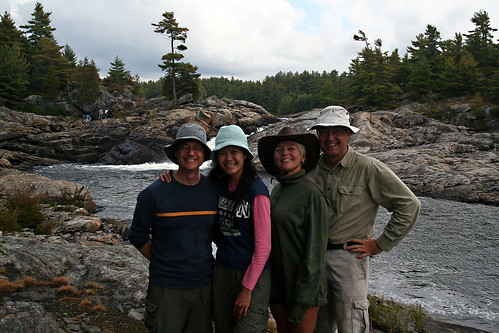
Moon Falls: Wayne, Lynn, Catherine and Jack

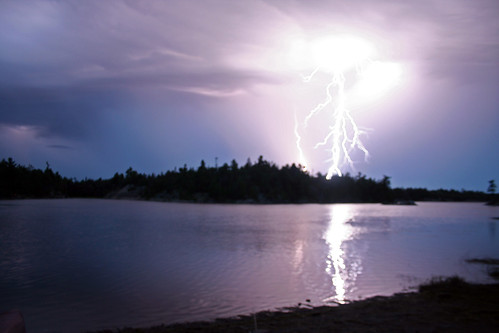
Last day welcomed us with wind, rain. lighting and thunder. Lynn and Wayne, who were up early, bid us farewell and paddled back to Pete’s Place, but we missed the break in the weather and had to wait out very strong winds and lighting, huddled under our too small tarp. Eventually we did get on the water, strenuously paddling towards our destination. A few hundred meters from the docks the wind picked up significantly and it became quite a challenge to keep the canoe moving forward! Yet we did make it without any problems.
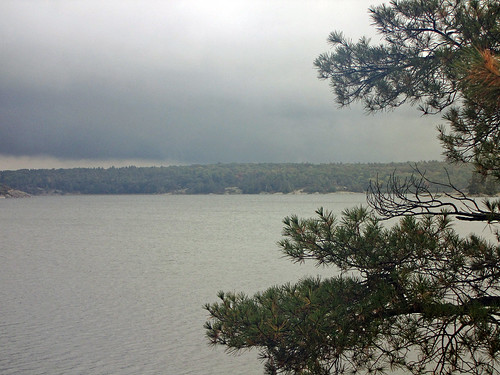

While returning the canoe, we met a park warden who said he had just seen a bear in the parking lot. Not only that—he had seen a black bear on our campsite the previous day, when we were paddling to the Moon River Falls!

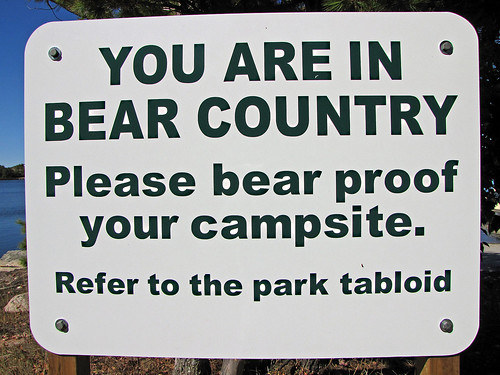
Each time I see this sign, for some reasons I think it says, "You are in BEER country"!

He told us that bears had been very active at all those campsites along Blackstone Harbour—whereas they did not attack anyone, they did a lot of damage to tens of coolers and tents, stole plenty of food and caused people to make a lot of “911” phone calls. Last, but not least, he said that our campsite # 509 had the worst reputation in terms of bear activity this summer! I’m kind of glad we didn’t know that before arriving at the park... 


P.S.

In June/July, 2010, we again visited the Massasauga and stayed for several days on campsite #509! And then we visited the Massasauga Park many times-please take a look at my blogs if you'd like to find out more about the park and our trips.

Thursday, June 24, 2010

Canoeing in Killarney Provincial Park, August 12-16, 2009

More photos fom this trip: http://www.flickr.com/photos/jack_1962/sets/72157622560580991 

Blog po polsku/Polish Blog: http://ontario-nature-polish.blogspot.com/2011/07/na-kanu-w-killarney-provincial-park.html  


I could probably go on and on describing the utmost beauty of Killarney Park, but just let me say that its numerous gorgeous lakes and unique white mountains (La Cloche), combined with many long hiking and canoeing routes, make it a true gem not only in Ontario, but probably in North America. However, in order to explore it, one must spend at least one week hiking—or better yet, canoeing on its many long routes. Unfortunately, the vast majority of canoe routes require extensive portaging, sometimes of over one kilometer. Nevertheless, there are a few shorter routes which offer great portage-less paddling opportunities. 
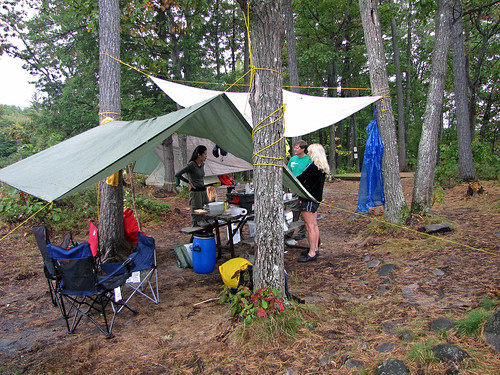
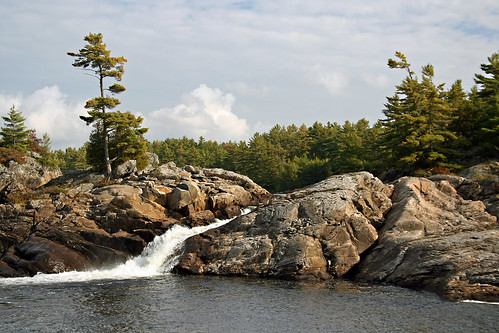

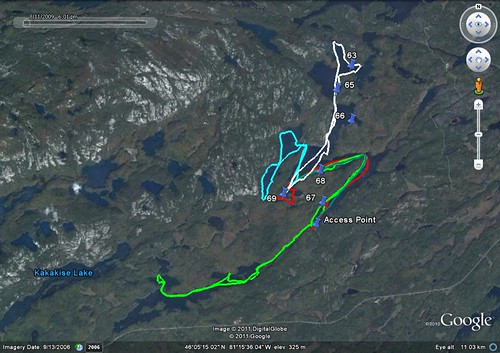
After poring for a few hours over the Killarney map, we decided to reserve a campsite on Johnnie Lake. This lake did not seem to have any portages and it also was adjacent to Carlyle Lake, another long and portage-free lake. When we called the park, we were quite lucky—there was only one campsite left in the park and it happened to be on Johnnie Lake! It's a very popular park and most of campsites are gone within days, if not hours. By the way, according to the map, there were several campsites all over the lake and we were free to camp on any one of them which was not occupied. After studying the Google satellite map, I noticed that campsite number 69 was located at the cul-de-sac of the lake, vis-à-vis an island and next to a small, weeded bay. Whereas we were not sure if this campsite was otherwise nice—or vacant—we certainly were thinking about setting our camp there. 


We left Toronto in two separate cars since Catherine was planning to afterwards drive to the USA via Sault Ste Marie and the famous Mackinac Bridge. It was of course a long drive from Toronto, but I always enjoy it: the traffic is usually very light and the surrounding typical Canadian Shield rugged scenery make it a pleasant experience. By the way, we stopped for two nights in Oastler Lake Park on site 143, near a big rock outcropping beside the lake and paddled for a few hours on Oastler Lake the next day.  


Once we reached the park, we had to drive to the park office to pick up our campsite and parking permits, then we drove back on road 637, turned left on unpaved road and soon arrived at the Johnnie Lake parking lot. Our canoe (which we had earlier booked and paid for) was waiting for us. Some fishermen who were departing warned us against the swampy site at the cul de sac bay... we later discovered was site 69... ours! We got on the water and started paddling. There were a few cottages on the right and we saw the first campsite on our left. After about 30 minutes we made a sharp left 180° turn and kept paddling towards the end of the lake. The area was very picturesque, dotted with a number of islands, plenty of bays and rocky shores. Having passed a small cottage on an island, we finally reached our campsite number 69. Indeed, it was very similar to what we imagined based on the Google satellite map: it was in the forest, had a nice rocky shore and faced the island we had seen on the map—in a nutshell, it was an excellent site!  


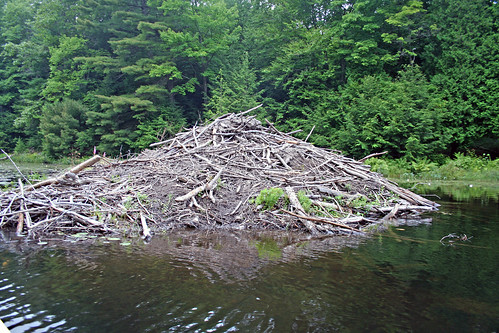
After pitching the tent, we went paddling around the island. A large beaver lodge rose from the water, adjacent to the other side of the island and apparently the beavers frequented the island on a regular basis, as we spotted a beaten path leading to the water. Later we saw several beavers swimming around, but mostly heard them in the evening and at night when they were slapping their flat tails against the water. 


It was slowly getting dark and we were still on the water, enjoying the silence, interrupted only by nature's natural sounds—until several canoeists in two canoes entered the area and shouted to us if there were any campsites available around. Since there were none, they paddled back, visibly upset, as one of the teen girls started swearing profoundly, not realizing that her voice was carrying across the water, right to our unsuspecting ears!  


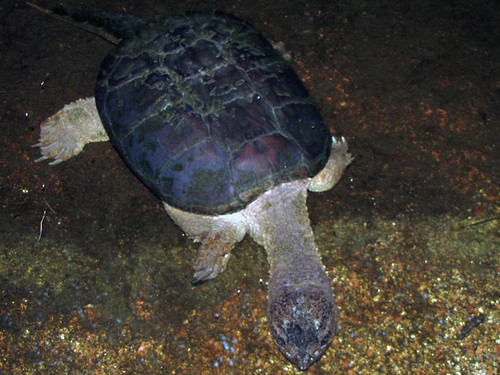
Once back at the campsite, I was trying my luck in fishing, yet I knew that lakes in Killarney did not have too many fish, the result of years of acid rain, caused by the smelters in the Sudbury area (that rain also destroyed plenty of trees). Strangely, the water was crystal clear. Indeed, I caught a few catfish, but they were too small for the frying pan! At one point I bent and was washing hands in the lake when I saw a HUGE snapping turtle floating just a meter or so away and slowly swimming towards me! But it was not all—there were two other snapping turtles in the water! Well, I had been used to raccoons usually visiting our campsites every night, hoping to steal anything edible, but it was the first time big snapping turtles decided to emulate their ground friends and approach tourists' campsites from the water! Soon the turtles were enjoying the catfish, indifferent to my videotaping them and using a strong flashlight. The turtles paid us regular evening visits and we enjoyed watching them. With their tough, leader-like skin, big paws, long and sharp claws, hard shell, powerful mouth and long tail, they looked like creatures from the Jurassic Park!  


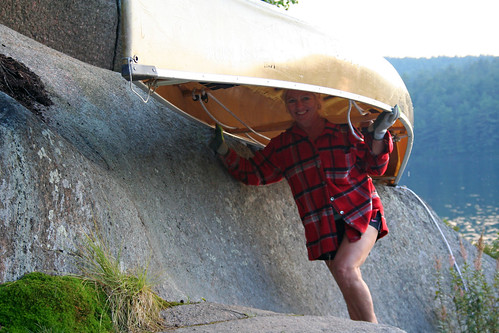
Over the next several days we paddled all over Johnnie Lake, as well as Catherine portaged (for the first time in her life) the canoe over a 100 meter portage to a small and scenic lake called Ruth Roy Lake, just north of Johnnie Lake. 


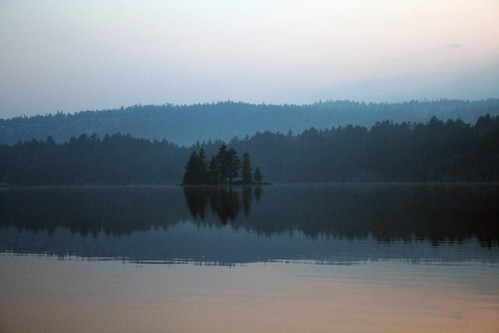
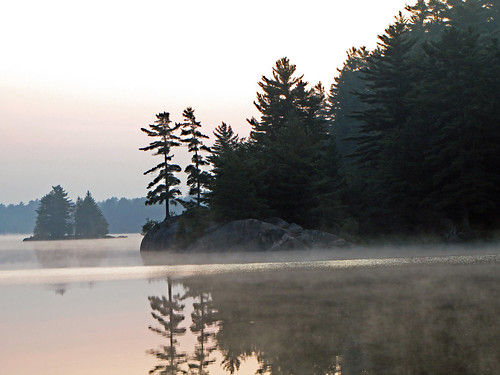
There was at least one campsite, occupied by a couple—they made a great choice, picking this lake! Another day we paddled towards the access point (where our car was parked) and onto Carlyle Lake. The first part of the lake was quite narrow, weeded and dotted with beaver lodges—yet one of them was inhabited by a family of otters. Upon seeing us, the otters kept disappearing into the lodge's numerous cracks and crannies and appearing in other openings, as well as started making not-so friendly sounds, presumably to scare us off. We paddled on and soon reached a very interesting campsite, located next to a big, moss covered rock; it was dark, quiet and very mysterious! We took a right turn, paddled through a short strait and entered a small bay just south of Terry Lake. A British family was camping there and we briefly spoke to them. As we paddled around the bay, we heard a small fall or rapids near Terry Lake. Since it was getting late, we turned back, yet managed to quickly go ashore and examine a few campsites. When we finally reached the “180 degree turn” on Johnnie Lake, it was quite dark and foggy and I took a number of photographs—one of them even won an award in my photo club!

Here I would like to mention that in 2013 Catherine, I and several of our friends camped on that site where the British family was camping (http://ontario-nature.blogspot.com/2013/12/killarney-provincial-park-ontario.html). Also, in 2014 (http://ontario-nature.blogspot.com/2015/10/killarney-provincial-park.html) and then in 2017 (http://ontario-nature.blogspot.com/2018/08/car-camping-trip-to-killbear-killarney.html), we camped on the campsite very close to the small falls/rapids, which was located between Carlyle and Terry Lakes.


I have to mention another quite amusing, almost mystifying thing that we experienced during our trip. After setting up our camp the first day, we packed up our canoe with the usual stuff—cameras, rain gear, fishing equipment, tripods, binoculars, GPS unit and the like—and as we were about to depart, we clearly HEARD IT: absolutely eerie sounds, as if a child were slowly practicing a cello or a similar instrument... it was the type of music often heard in horror movies! We were almost certain there was nobody else around, yet the sound was so distinct that we started to apprehensively look around, trying to find the culprit who produced the tunes—but to no avail! While paddling the next day on the other side of Johnnie Lake, we heard it again—it was not as pronounced as before, but still clearly discernible, as if lazily flowing from afar, filling the air with subtle and mysterious tunes. Because both of us heard it, we presumed it was not our imagination (unless we fell victims to a mass imagination...). So, at one point we asked a camping family if they heard the sound... and then we posed the same question to another lonely camper. In both cases they said they did not hear anything; judging upon the looks on their faces, I do not even want to speculate what they REALLY THOUGHT about us! We kept hearing this inexplicable music on and off till the end of the trip and we did not manage to figure out its source. It was only the next year when we finally deciphered this enigma: it was my fishing rod's line, whipped by the wind, that acted like a harp and created those amazing sounds! Well, another Killarney mystery solved!


Under Construction

Under Construction

Under Construction

Under Construction

French River Trip, September 4-9, 2008.

Day One, September 04, 2008. 
Paddling time: 3 hours 05 minutes. 
Trip Length: 13.7 km. 

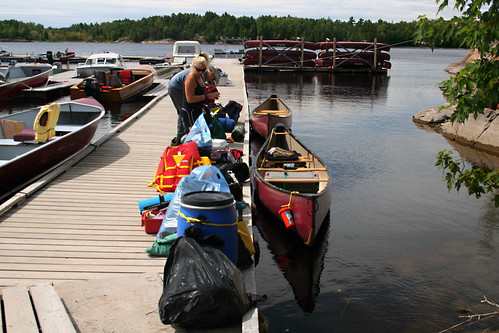
 We left Toronto at 7:20 am and stopped only once for coffee. Arrived at 11:00 am at the Hungry Bear Restaurant; Mike and Morgan had already been there waiting for us. After a traditional lunch (excellent flame-grilled burger), we drove for about 25 minutes to Hartley Bay House and Marina, where we rented the canoes and purchase park permits. As planned, we were on the water on 01:00 pm. Our goal was to reach a campsite just before the Dalles Rapids. We headed south on Wanapitei Bay, passed the entrance to the Western Channel and took the Main Channel. 


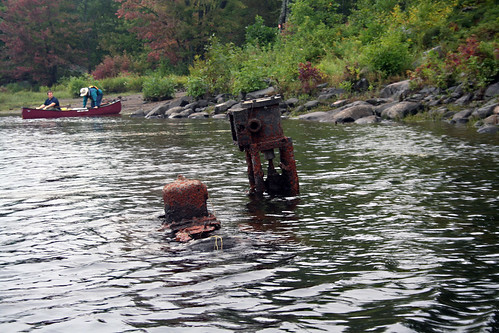
At the Elbow we turned right and soon began looking for a campsite. All campsites were vacant, we checked out campsite #624 and the next one (which did not even appear on the map)—they were quite nice, yet we could not find space to set up even one tent. Eventually, we selected campsite # 625, (N45 58 16.2 W80 52 10.3) which had a beach, plenty of space for many tents and enough trees for hammocks. Not far from the campsite were rusty remnants of old machinery, apparently an alligator. 


Alligators were shallow draft boats, with side-mounted paddle wheels, powered by a 20 horsepower steam engine and provided with a cable winch and large anchor. By using the winch they could pull themselves over land, around portages and up as much as a 20 degree incline at the rate of 1 to 2 1/2 miles per day. And they could haul a boom of some 60,000 logs across water against all but the strongest winds. They were heavily but simply built, making rebuilding and repair easy. We would see several of old shells of such alligators from now on—once they must have been a very popular sight in this area. In the evening I went paddling solo and caught one pike and one bass, which we promptly grilled over the fire (I might add right now that these were the only fish I caught during the whole trip). In the evening it started to rain, then we saw lighting and eventually had to sit under a tarp to finish our supper.


Day Two, September 05, 2008. 
Paddling time: 4 hours 46 minutes. 
Trip Length: 5.4 km. 

After breakfast we packed and were on the water; minutes later we reached the beginning of the Dalles Rapids Portage. According to the information on the map, the portage was supposed to be 180 km. long, but we soon realized it was much longer (according to my GPS, at least 310 m.). Apparently it must have been changed since 1995, when I was there for the first time, because I certainly remember it was much shorter then! 


It took us several trips to carry all our gear; Mike was kind enough to carry BOTH canoes for us. Anyway, the portage turned out to be the lowest point of our trip, perhaps because it was 130 meters longer than we expected, we were not prepared for portaging and had to walk numerous times to bring our gear. Of course, we also stopped to take a look at the Dalles Rapids (when we returned to Hartley Bay House & Marina, we were told that three weeks ago somebody’s motor boat had been pulled into the Dalles Rapids; the boater had not worn a lifejacket and unfortunately drowned). In 1995 I set 
up my tent on the flat rock just next to the rapids; today at the very spot a marker is erected, saying, “Final Resting Place of Garth L. Smoot ‘Doug’”. Well, you can’t wish a better resting place! 


After a quick rest we were again on the water. From the Dalles Rapids south the scenery changes, it becomes more rocky and quite scenic with all those interesting rocks formations. After a while we saw the old ruins of a mill at the location of French River Village, which we were planning to explore the next day. Once the Main Channel entered Georgian Bay, we spotted a campsite at the Bluff Point on our left—campsite # 714 (N45 56 30.1 W80 54 00.5). It provided
a great view of the French River as well as Georgia Bay. In front of us was Sabine Island; initially we were hoping to camp there, but the campsite had already been occupied. 


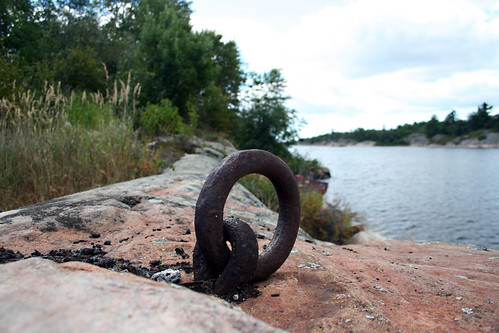
Again we had some problems finding a good place to set up a tent; eventually we had to settle on a rocky, damp depression. An old rusty ring was attached to the rock, another remainder of the extensive logging operations that used to take place in this area; we used it for attaching water container while filtering our water. Every night we saw flashing beacons from two lighthouses as well as were treated to the Northern Lights, which however did not look anything like on photographs; in fact, initially we thought it was the night lights of Sudbury.

Day Three, September 06, 2008. 
Paddling time: 4 hours 04 minutes. 
Trip Length: 6.9 km. 


The weather was excellent, not a drop of rain! We chose to spend two nights on this campsite, so did not have to go through the packing/unpacking ritual again. After breakfast we paddled to the site of French River Village. Along the rocky shores we spotted a couple of old rings and hooks as well as old, rusty metal parts, hardly identifiable by now. The first structure, still visible from the river, is the ruins of the old mill.


When we walked further, we saw more ruins, a big metal wheel (probably part of the mill) and some old machinery equipment. Using a map, I tried to find the main street of French River Village. After walking for about 15 minutes on rocky ridges, I finally was standing in a ‘channel’ between two long rocks; apparently, the area between those long rocks used to be the main street and the houses stood 
on those rocks.


Unfortunately, due to very dense growth, I was unable to see anything interesting, nevertheless this area was very similar to an old photograph of French River Village, apparently showing this very location—after all, the building were gone, yet the rocks remain. Here and there I saw the unmistakable black bear poop and had to watch for the venomous Massasauga Rattlesnake which is relatively common in that area—not to mention the ubiquitous poison ivy, about which I had totally forgotten! 


Later I saw solid foundations of a structure (prison?), several metal pipes, rusty implements, bricks… It was difficult to believe at this place had up to 600 permanent residents and swelled to up to 1,500 in the summer! Since the map also showed a cemetery on the opposite bank of the river, I decided to paddle there and find it. We found a small bay, full of logs, most likely around 100 years old and could see the lighthouse (apparently it’s the original French River Village Lighthouse, yet nowadays fully automatic). After spending well over one hour looking for the cemetery, I gave up—the area was very swampy, had two big bear droppings and some of the rocks were difficult to climb. So, I still don’t know if the cemetery is somewhere else or since it’s not marked, it’s easy to overlook it. While standing on top of the rock, on my right I could see the mouth of the Main Channel, with our campsite, on the right… I took a look at a copy of an old photograph from a book on the area and bingo!—it turned out it had been taken from the very same spot I was standing now! I could clearly see the characteristic outline of the bay (where I left my canoe) as well as the opposite shore. The photograph showed that very same shore, albeit with a row of houses along it; today the only visible structure was the lighthouse and the ruins of the mill…The funny thing is that on that old photo the small bay is also cluttered with logs, like these days!


We paddled back to the campsite. Afterward I paddled solo on Georgian Bay, exploring the bays and channels just behind our campsite, trying, in vain, my luck in fishing, and simply enjoying the beautiful weather! Later I found out that Morgan had seen a rattlesnake on our campsite. I spent some time at that very spot with my camera, but never spotted one. 

Day Four, September 07, 2008. 
Paddling time: 3 hours 20 minutes. 
Trip Length: 8.9 km.

Our plan was to find a nice campsite east of the entrance to the Eastern Outlet; for the first time we were going to paddle on Georgian Bay, often being exposed to strong winds. However, the weather appeared to be OK and the only problem was navigating among numerous islands and rocks that dot that area; again, the GPS turned out to be invaluable. Once more we passed abundant relics from the days of logging in the delta, including some machinery up on a rock (another alligator, I presume).


Whereas in front of us (i.e., the east) the sky was blue and cloudless, something definitively very ominous was brewing behind us—the sky was dark, we characteristic rain streaks in the sky far from us and the whole cloud formation seemed to move towards us. Once we saw a lighting, we knew it was the time to seek shelter.

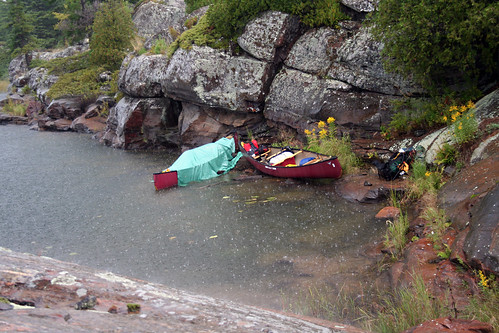
We spotted a small bay to our left and promptly paddled there; as were entering it, a small black bear cub appeared on the left shore, but had been gone by the time some of us could even see us. Out of caution, we decided to stop on the opposite rock (N45 55 34.0 W80 51 53.9). I covered my canoe with a tarp and walk up the rock, where the four of were sitting under a spread tarp, supported by our paddles (courtesy of Mike and Morgan). 


It was raining hard, we saw lightings indicating the storm was very close to us. Thirty minutes later the weather cleared, it even became sunny and after bailing the water, we were ready to continue on. Finally we found campsite # 920 (N45 55 05.6 W80 49 50.1) on an island just north of Finger Island.


What a fantastic campsite! The view was just spectacular, we had total privacy, did not see any boats or canoes, the tent was set up on a flat rock and even the nearby privy offered an amazing view of the area! We wished we could have stayed two nights on this campsite, but since it was becoming windy—and we had to paddle back on Georgian Bay—we decided to leave this campsite next morning. 

Day Five, September 08, 2008. 
Paddling time: 1 hour 46 minutes. 
Trip Length: 4.9 km. 

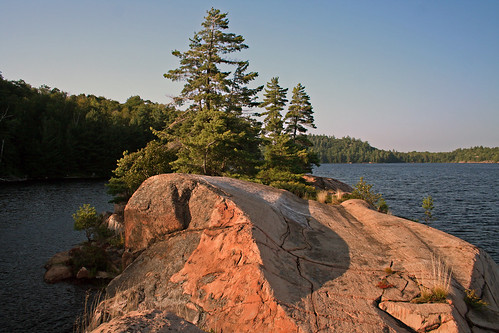
Since the scenery around the campsite was so magnificent, I was up before 06:00 am and took a number of photographs in the morning. Some of the rocks exhibited very interesting patters, similar to those on Wreck Island in the Massasauga Park. 


The wind was gradually getting stronger, yet we decided depart and paddle to a campsite somewhere before the Bass Lake portage (Tramway). This was one of our heaviest paddle days, as the wind made paddling very strenuous and we had to keep our canoes at the 45-90 degree angle towards the waves to avoid capsizing the canoe. We rested a short time sheltered by Dock Island and while paddling to another sheltered channel, we passed a group of kayakers. A black bear appeared on the shore, but it was gone before I was able to take a good photo.


It took us another 30 minutes to go through the Parting Channel and to Obstacle Island where we found our last campsite of this trip, # 718 (N45 55 52.2 W80 52 27.0). This rocky island was very scenic and the view magnificent. There were plenty of blueberry bushes with ripe berries—a good sign, we concluded, as it meant there were no bears on the island (actually, I don’t know how we would feel if, after setting up our tents, we’d realize we share the island with a black bear…). After our daily rituals—starting the fire and having supper—we sat around the fire for an hour or tow and went to our tents & hammocks just past midnight. 

Day Six, September 08, 2008. 
Paddling time: 6 hours 07 minutes. 
Trip Length: 20.4 km. 

We were up at 6:00 am, just in case we encounter strong head winds. By 8:20 am we were on the water and in several minutes reached the Bass Lake Portage, the so-called “Tramway”. The tramway was constructed in the early 20th century so logging companies could transport heavy equipment and machinery, then abandoned, then rebuilt and is now maintained by the Friends of the French River and the Ministry of Natural Resources. There was a wheelbarrow and a cart to carry the canoe, yet it was inoperable, so Mike and Morgan gratefully volunteered to carry the canoe in the traditional way. 


The area around the portage is very pictographic. We continued on Bass Lake and then north on the Eastern Channel, where on campsite # 623 had a quick lunch and turned right, passed an old cottage, then turned left into the Canoe Channel. The scenery was very serene, we did not see too many boats and slowly approached Canal Island, paddled south of it and in no time were on Wanapitei Bay, keeping to close to the right shore to avoid the wind. We arrived back at Hartley Bay House and Marina at 02:30 pm. Wow, we made it! Later we drove to the Hungry Bear Restaurant where we had our ‘civilized’ lunch and said goodbye. On our way back to Toronto I stopped to take several photographs of an interesting abandoned gas & service station as well as visited an Indian reserve. We arrived in Toronto about 10 pm.