Showing posts with label blackstone harbour. Show all posts

Sunday, October 30, 2016

THE MASSASAGA PROVINCIAL PARK, ONTARIO—CAMPING AND CANOEING, JUNE 26-JULY 09, 2016


Sometime in March, 2016 I had reserved two campsites in the Massasauga Provincial Park on Blackstone Harbour—one on the south side of the channel leading to Woods Bay and the other one on the north of the channel. They were quite nice and not far from the park’s parking lot at Pete’s Place Access Point, so even novice canoeists should not find it difficult to get there (although in windy weather that may challenging). We had also invited several of our friends to stay with us over the Canada Day long weekend—eventually Ian & Sue spent a few days with us.
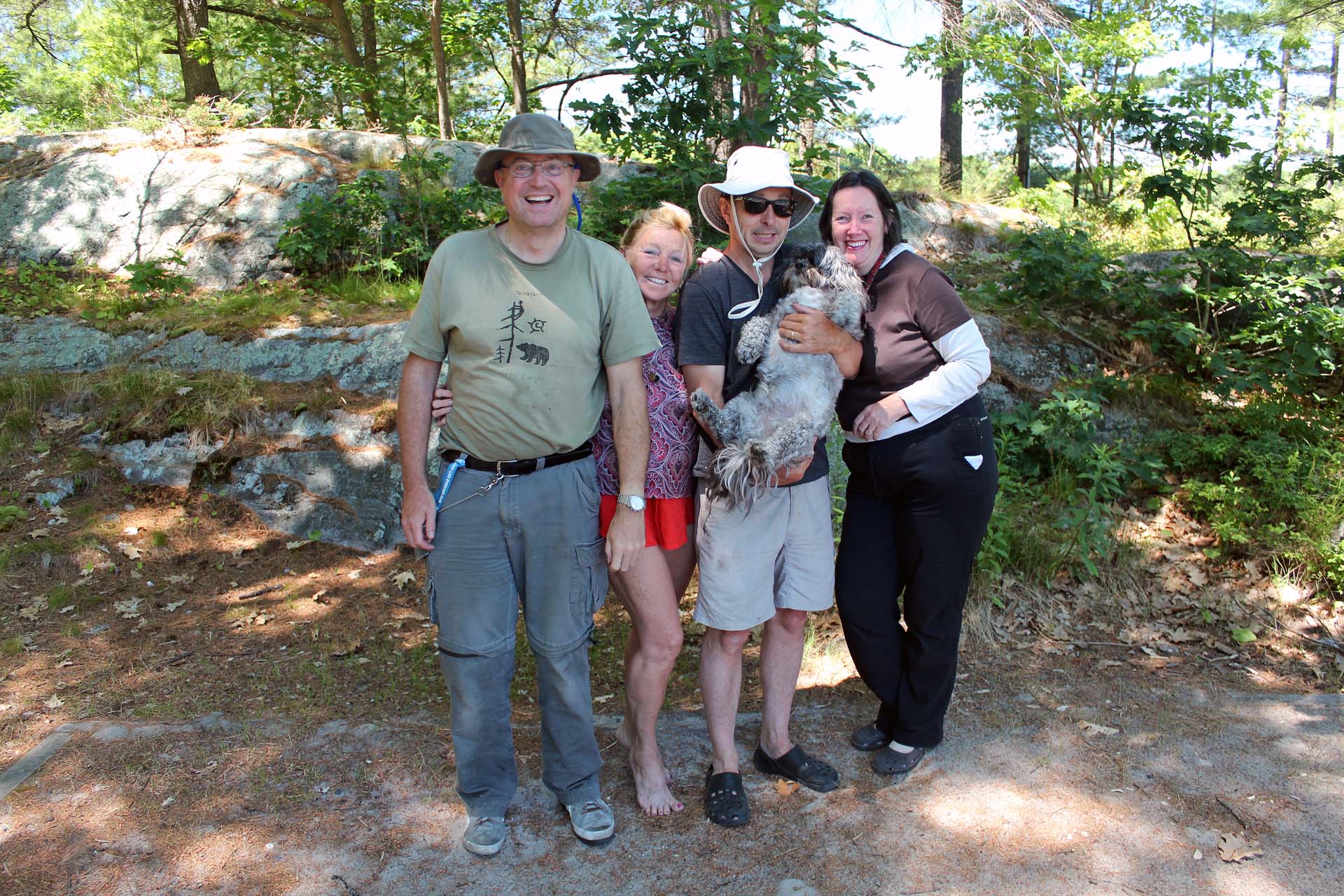
 
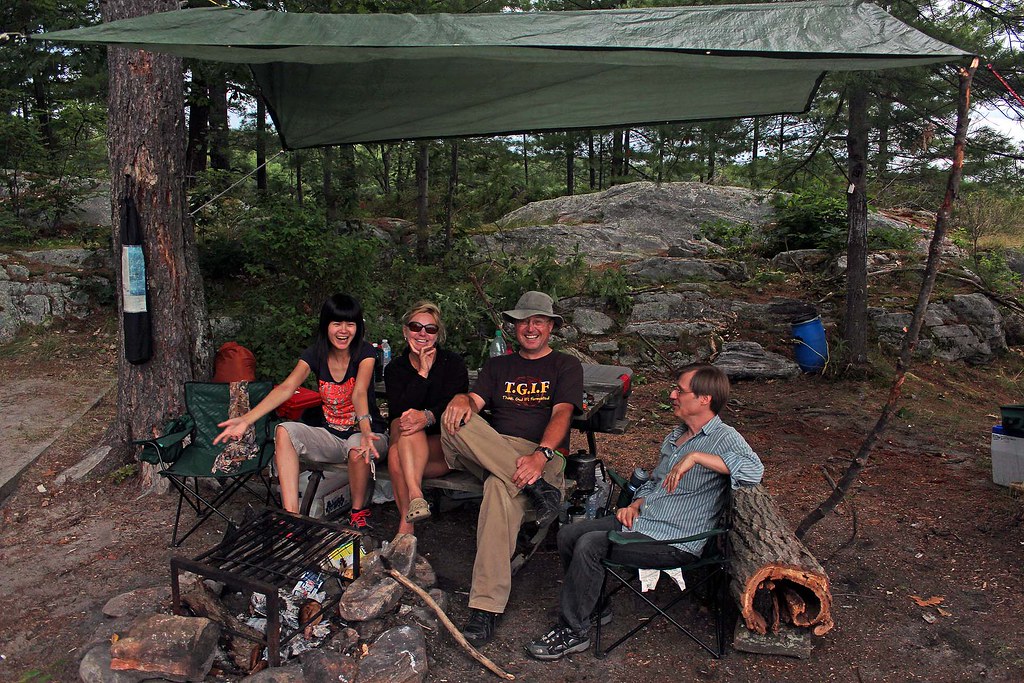
Jack, Catherine, Ian, Sue and Miro the dog
We were planning to depart from Toronto at 10:00 a.m., but finally left at 2:00 p.m. The weather was hot and sunny and after 2 hours we arrived at MacTier, where we quickly went to the supermarket as well as purchased cold beer. Just before 6:00 p.m. we reached Pete’s Place Access Point.

The park office was closed, but we were pleasantly surprised to find a self-serve registration & fee station—our names already appeared on the list. We paid the remaining camping fee by credit card and proceeded to the put-in area. Nobody else was around and we did not have to hurry. When our canoe was packed and we were ready to paddle to our campsite, a sizable water snake suddenly slithered from the rock above and jumped into the water, missing our canoe by a hair’s breadth and causing Catherine to utter a very piercing scream which certainly reverberated across the whole bay. Well, we almost ended up with an unexpected (and unwelcomed) guest!
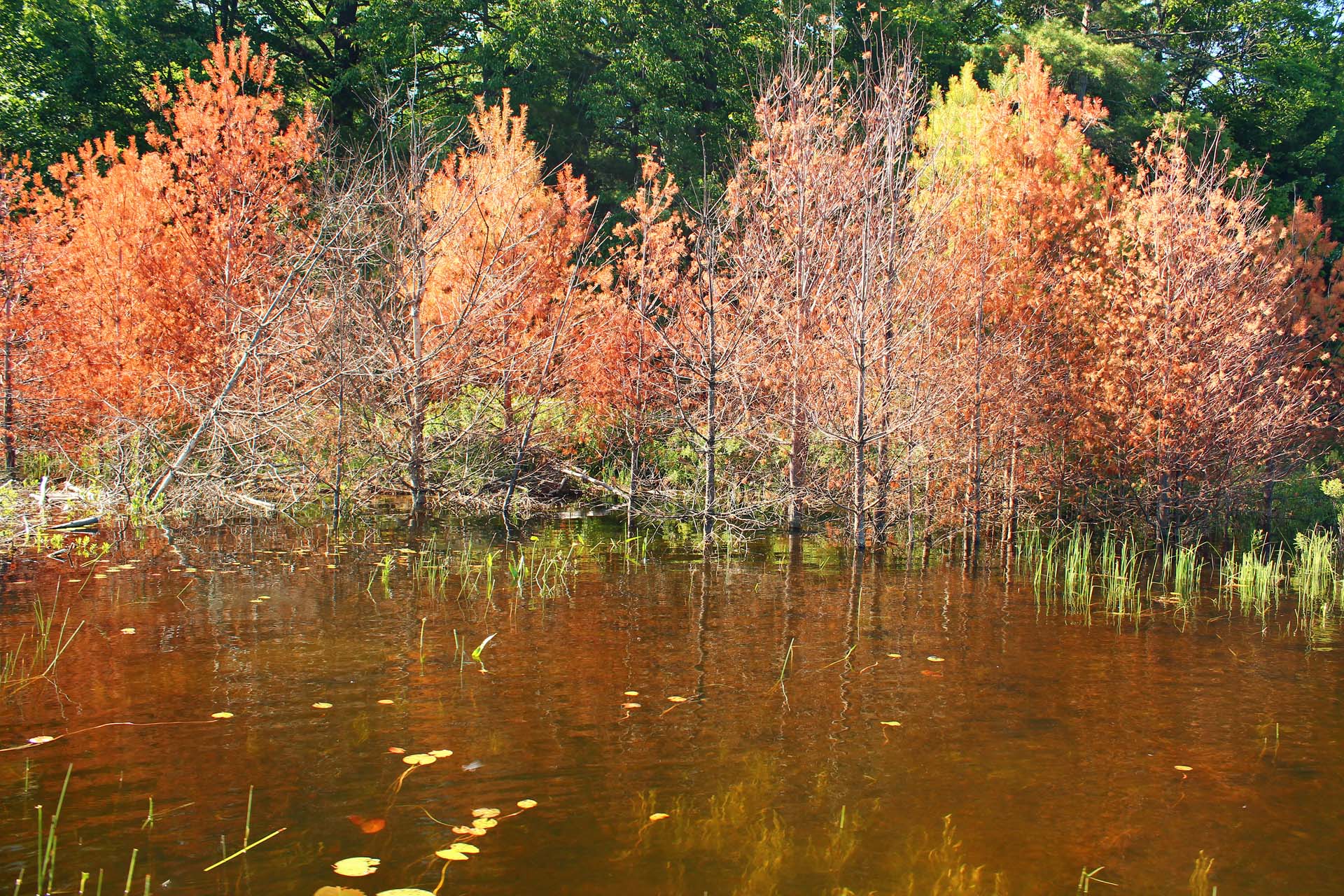
 
Dying evergreen trees
We noticed that the water level was the highest in many years. Indeed, most of rocks that we used to walk on in the past now were under the water, as well as we saw plenty of rust-colored and seemingly dying evergreen pine trees along the shores of the bay. Upon a closer examination, we realized that lower part of their trunks (and, of course, their roots) were submerged, which probably was causing them to slowly die—after all, they were not tolerant of growing in water.

Our first campsite...

Our campsite, although adjacent to the channel, was relatively private and quiet due to a rocky ridge between it and the channel; besides, we quickly got accustomed to passing jet skis & motorboats (noisy!), yet it was something we had expected—after all, it was my seventh visit in this park. Every day we saw many packed canoes and kayaks; some were heading towards Georgian Bay, others back to Pete’s Place. Almost every evening we reveled in sitting on the rocky ridge, under a small, bowed tree, observing passing boats, admiring the setting sun and sipping wine and cold beer. Sometimes we could see campers on the other two campsites, usually boisterous and having plenty of fun!
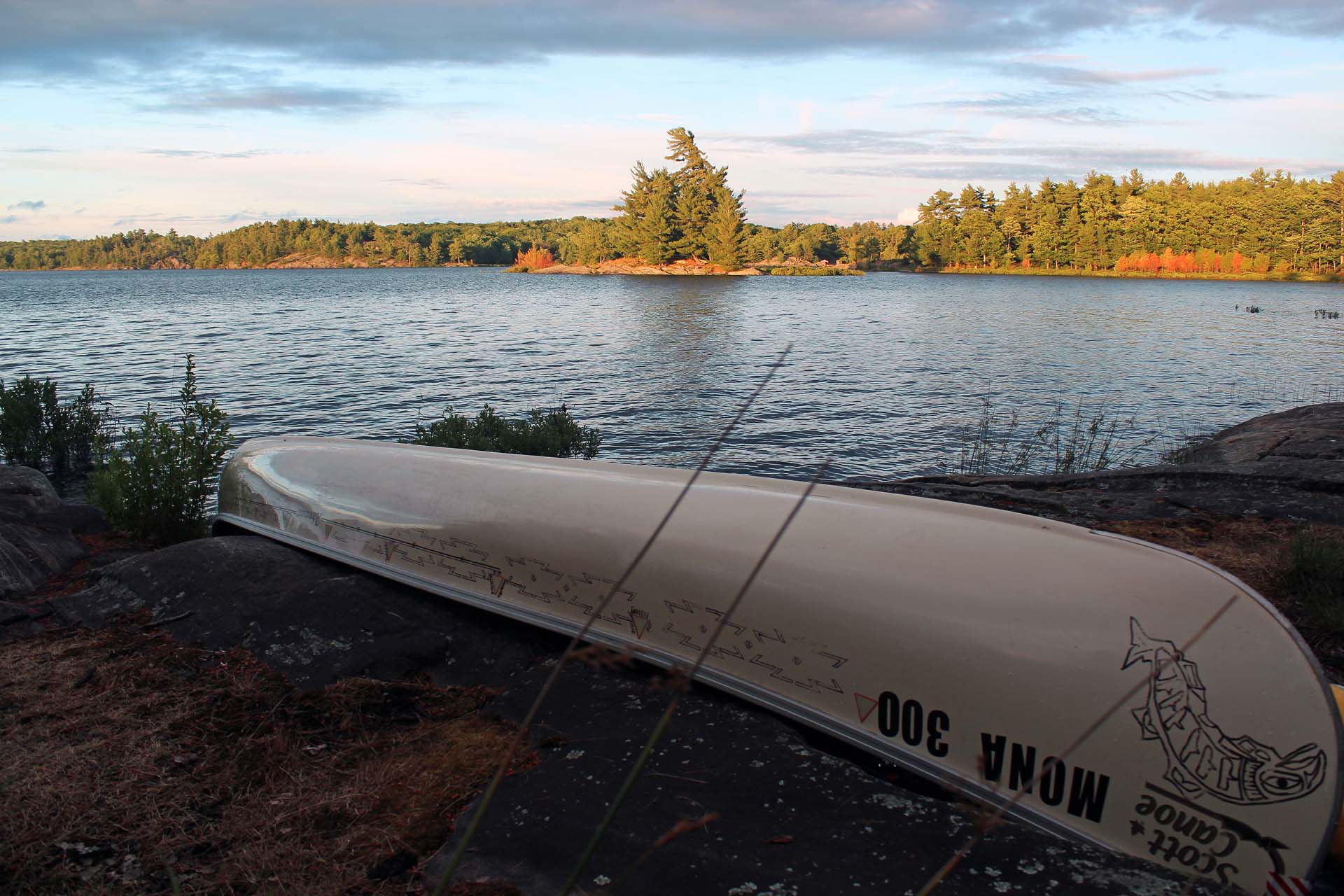
... and the view from the campsite!

There were plenty of water snakes along the shores of the campsite and they were often attracted to our walking or swimming. Once I saw a big snapping turtle, floating near the shore, but once I came near the water edge, it swiftly vanished. One morning I found a tiny red-bellied snake in the tent’s vestibule—at first I thought it was a big, thick dew worm. There was also a beaver lodge nearby and once I spotted a snake sun-tanning there, but when it saw me, it fled with an astonishing speed and I was not even able to take a good look to identify it. Every day we saw a number of beavers swimming around the tip of peninsula our campsite was located on, from one beaver lodge to the other. They must have been quite active at night, as we often heard loud slapping the water with their broad tails. A small skink was living around the fire pit and from time to time we saw it sun tanning on the rocks. Occasionally a majestic blue heron landed nearby, waded for some time trying to catch fish and later flew off. In the evening and at night we were often serenaded by loons and frogs. In the morning we were awaken by a pileated woodpecker doggedly pecking at nearby trees. A few chipmunks ran here and there, but they did not seek any interaction with us—unlike those at some other parks, where it was next to impossible to get rid of the company of those sociable critters! We also had a resident seagull who hung around the fire pit looking for leftover tidbits—fruitlessly, I might add. And there was also an American Bullfrog, the largest frog in North America, patiently waiting in the shallow water for any prey. As I later found out, they have voracious, indiscriminate appetite and will eat virtually any animal they can swallow, including insects, birds, mammals, reptiles and even other bullfrogs.
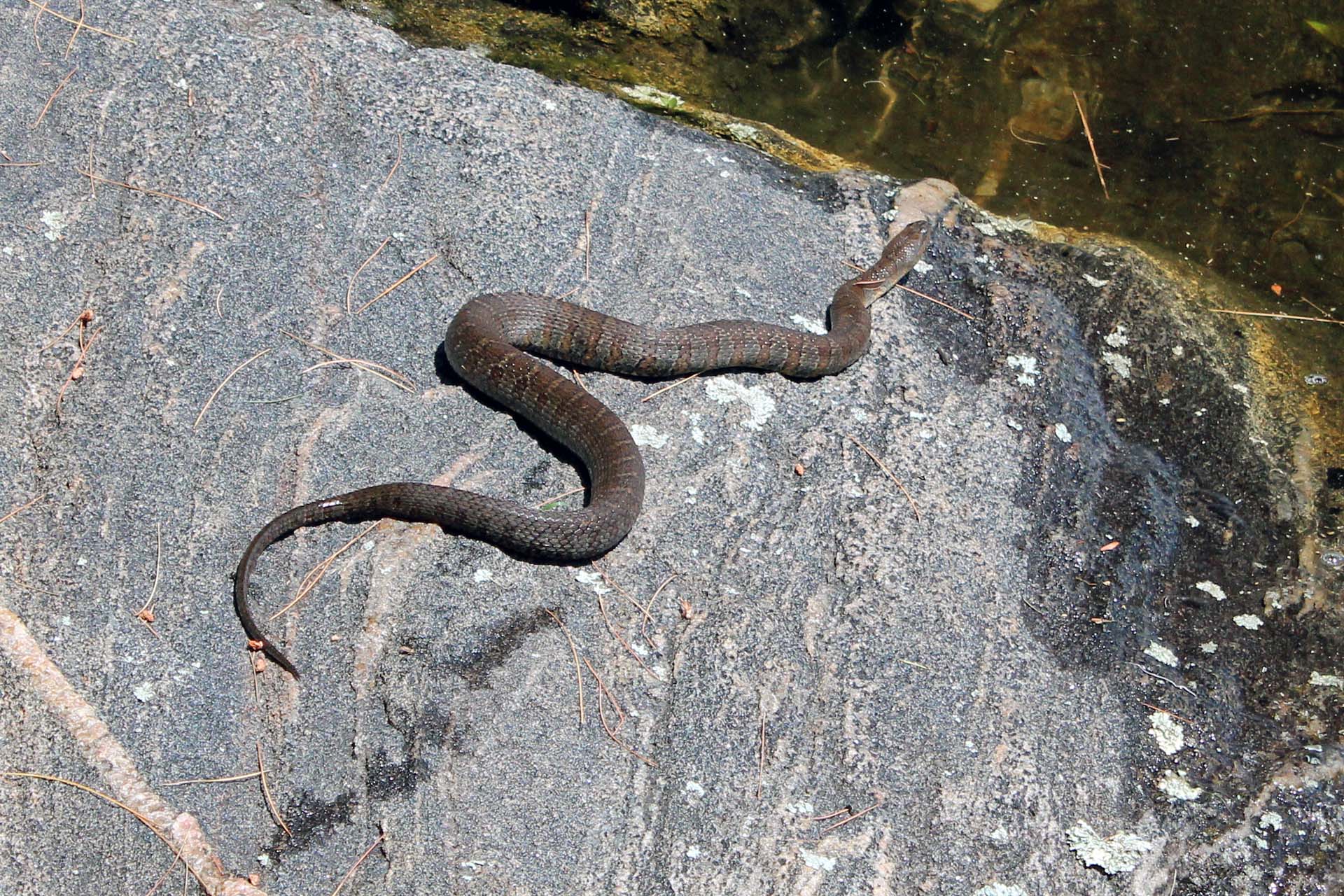
Water snake

I spent considerable time observing spider wasps, which were relentlessly digging holes in sandy soil. Later they dragged a spider (which they had paralyzed with a venomous stinger) to the nest. The unlucky spider was to become a host for feeding their larvae—the wasp would lay an egg on the abdomen of the spider and would close the nest. When the wasp larva hatches, it begins to feed on the still-living spider. After devouring the spider’s edible parts, the larva makes a silk cocoon and pupates. Interestingly, some wasps spent a lot of time burrowing potential nests in sandy soil, but suddenly changed their mind and ended up dragging a paralyzed spider for many meters on the ground and finally climbed up a tree where, I presume, they created the proper nest.
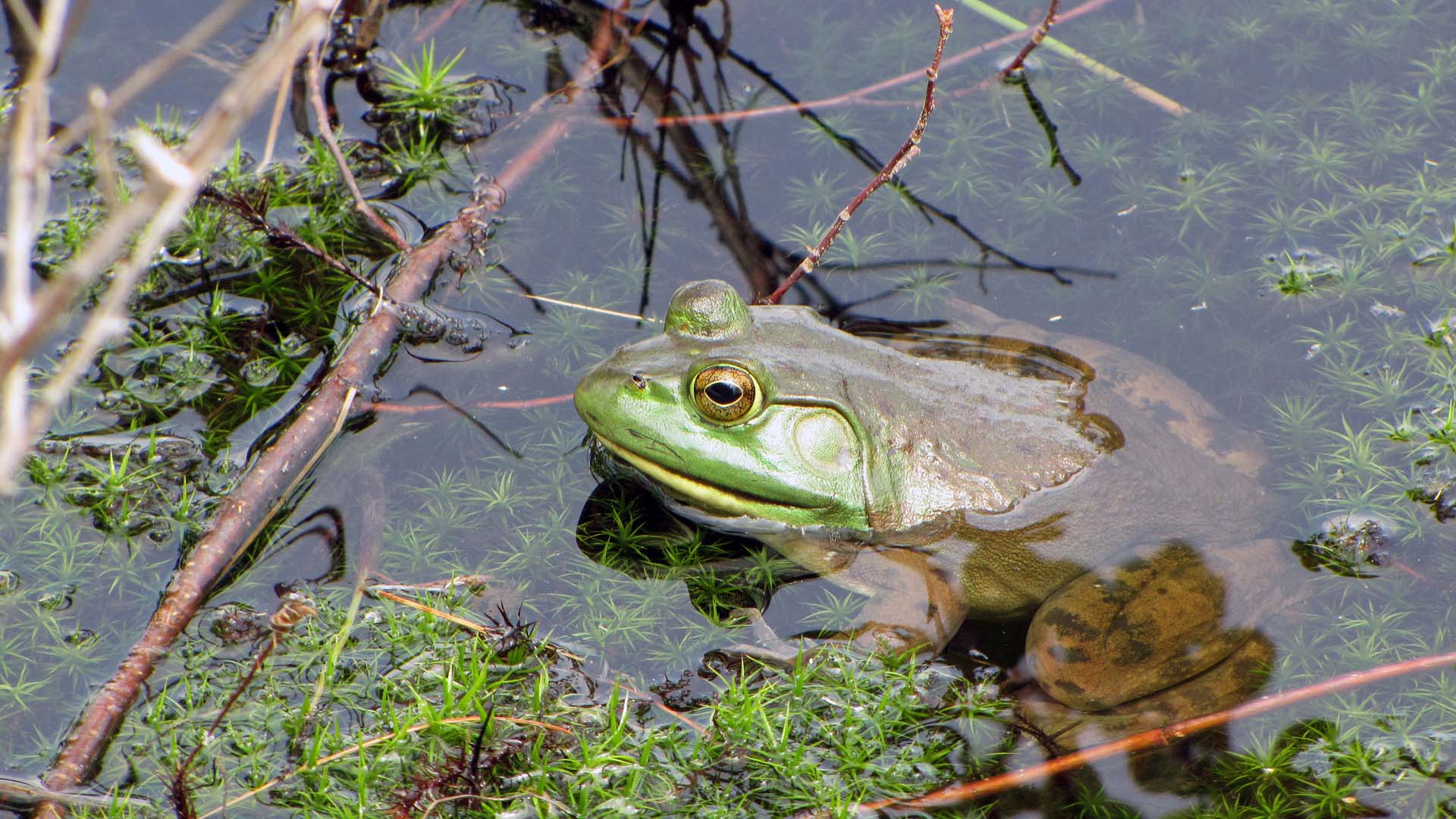
Bull frog

During our whole stay the weather was almost perfect—very hot & dry, mostly sunny and even though the fire ban was in effect in the Parry Sound area, the park still allowed campfires. Unfortunately, our final day was stormy and we had to pack up and paddle in the pouring rain, but since it was still very warm, we did not complain much—after all, the area certainly needed rain. Perhaps because of the lack of rain, mosquitoes were not very bad at all—usually they appeared around 9 p.m. and disappeared one hour later.
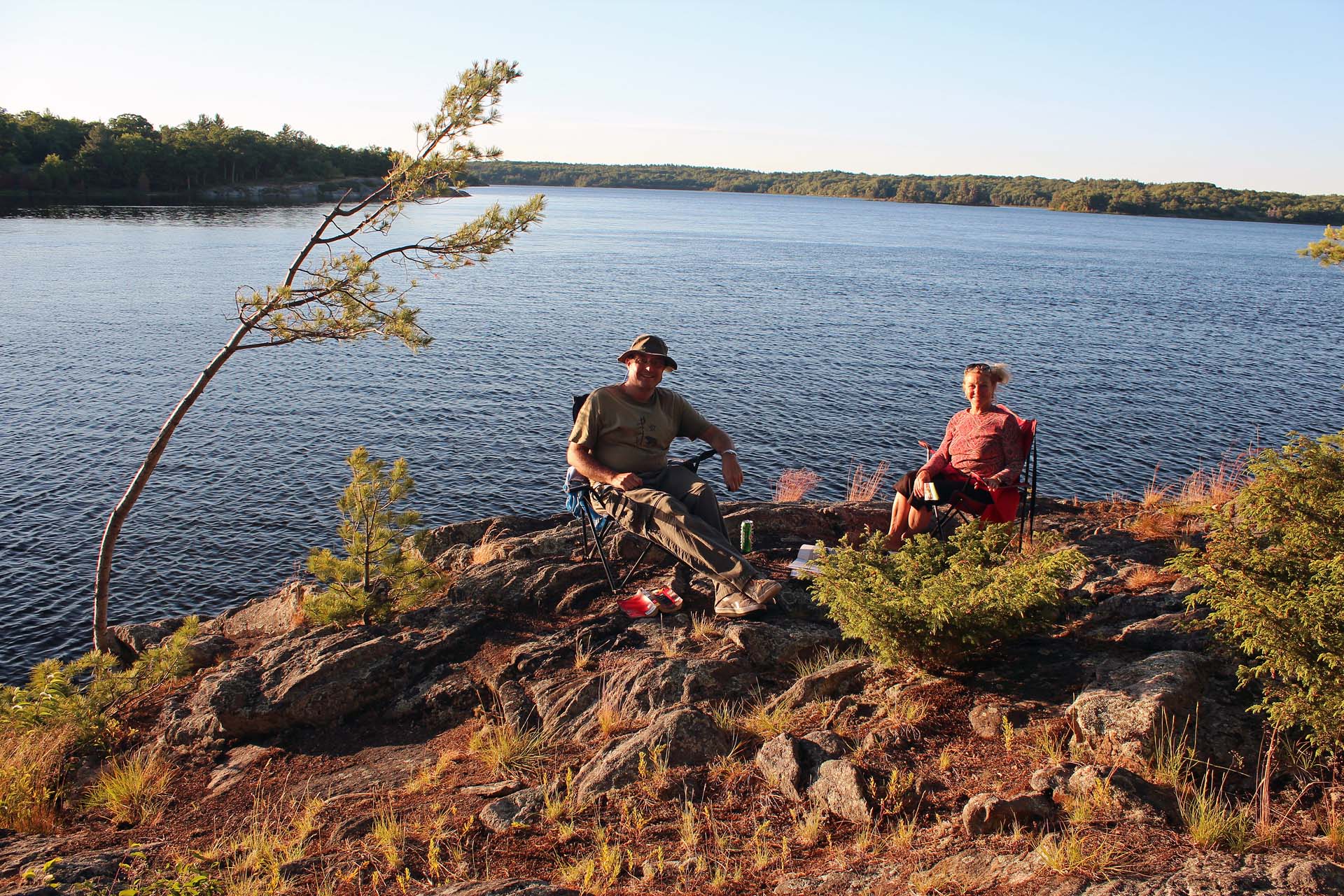
Our favorite spot, where we enjoyed watching sunsets, observed passing boats and read books

The evening before Canada Day we canoed to Moon River Marina for a few supplies. Catherine was surprised to discover that the store and the LCBO outlet had just closed at 6 pm (somehow I anticipated that). She did manage to talk the sales person into a quick beer sale. On our way back we spotted a building with a lit neon sign ‘OPEN’; it was West View Resort—indeed, the small store carried cream which Catherine was desperately craving for her morning coffee. The resort owner, a very chatty gentleman, happened to sit in front of the store and we started talking to him. I noticed a book called “My Life on the Moon River” by Peter (Pete) Grisdale (who passed away in 2014, aged 94 years). I immediately pointed this out to Catherine, saying that the author used to have a house in the location where the parks office & parking lot were now located—“Pete’s Place Access Point” was named after him.

“This was my brother”, the owner said.

Wow! Indeed, his name was George Grisdale (and the resort was located on Grisdale’s Road!) and he briefly talked about his late brother. When I mentioned Calhoun Lodge (which we had visited several times in the past), Mr. Grisdale grabbed the park’s brochure, “Calhoun Lodge and the Baker Homestead”, opened it on page 5 and pointing to a photo depicting two men working near the fireplace, said,

“Although my name does not appear under the photo, the lad on the right—it’s me!”

Of course, I bought the (autographed!) book, which contains plenty of stories about the author’s war years spent in Europe as well as fascinating tales of local people and events that had taken place in this area.

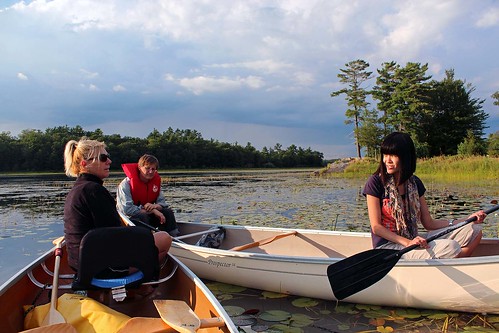
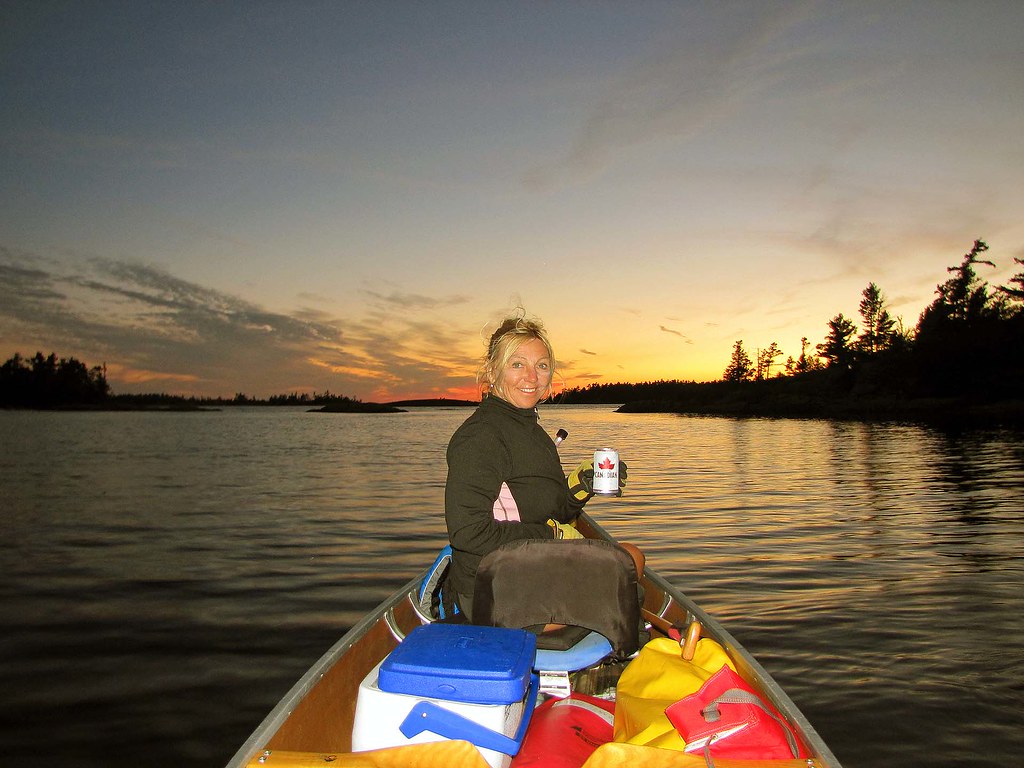
Canoeing around our campsite

We enjoyed paddling on Blackstone Harbour, especially at night. One day we paddled to Pete’s Place and drove to Parry Sound (and caught sight of a medium-size black bear running across Healey Lake Road). An evening storm, accompanied with lighting, thunders and pouring rain, significantly delayed us from canoeing back to the campsite and for over one hour we sat in the car, waiting for the storm to pass. When it did, it became exceptionally calm and quiet, as though the storm had been just a bad dream. At 10:30 pm, in total darkness, we began heading to the campsite. There was no wind and nobody else was on the water; from time to time we saw distant lighting in the sky, but did not hear any thunders. It was a magical feeling! When we finally approached the shore, I was able to try out my new flashlight, which provided ample illumination at a fraction of its maximum output of 1,000 lumens.

A storm is coming!

While in Parry Sound, we went to No Frills and the Hart Store at the Parry Sound Mall and later drove to the Sequin River where we had traditionally our lunch under the railway trestle, which was constructed in 1907. The trestle is 517 m long and 32 m high, the longest rail trestle east of the Rocky Mountains. In 1914 Tom Thomson, one of the most famous Canadian painters, was travelling by canoe on the Sequin River. He stopped near the trestle and painted the bridge and the former Parry Sound Lumber Company. A sign, depicting the painting, marks the location.

Trestle at Parry Sound, 1914

Later we went for a stroll in Parry Sound and ‘discovered’ an awesome second-hand bookstore, “Bearly Used Books”. I was pleasantly surprised not only by the store’s size and number of books it carried, but also by the diversity of categories and titles! I especially enjoyed the section about local authors/history—I immediately spotted a poster advertising “My Life on the Moon River” by Peter (Pete) Grisdale! After browsing for over 30 minutes, I picked several really good and mostly out-of-print books which I would have never found in Chapters!
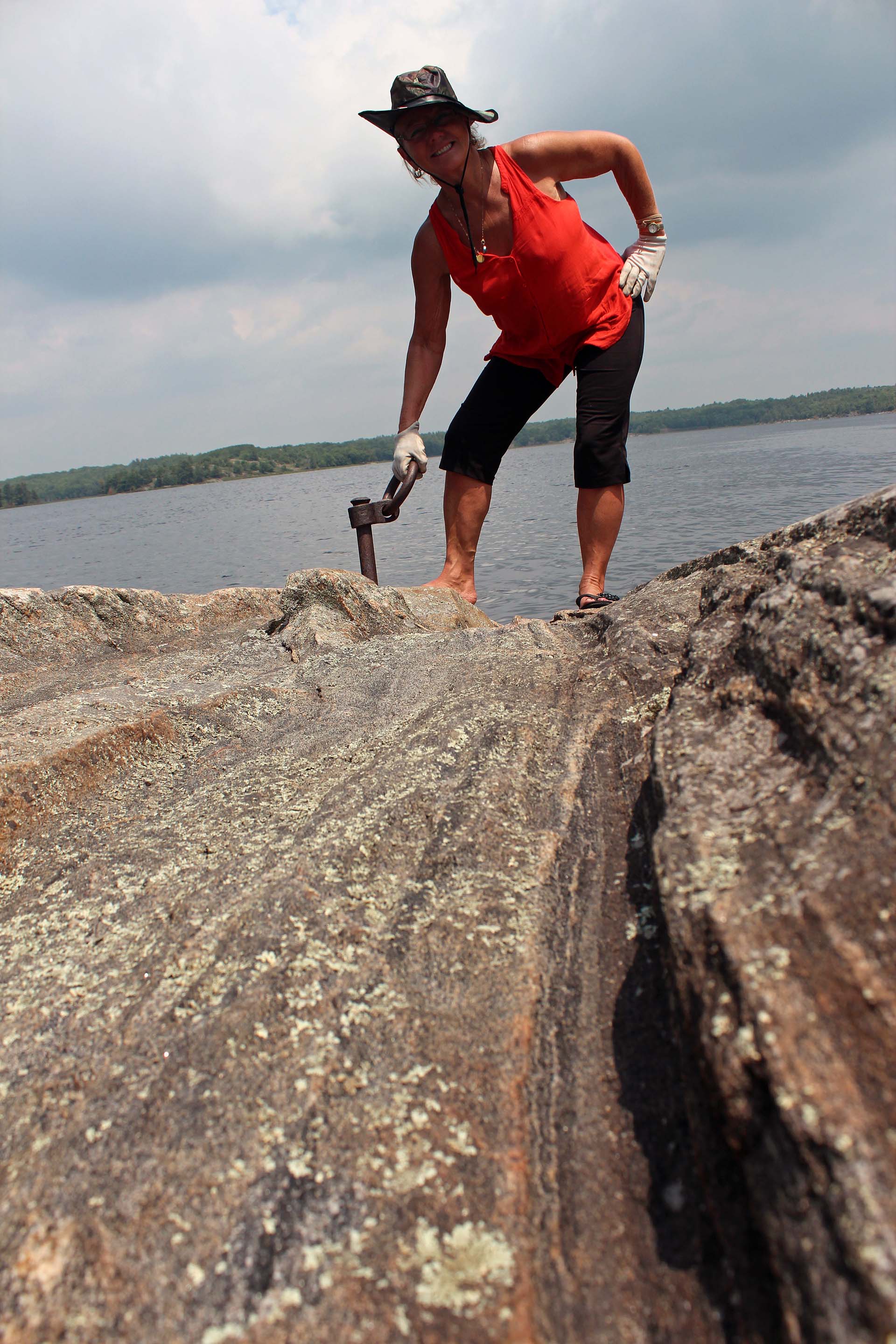
An old steel logging ring at our campsite

I had just finished reading “City of Thieves” by David Benioff—an awesome book, set during the siege of Leningrad and most likely loosely based on a real story, as told to the author by his grandfather—and I immediately started reading “The Gates of Hell” by Harrison E. Salisbury, which I found in the bookstore. This excellent novel was also about the Soviet Union—although a work of fiction, I quickly realized that the main character closely resembled the famous Russian writer Aleksandr Solzhenitsyn. Thus, it was based on many factual events and realistically showed the intricacies of the brutal Soviet system, from the time of the October Revolution to the 1970s. Incidentally, Harrison E. Salisbury was also the author of “The 900 Days: The Siege of Leningrad” and David Benioff used it extensively while writing his novel.

We also visited the Charles W. Stockey Center for the Performing Arts, which stages plenty of excellent performances. Situated on the shores of Georgian Bay, it makes an excellent location to observe sunsets. We also spotted a new monument that had been unveiled just two weeks before—a life-sized bronze monument of Francis Pegahmagabow, a First World War hero and the most highly-decorated First Nations soldier of WW I.

Francis Pegahmagabow's Monument

Later we leisurely walked on the Rotary and Algonquin Fitness Trail and reached the Waubuno Beach. There was a sizable anchor and a historical plaque:

THE SINKING OF THE WAUBUNO 1879

“This anchor, recovered in 1959, belonged to the steamer "Waubuno", a wooden sidewheeler of some 180 tonnes which was built at Port Robinson in 1865. She carried freight and passengers in the shipping trade which flourished on Lake Huron during the nineteenth century. Commanded by Captain J. Burkett, she sailed from Collingwood on November 22, 1879, bound for Parry Sound. The "Waubuno" encountered a violent gale later that day and sank in Georgian Bay some 32 km south of here. All on board perished, and although some wreckage was later discovered, the bodies of the 24 victims were never found. The specific cause of this disaster has never been determined.”

Incidentally, several years ago we had been camping on Wreck Island (also in the Massasauga Park) where the wreck of the “Waubuno” was located. We had paddled there and seen it in the shallow water, between Bradden Island and Wreck Island.
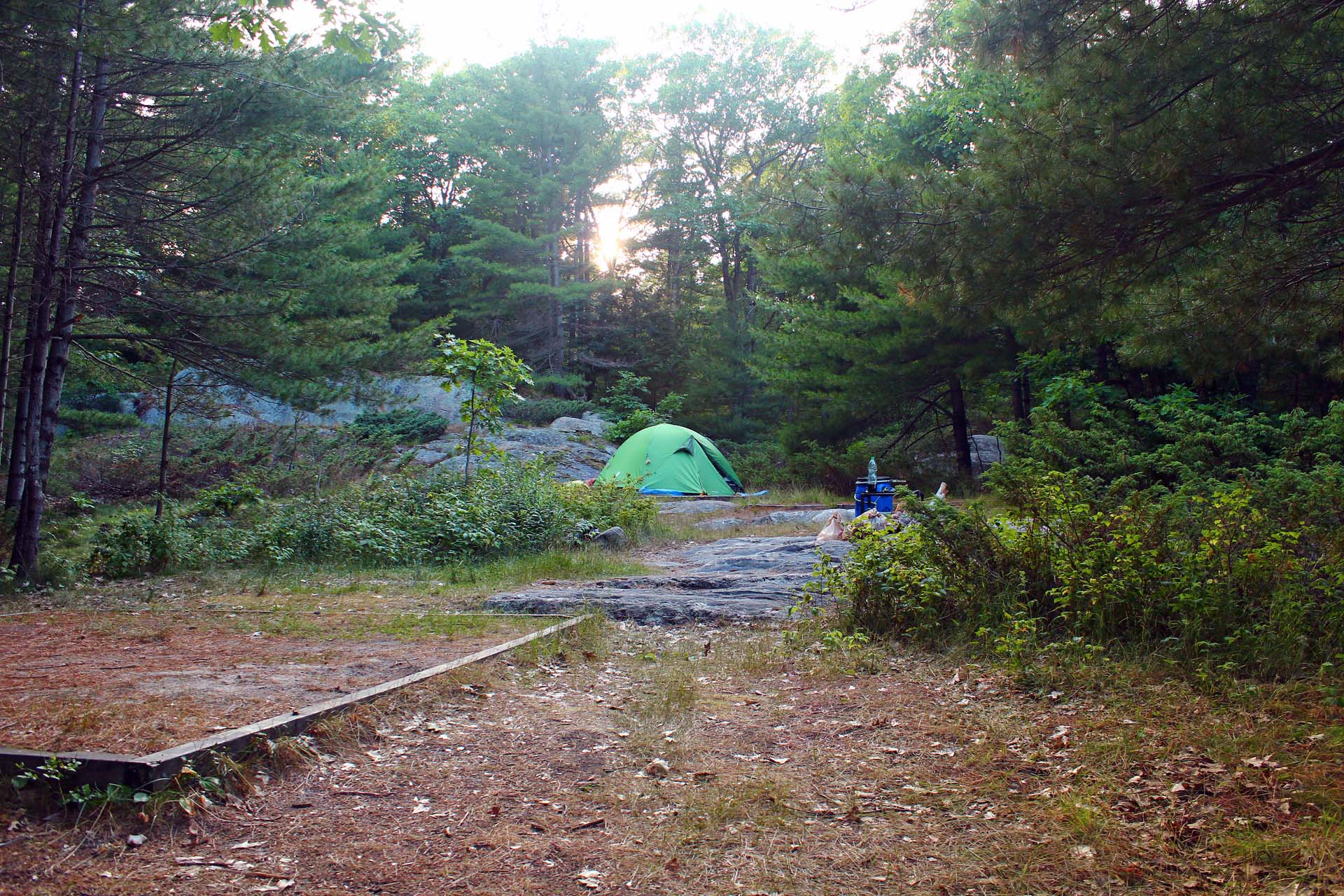
Our second campsite

As our campsite had already been reserved on Thursday, for the last two days we managed to book campsite #507, located on the north side of the channel, just a stone’s throw away from campsite #508. On Thursday afternoon we made three short trips to the new campsite, transporting our (too) numerous pieces of equipment. The new campsite was quite nice and scenic, we set up the tent on a tent pad near a big rock, farthest from the fire pit. Unlike our previous campsite, this one did not have any rocky ridge between the channel, so we could see (and especially hear) all the passing motorboats—yes, it was noisy! Besides, we were not able to admire sunsets.
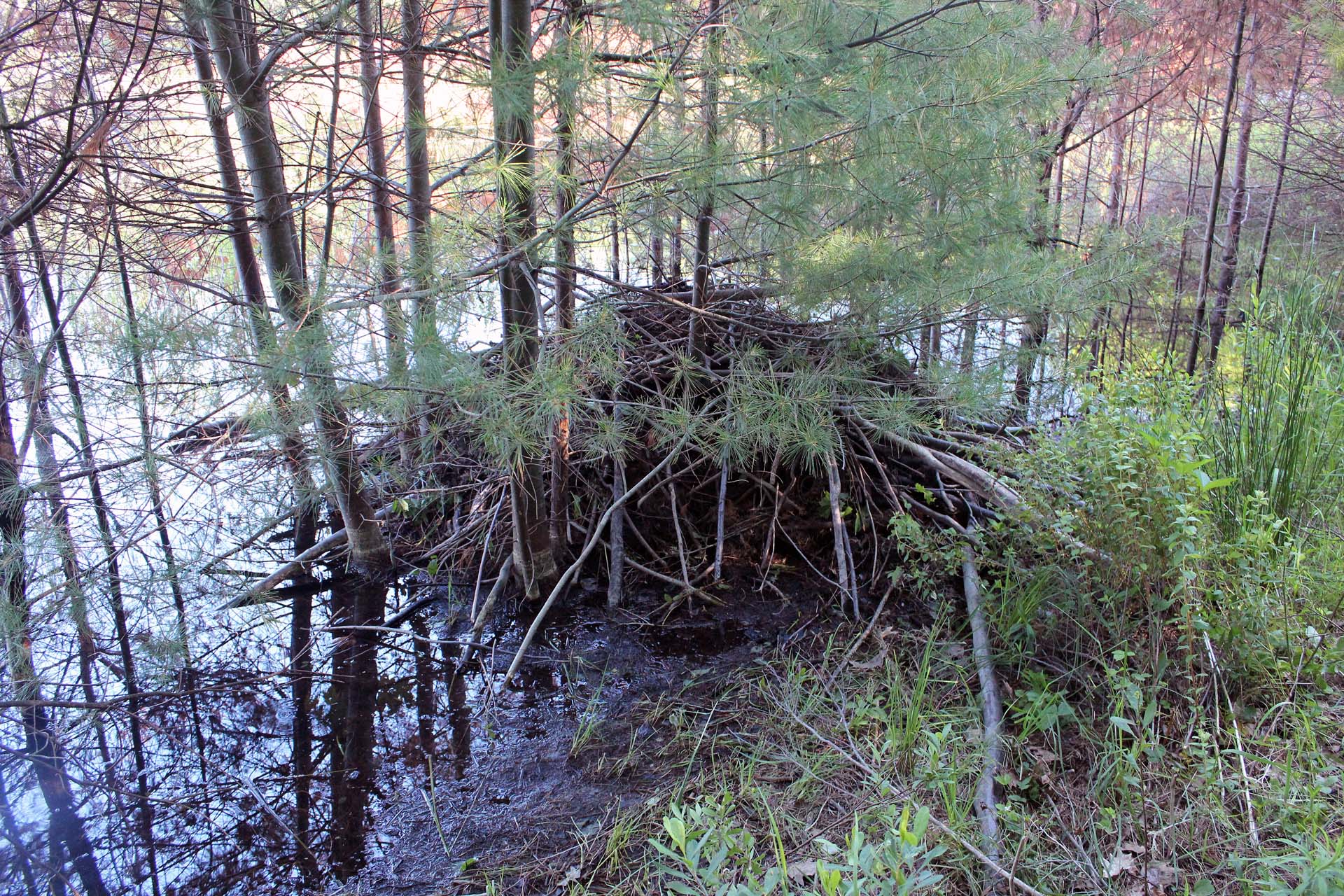
Beaver Lodge

The first morning on the new site we heard clatter; as Catherine got out of the tent, she saw a black bear hanging around the bear box. Upon seeing her, it hastily ran away and vanished in the forest. Fifteen minutes later we heard some commotion and yells on the campsite located on the other side of the channel—“there is a bear, there is a bear!” Apparently, the bear decided to check out that campsite and must have swam across the channel.

The following night we again heard some suspicious noises around the tent, as if something were slowly plodding nearby, but whatever was there, disappeared before I had a chance to get out of the tent and shine my powerful flashlight all over the campsite.

Wasp with its victim, a paralyzed spider

On Friday, our last full day at the park, was hot and humid, but in the afternoon there was that distinct calm before the storm, even the air smelled peculiar. We decided to start the campfire at 7:00 pm, a couple of hours earlier than usually. It was a great idea—we just managed to grill our steaks as black clouds appeared, accompanied by lighting and thunder—in no time it was pouring rain! I grabbed the meat from the grill and we had it while sitting under the tarps. Eventually we made a run to the tent. It was raining for some time and we had soon fallen asleep, hoping to get up early morning next day

Unfortunately, it was still raining the whole morning and even afternoon, so at noon, taking advantage of intermittent rain-less periods, we packed up and carried everything to the canoe. As we were ready to depart, dark clouds slowly moved over our location and it was drenching rain! I covered the canoe with our big tarp—it was a great idea! At least it was warm and even being a little wet did not bother us that much. Thirty minutes later, exactly at 2:00 p.m. (the ‘official’ check out time) we started paddling to Pete’s Place, reaching it in less than 30 minutes. From afar we saw a throng of people standing on the docks and in the loading/unloading area—several dozen of girls from a nearby camp were departing for their wilderness camping experience for the next four nights! Besides, there were plenty of other tourists—some were waiting to start their trips, others were just packing up after several days on the water.

Rainbow over Kempenfelt Bay

On our way to Toronto we stopped in Barrie, in a park on the shores of Kempenfelt Bay (Lake Simcoe) where we had lunch—and observed a wonderful, double rainbow! Later we drove to Minet’s Point, where Catherine’s father parents had a cottage and where he had spent his childhood and teen years in the 1920s, 30s and 40s. The cottage was still there (209 Southview Road)—as well as the park where he used to go to all the time!

BEAR-PROOF CONTAINERS

The big sign at Pete’s Place Access Point said, “You are in bear country”, which was true: we had seen bears in this park before and heard plenty of stories of hapless and often petrified campers, losing not only their food and coolers, but also ending up with damaged tents. So, it was always part of our routine to religiously hang food up in the trees so that bears could not reach it. Not that we were looking forward to doing so—each time before leaving the campsite we had to secure the food and hoist it; each time we wanted to get anything to eat, we had to lower the food container and coolers—and hoist them back up. It was often a strenuous activity, especially for Catherine, who, as I said before, was responsible for the kitchen & food supplies.
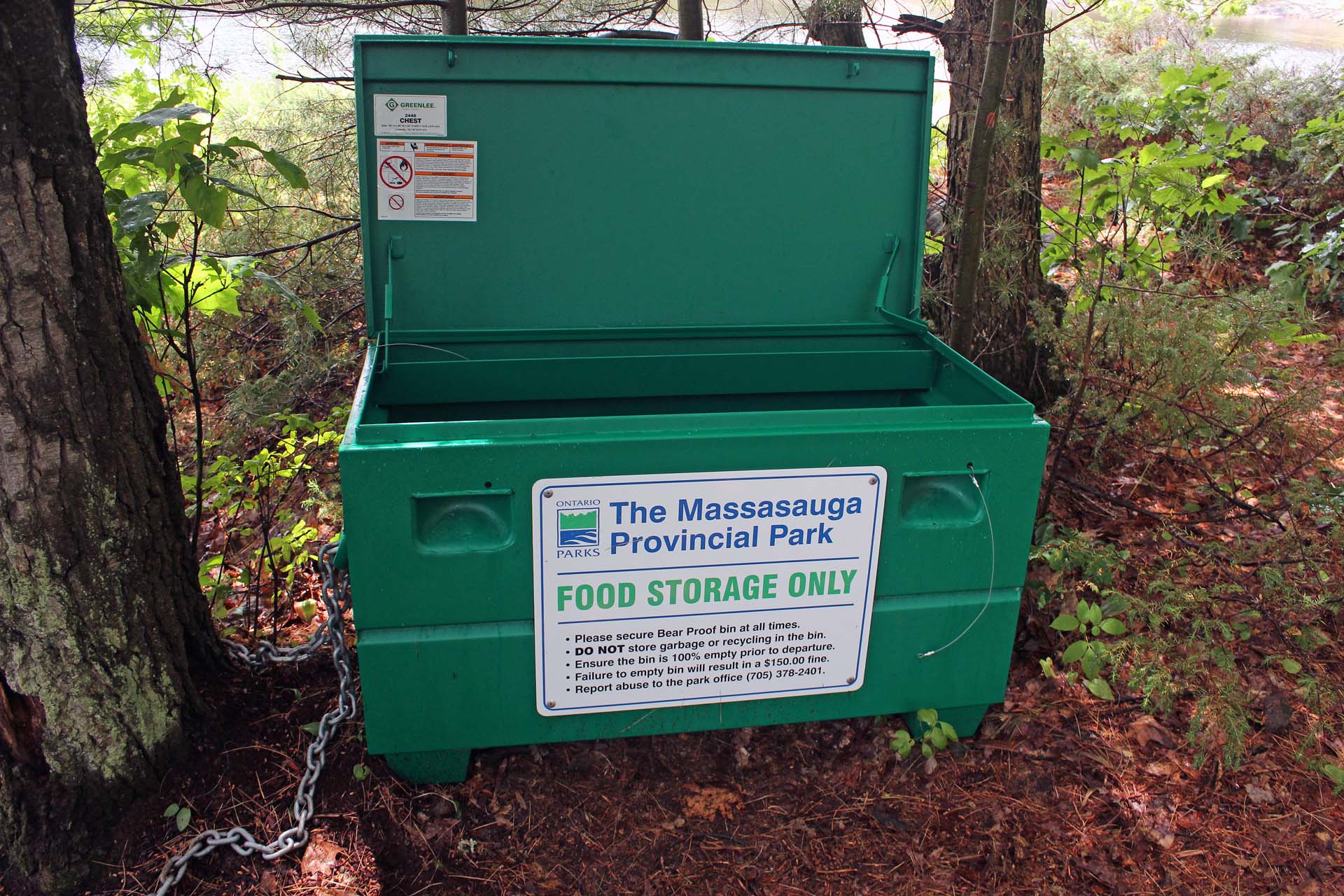
Bear-proof bin

This year we were for a huge treat—there was a food storage locker (a.k.a. the bear box/bear proof bin) installed on our campsite (and, as we found out later, on a number of other campsites too, especially those most frequented by bears). It was undoubtedly an EXCELLENT idea and I would like to extend my genuine gratitude and appreciation to the Park for installing them—THANK YOU!

However… I hate to rain on the park’s parade and be negative of this otherwise wonderful piece of equipment, yet after using the box just once both of us immediately noticed a number of issues with its design.

For one thing, the bear box’s opening was on top and it took some effort, sometimes considerable, to lift the lid—especially Catherine, who was in charge of the kitchen & food supplies, found it challenging to open (and close) the box and a few times she bumped her head against the lid (you should hear her thunderous swearing then!). Also while closing the lid, we had to exert some force, invariably causing a loud clamor. There were two rather awkward hinges inside the box—I thought they made it more difficult to open/close the box and were prone to break.

When we arrived at the campsite, the box was closed, yet there was some water inside (and a big dew worm!); since there was no opening in the bottom to let the water out, we had to manually remove the water (with a coffee cup) and later used plenty of paper towels to clean and dry its floor. After it rained, some water accumulated inside the box, even though the box remained closed—meaning that it was not totally waterproof.

We also found the locking mechanism somehow unpractical. There were hasps and staples on each side of the box and two carabiners, attached to the box with a thin steel line. I could immediately tell that sooner or later (probably sooner) the steel lines would break or unravel and the carabiners would become detached, they were simply too fragile to withstand continuous usage by throngs of campers, let alone occasional vandals—or a pesky and dexterous bear.

After relocating to our second campsite, as Catherine was about to put our food inside the bear container on the new site, she found it impossible to open it. It took both of us a lot of effort to finally lift the lid—it turned out that one of the hinges had gotten twisted & almost detached on one side, thus blocking the lid from opening. In addition, one carabiner was missing, the other one was already disconnected from the box. We could not believe that our predictions came true so soon! Furthermore, the box was on such uneven ground that it kept tipping backwards when the lid was lifted.

Last year we had spent several weeks camping at various parks in the USA (Yellowstone) and all of them had had bear boxes installed (due to Grizzly bear activity), so we could compare the boxes in the Massasauga to the ones in the USA.

The bear boxes in the U.S. parks were standard cupboard-style, with two front doors, very practical—the top area could be conveniently used as a ‘table’ for temporarily placing various items and it was much easier to put heavy items inside. The closing/opening mechanism was simple and quiet (no awkward hinges) and the latch/lock was ‘built-in’ and did not require fiddling with carabiners (i.e., less parts to break or get missing). The boxes were also permanently attached to the ground. I do not remember any water accumulating inside—and it was so easy to clean them.
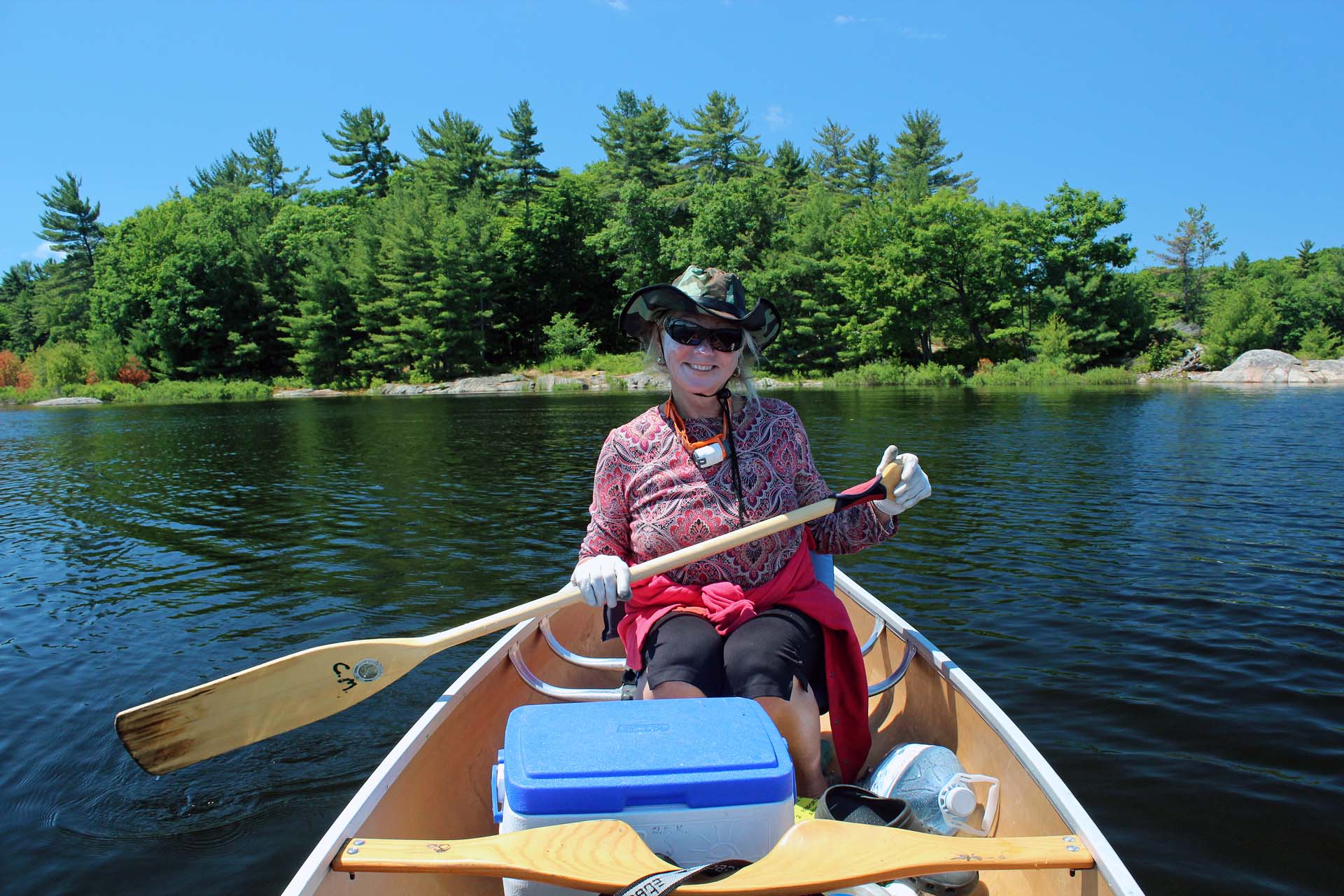
Our campsite is behind

Notwithstanding the above observations, we were still very grateful to the park for installing such bear-proof containers!

To sum up, even though we did not paddle a lot, we had a wonderful time in the park and we are looking forward to visiting it again!


Friday, July 11, 2014

The Massasauga Park, Ontario, August, 2013: Camping and Canoeing at Blackstone Harbour and Wreck Island


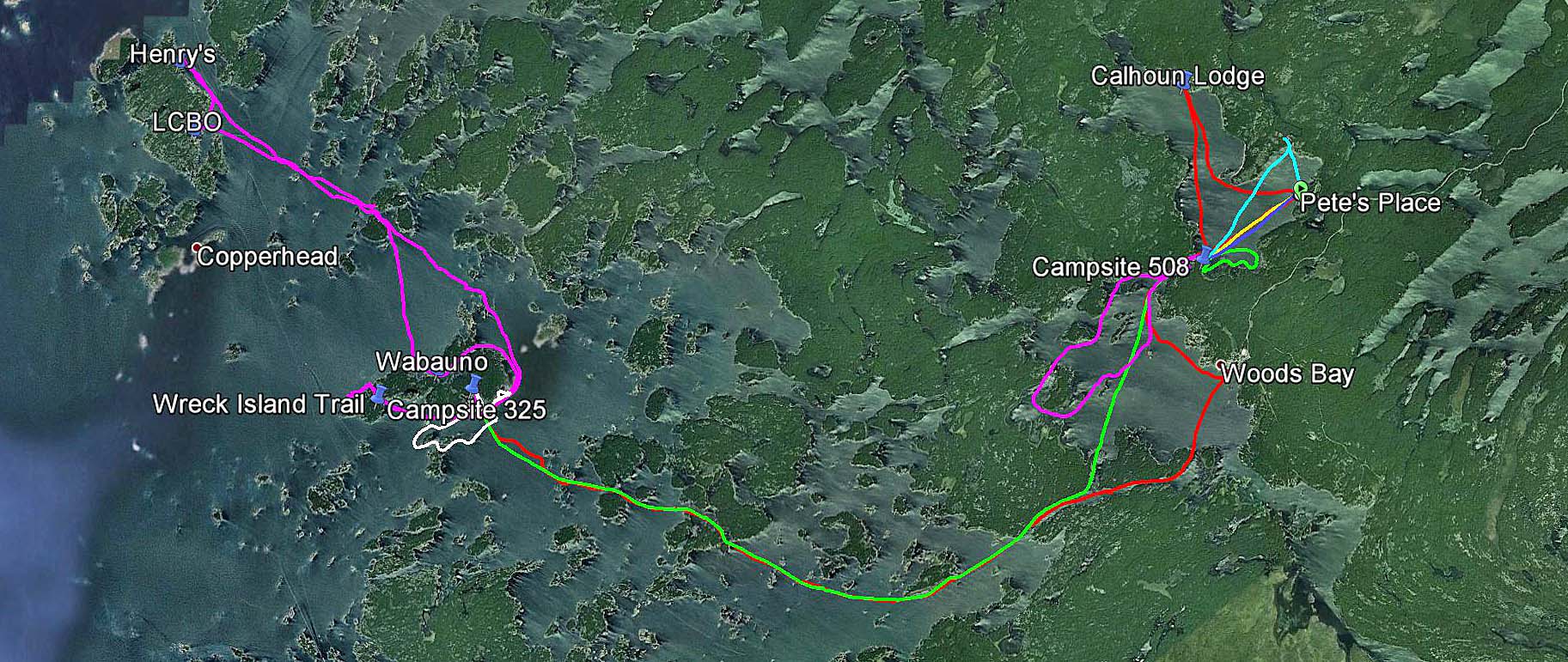
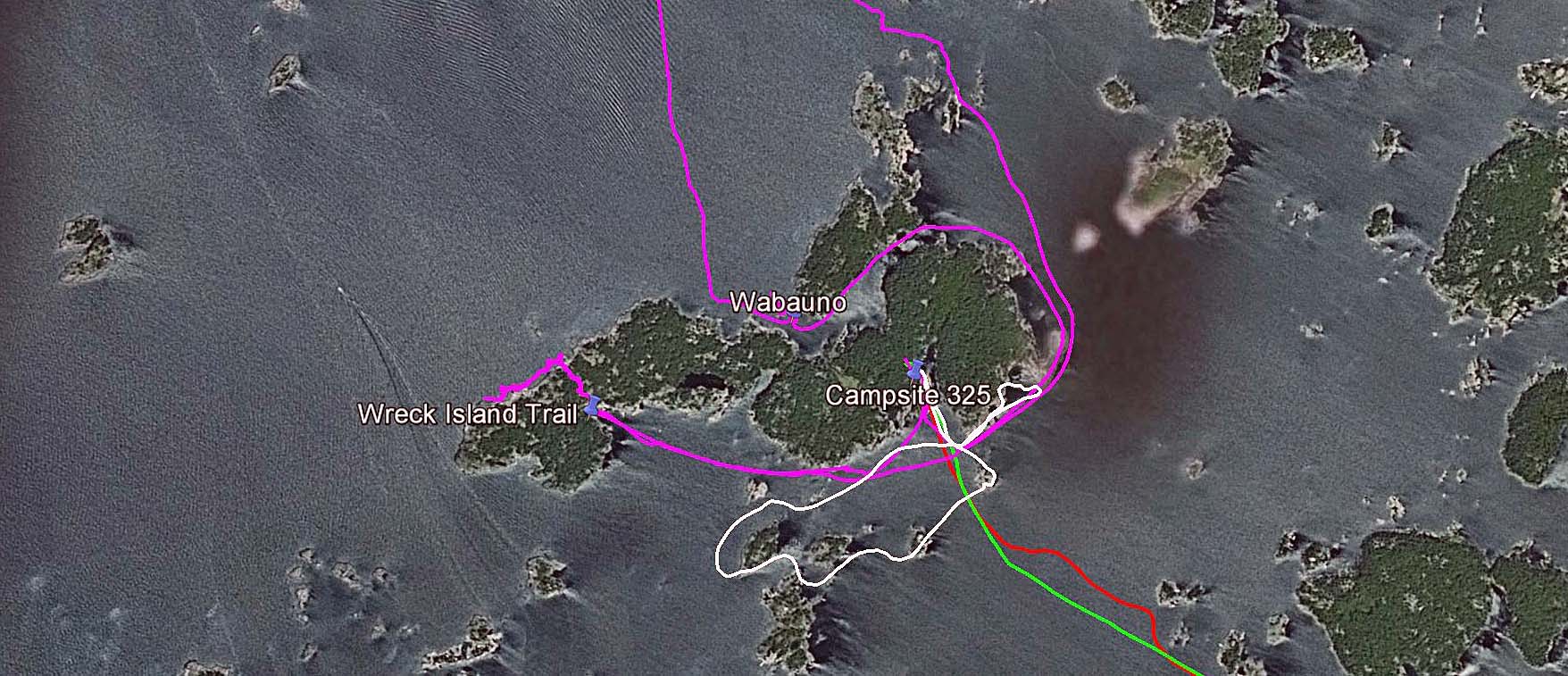
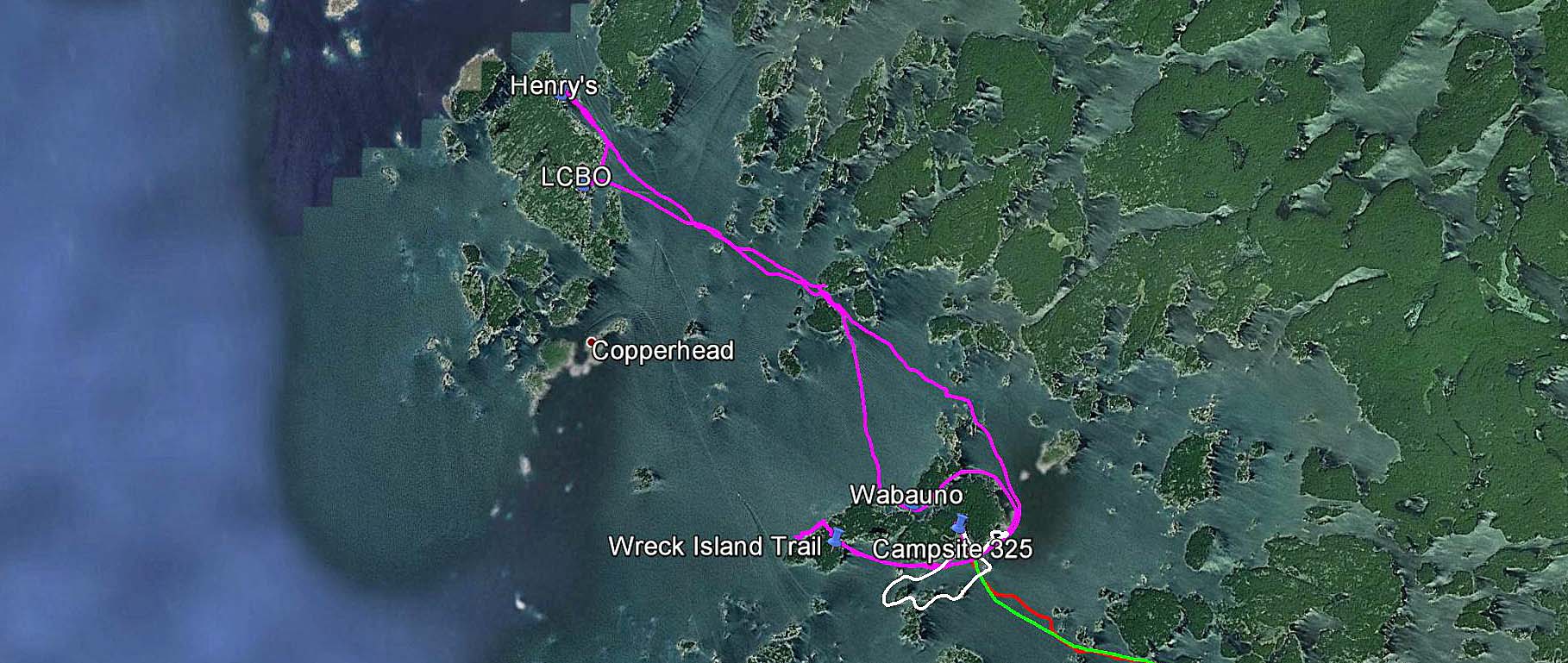
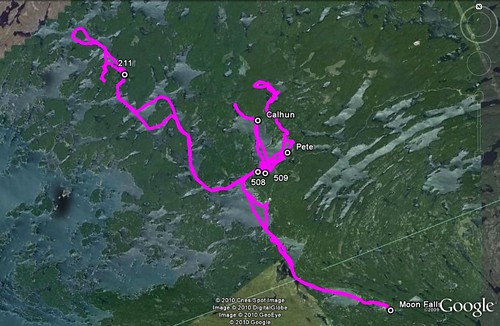
Our GPS tracks in the Massassauga Park
Initially Catherine and I were planning to stay in the Massasauga Provincial Park over the Canada Day long weekend, on a campsite near the channel. In March, 2013 we called Ontario Park Reservation and the site was still available, yet a day or two later, when we finally called to book it, it was taken! Since it was still available for the Simcoe Day long weekend in August, we quickly booked it — and managed to reserve a campsite in Killarney Park over the July long weekend instead. But it was not the end of the story: a month later, while chatting with my clients, it turned out that they were also spending weekends camping and canoeing and were looking forward to going camping over the Canada Day long weekend.

“Which park are you going to?” I asked.
“The Massasauga”, they said. “We had already reserved a campsite”.
“Which one?”
“The one near the channel”, they said to my astonishment!

Wow, what are the chances of this happening?

Pete's Place, we depart from here
So, on August 1, 2013 (the 69th anniversary of the Warsaw Uprising) we arrived at the Massasauga Park, Pete’s Place, to start our sixth trip in this park. There were not too many people around — we met a young guy of Serbian or Croatian origin from Toronto who was dragging his small kayak to the water. He was staying on one of the campsites located along Captain’s Allan Strait and we paddled together until we reached our campsite.

Evening paddle on Woods Bay
We had stayed on that campsite in July, 2011 with some friends, as well as part of our group had camped on it in 2010. It was located on the shores of the only channel leading to Woods Bay (and to Georgian Bay), so there was plenty of boat traffic. Nevertheless, the boats did not bother us — we could hardly see them — and we even enjoyed sitting on the rock and watching the passing boats and the setting sun. The campsite also looked out on a small island (private, but without any structures), sometimes we swam to the island and relaxed on its rocks.

Lynn, Catherine, Jack and Wayne at our Blackstone
Harbour campsite, near the channel
The next day Lynn and Wayne arrived and set up their new tent and a tarp. Later in the evening all of us went for a paddle on Woods Bay, around Georgina and Fritz Islands. The weather was perfect and we could enjoy the wonderful sunset. Once we were back, we had a campfire.

Since Catherine had left her hat in the car, the next morning we paddled to Pete’s Point (about 15 minutes) to fetch it and then we headed to Calhoun Lodge, facing a rather strong head wind. While Catherine, Lynn and Wayne went on a rigorous hike on the Baker Homestead hiking trail, I spent all this time exploring the lodge and adjacent buildings. 

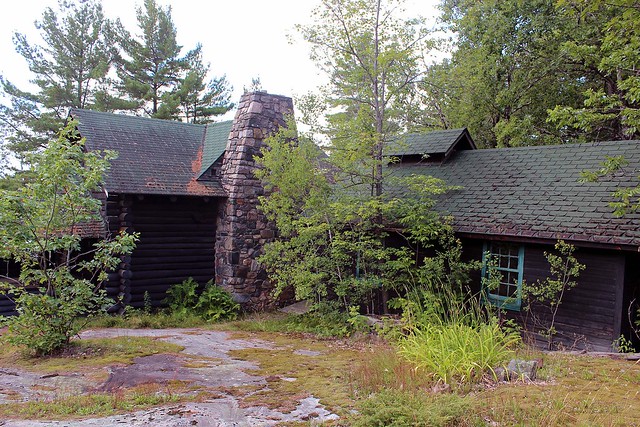
Calhoun Lodge
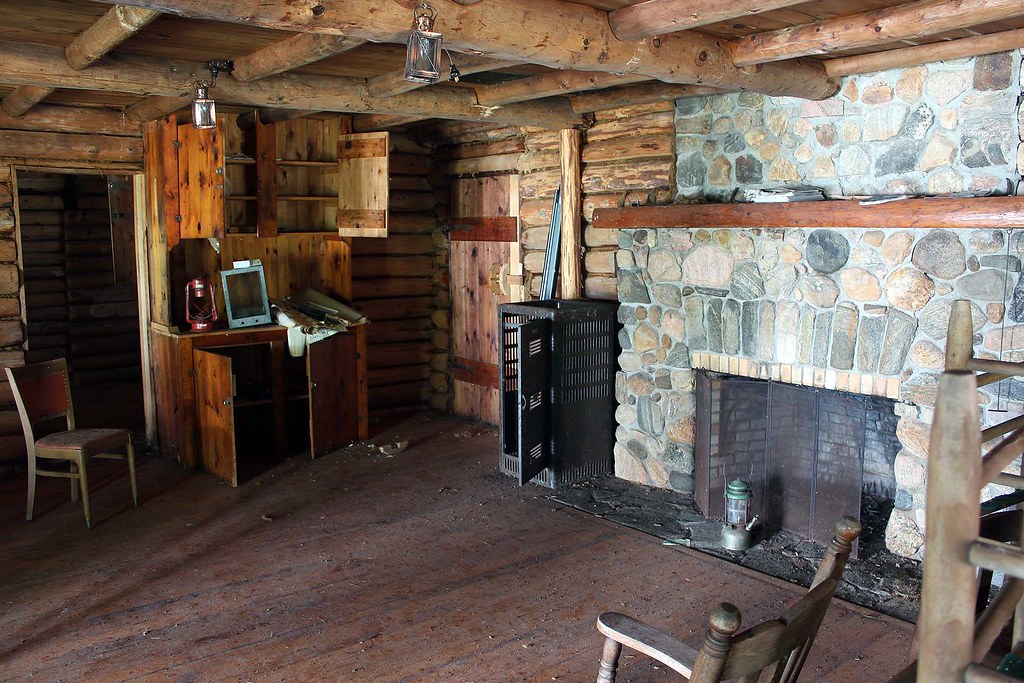
Although I had visited the lodge several years ago (also with the same group), this time I appreciated its past history much more: Several months ago I had been contacted by Mr. Dave Nadzam from Ohio, who had seen my photos of Calhoun Lodge and made a few comments. It turned out that Dave, as a teenager, used to visit the Lodge and of course, knew its owner, Joseph Calhoun. He emailed me several photos depicting him having a wonderful time at the Lodge and wrote a couple of stories about the Lodge, ‘Judge’ Calhoun and his family. I also sent him the Massasauga Park tabloid and a brochure about Calhoun Lodge. So, now I was taking photographs and videos of the Lodge and later emailed them to Dave.

At Calhoun Lodge
I intended to incorporate his stories and some of the photographs in my blog — but he created his own blog, “The Calhoun Lodge: Willebejobe”, (https://dhnadzam.wordpress.com/), where you can find plenty of photos and very interesting stories related to the Lodge and its inhabitants-it is really worth visiting! I found it fascinating to read about the owner, “Judge” Jo Calhoun and his family (including his sister, who starred in almost 50 silent movies), Dave’s personal stories and finally stories about the Taylor family, who purchased the property from Mr. Calhoun.

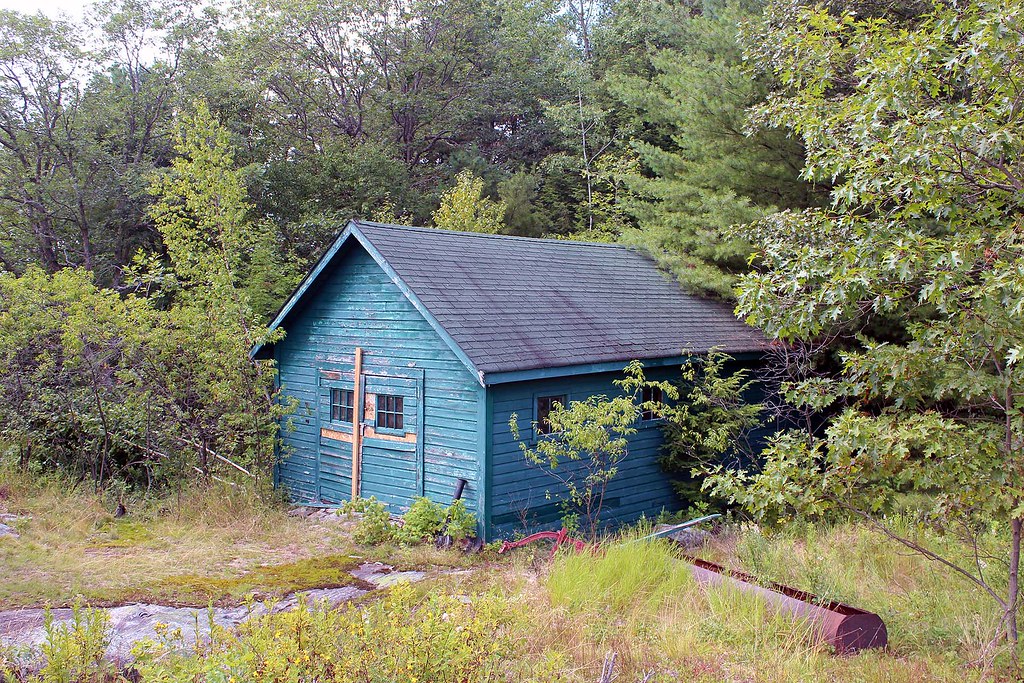
The Maintenance Shed
Most of the buildings still survive in various state of (dis)repair. One of them, the maintenance shed, has a rather gloomy history: On May 24, 1968, Jerome Cassanette, the caretaker, dressed in his best clothes, and with a bottle of the Judge’s finest scotch, went to the maintenance shed, closed the shed door, started the tractor and then lay on the work bench until he succumbed to the fumes. The Judge, arriving from Ohio the next day, discovered his body. It is said that Jerome’s ghost haunts the property even to this day. While I was there alone, taking photos and exploring the buildings, I did not see any ghosts, although I was rather more concerned about encountering a black bear or an Eastern Massasauga Rattlesnake, the only venomous snake in Ontario (the park is named after this snake).

Inside Calhoun Lodge
Dave also scanned and posted a brochure published by Ontario Parks called “Calhoun Lodge and the Baker Homestead” (https://dhnadzam.files.wordpress.com/2013/08/calhoun-lodge-and-baker-homestead1.pdf) which has many photographs and tells about the Lodge and its history. Sometimes when we see abandoned houses, we wonder what had occurred there and wish they could speak. Well, this time all you have to do is go to Dave’s blog and in no time you will look at this place from a very different perspective!

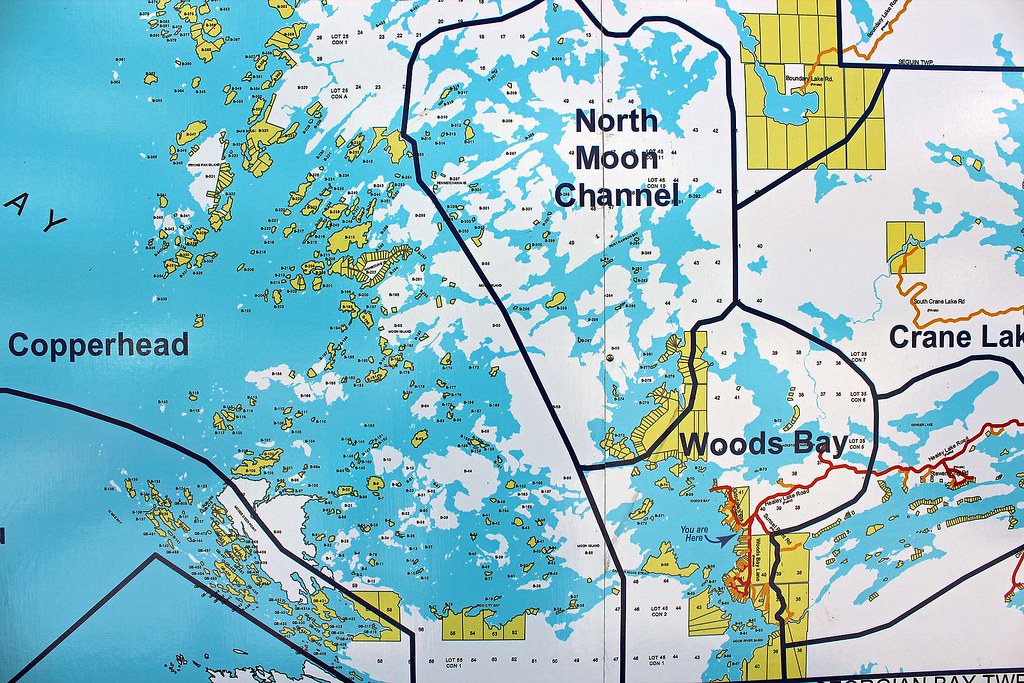
Map of the Massasauga area at the Moon River Marina
On Sunday, August 4, 2013, we paddled to the falls (vis-à-vis Pete’s) and later gave a lift to Lynn & Wayne to the parking lot where they had parked their car; after saying good bye, we drove to the town of MacTier with our canoe on the roof. Yeah, we were planning to do some paddling on Lake Joseph, but eventually got too lazy and just spent a few hours in town.

Wreck Island
On Tuesday, August 6, 2014, we packed up our stuff and headed to Wreck Island. The weather was awesome and even though we had to paddle on relatively open water, we had no problems with waves or winds. Unfortunately, some motorboats were totally oblivious to our presence and we had to carefully watch for the big rollers they created. At one point three powerful speedboats darted about 100 meters in front of our canoe. In no time they vanished, yet the high waves they had left behind literally swamped our canoe — had not we positioned the canoe perpendicularly to the waves, it would have likely capsized.

Our campsite on Wreck Island
We had visited Wreck Island twice before: in 2008, during our first canoeing trip (it was just a day visit) and then in 2009, when we stayed for several days on the only campsite located on the island. We truly enjoyed our stay and thus 4 years later we were looking forward to visiting our ‘old’ campsite again!

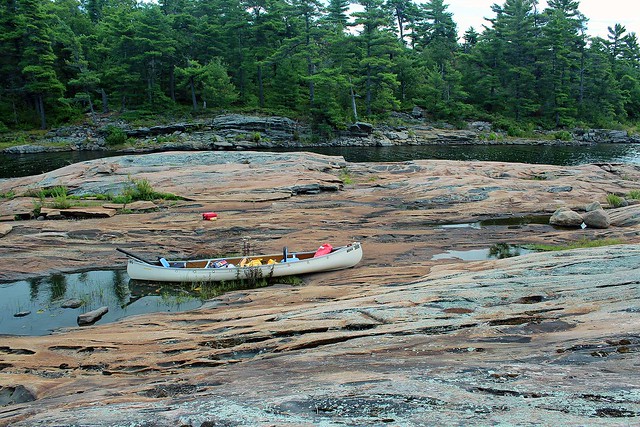
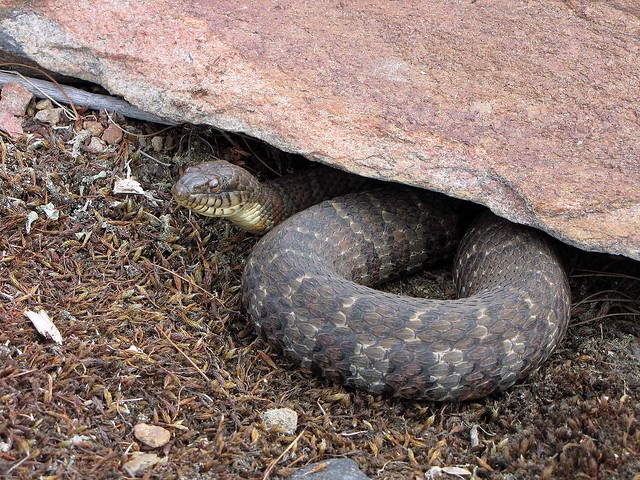
Since the water level was lower than in 2009, our ‘private’ island on the ‘private’ bay became a peninsula. We still remembered plenty of water snakes inhabiting the island in 2009-they were quite ubiquitous, swimming everywhere and sticking their heads from numerous crevices. They were there again-one, very long and thick, was living under a flat rock, most of the time part of his body exposed to the sun. It was shocking to think that we probably had seen him as a toddler back in 2009! Others either swam or hid in cracks.

Water Snake
While Catherine spent several hours painting the canoe with First Nation artwork, I tried fishing, but she was obviously much more successful in her activity than I was at mine. This time we did not see any wildlife — we kind of missed the lonely, shy black bear that inhabited the island in 2009 and sometimes was observing us from across the small bay!

At Henry's Restaurant on Fryingpan Island
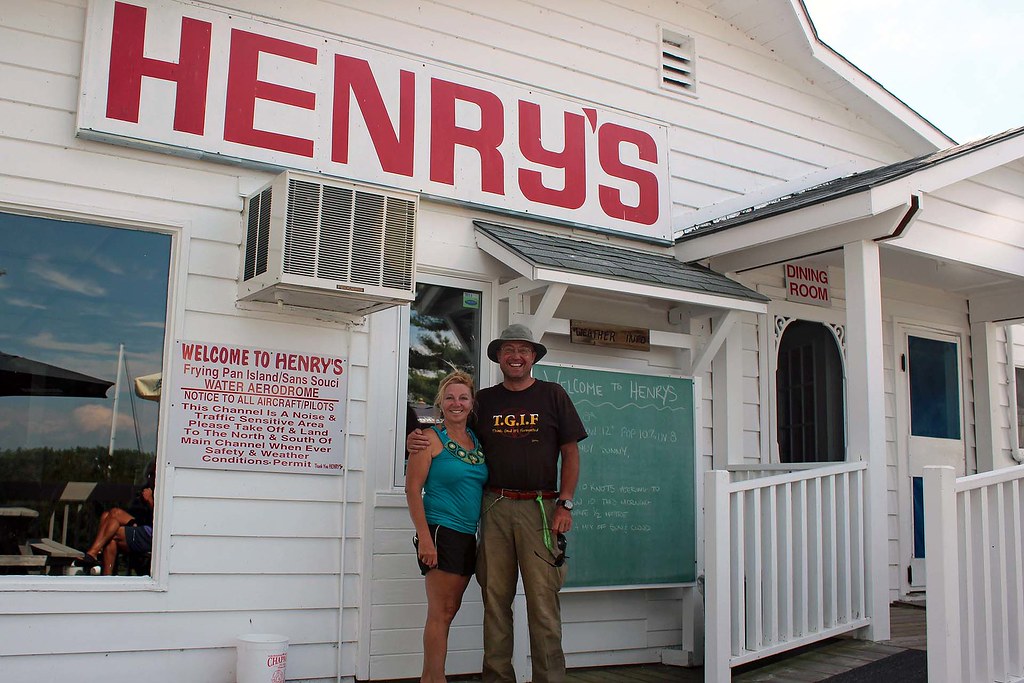
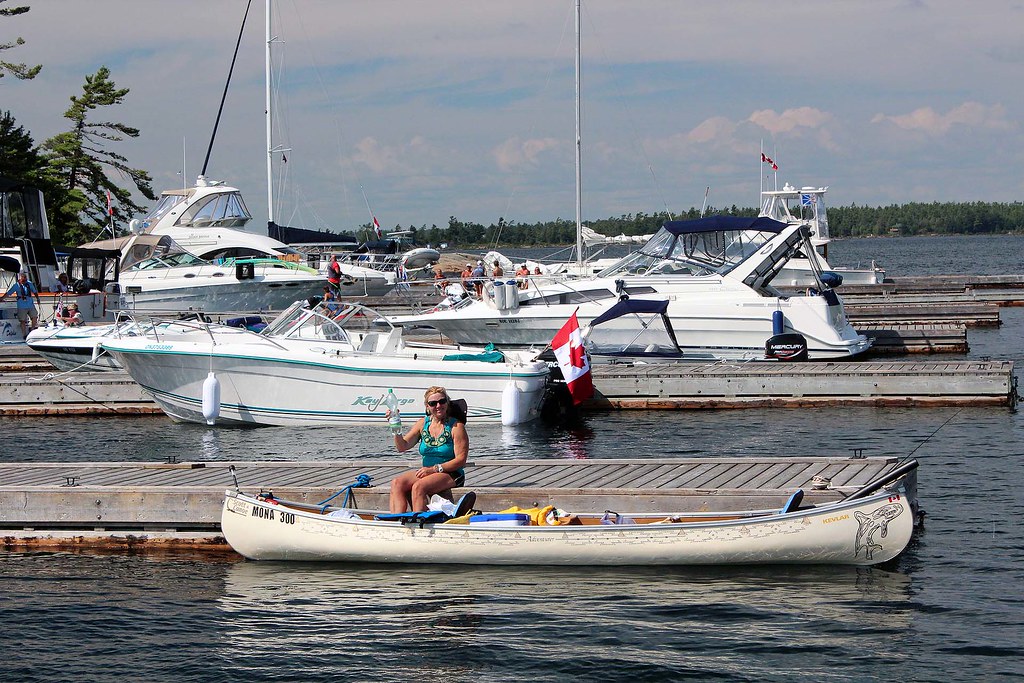
On August 8, 2013, we paddled to the famous Henry’s Restaurant on Frying Pan Island. As our trip required us to be traverse through quite exposed areas, I had made sure that the weather forecast did not call for any rapid weather changes and we were monitoring the sky and cloud patterns. We saw an OPP (Ontario Provincial Police) boat, checking boaters’ safety equipment-one hapless kayaker, who seemingly forgot to bring a life jacket, was turned back by the police. When we arrived at Henry’s, there were plenty of impressive boats, cruisers and sailboats (and one float plane) at the restaurant’s docks, yet we did not see any other canoes — we were the only brave ones!

We were the only canoeists that have arrive by canoe!
We just had French fries and briefly talked to the restaurant’s owner. Whereas the chips and fish are good, we did not think they were that great to justify their high price. Later we headed to the small store on the island.  Catherine bought ice cream, I opted for several cans of cold beer and we headed back to Wreck Island. At one point we were almost hit by a fast-moving motorboat — the driver saw us at the last moment and appeared visibly embarrassed and even terrified.

GPS tracks-poaddling to Fryingpan Island and back to Wreck Island
Instead of paddling directly to our campsite on the south shores of the island, I proceeded towards an entrance to a passage between Wreck Island and Bradden Island. There I was paddling back and forth around small rocky islands at the mouth of the passage and constantly scanning the area around the canoe. Catherine had no idea what I was doing or looking for and became quite perplexed by my peculiar behavior, yet I totally ignored her bemusement and kept paddling hither and thither.

“Do you remember the story of the Waubuno?” I asked her.

Considering all the many stories I had been regaling her with, Catherine could not recall this name.

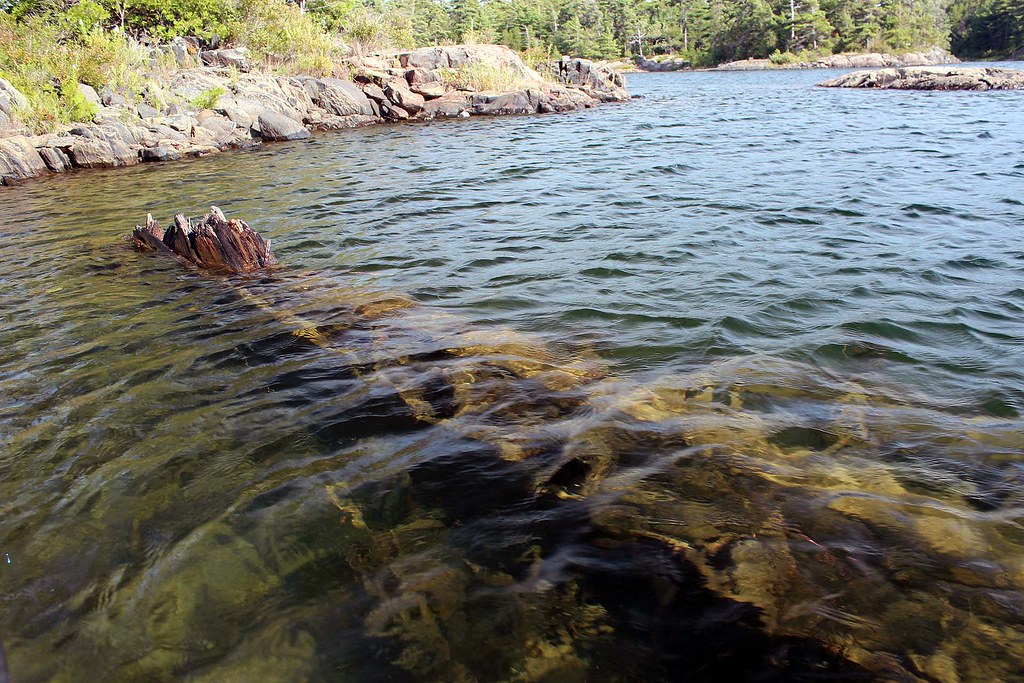
Remains of the hull of the Waubuno
“Well, there is a Historical Plaque in Parry Sound in Waubuno Park, where a sizable anchor is located. So, to make the story short, let me just read you what it says”, I said and pulled out a sheet of paper containing the text.

“This anchor, recovered in 1959, belonged to the steamer "Waubuno", a wooden sidewheeler of some 180 tonnes which was built at Port Robinson in 1865. She carried freight and passengers in the shipping trade which flourished on Lake Huron during the nineteenth century. Commanded by Captain J. Burkett, she sailed from Collingwood on November 22, 1879, bound for Parry Sound. The "Waubuno" encountered a violent gale later that day and sank in Georgian Bay some 32 km south of here. All on board perished, and although some wreckage was later discovered, the bodies of the 24 victims were never found. The specific cause of this disaster has never been determined.”

“Wow, what a terrible disaster!” she exclaimed.

I pointed to something sticking out of the water.

“And we’re now looking at what remains of the hull of the Waubuno!”

Both of us were quietly looking at this old, rusty and decaying object which 134 years ago was part of this well-known ship.

Rock formation on Wreck Island

Then we paddled past the campsite to the beginning of the Wreck Island hiking trail. There was one cruiser docked, whose occupants were having a small campfire on shore. We spoke to them for a while-they complained about the price of gas the boat was consuming-even a short trip ended up costing several dozens dollars. Also, when it was windy, they often had to wake up in the middle of the night to check if the wind did not push the boat towards the rocky shore. Listening to such stories-and they are quite common-made us appreciate our canoe even more!

Rock formation on Wreck Island
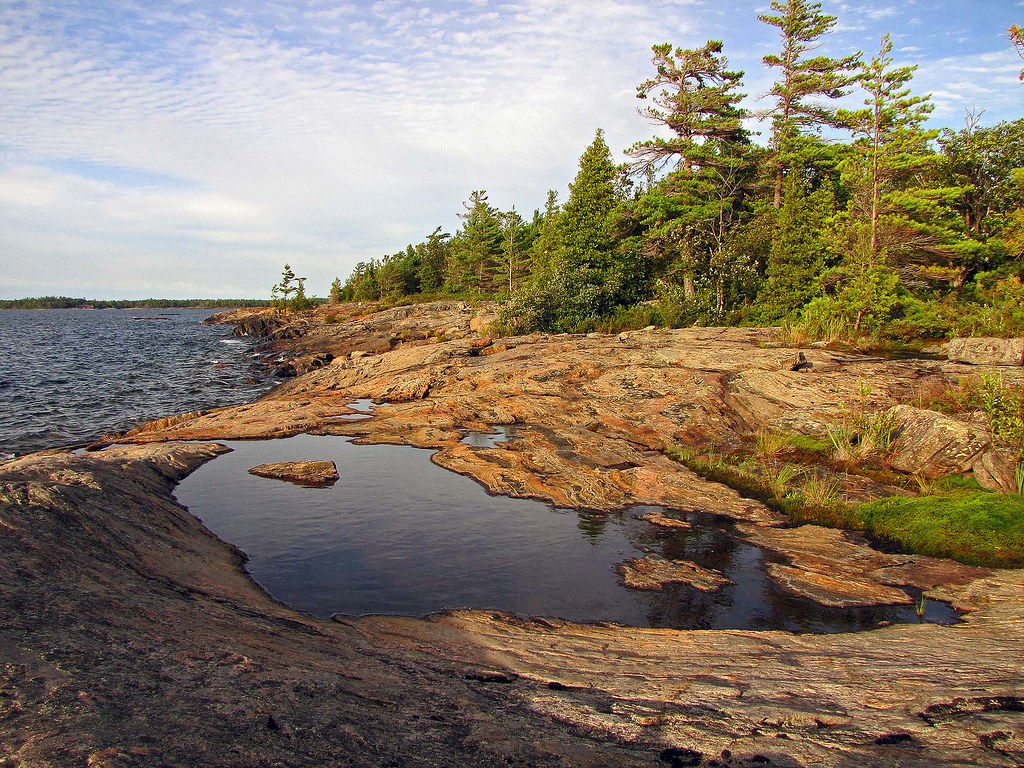
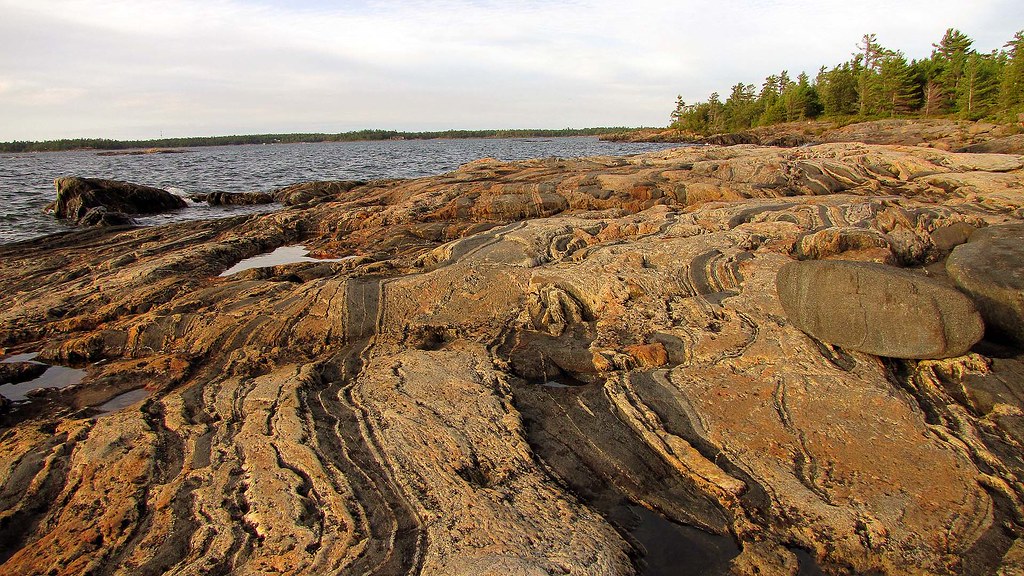
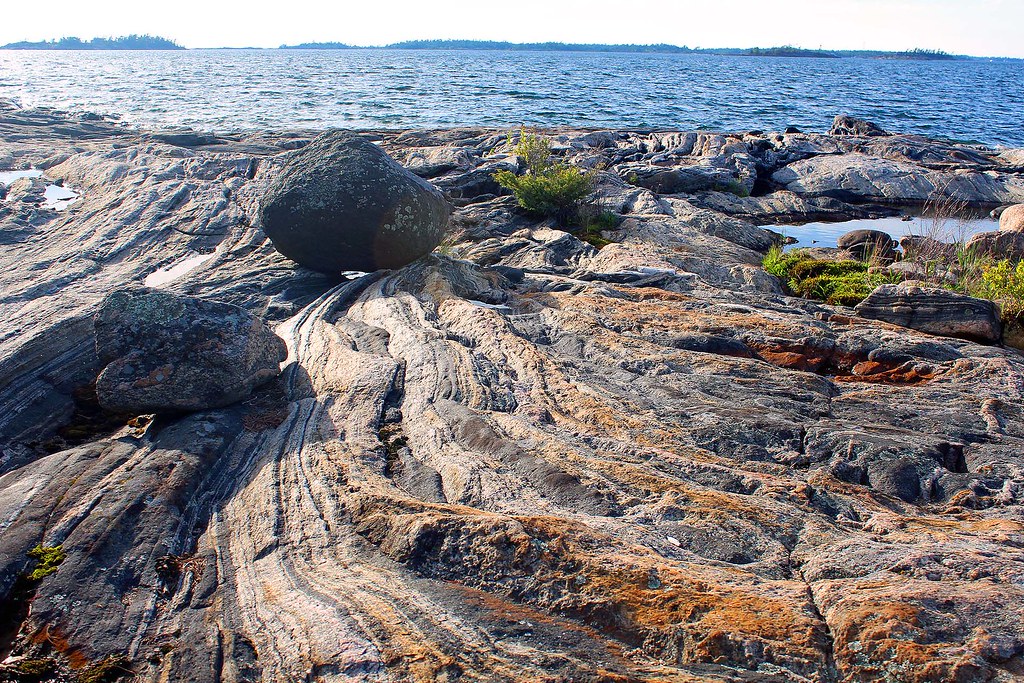
The Wreck Island Trail is quite short, but it is absolutely spectacular due to impressive rock formations! I was devouring the amazing and unique scenery and every few seconds took a photo — I could literally feel my camera overheating! I am not a geologist, but let me quote a few passages from “Wreck Island Trail” by Ontario Parks:

Geologists believe that the rocks in this area have experienced a mid-continental collision beginning some 1.1 billion years ago. Mountain building was followed by millions of years of erosion. Some 450 million years ago a marine sea flooded this area leaving deposits of limestone, yet none of these thick deposits have survived the subsequent erosion on Wreck Island.

Fantastic rock formations on Wreck Island
Glaciation has also contributed to sculpting the park’s landscape. Continental glaciation finished the job of removing the last traces of soft limestone. The last sheet covered the Wreck Island area approximately 60,000 years ago, however, it was 14,000 years ago that an event far to the north of Hudson Bay would leave a lasting record on the island. A catastrophic release of glacial meltwater occurred, releasing a huge quantity of debris-laden water with “nowhere to go”. Ice still covered this part of Georgian Bay, including Wreck Island, as the water rushed southward. It traveled beneath the ice under tremendous pressure. The water was able to push up the base of the glacier and travel along the ground. The rushing torrents was filled with sharp grit, cobbles and boulders. This torrent attacked the rock surfaces of Wreck Island much like a giant sand blaster, resulting in the erosional processes evident today.
Percussion Boulder

Percussion Boulders

Fourteen thousand years ago a catastrophic release of glacial meltwater occurred, releasing a huge quantity of debris-laden water with “nowhere to go”. Ice still covered this part of Georgian Bay, including Wreck Island, as the water rushed southward. It traveled beneath the ice under tremendous pressure.

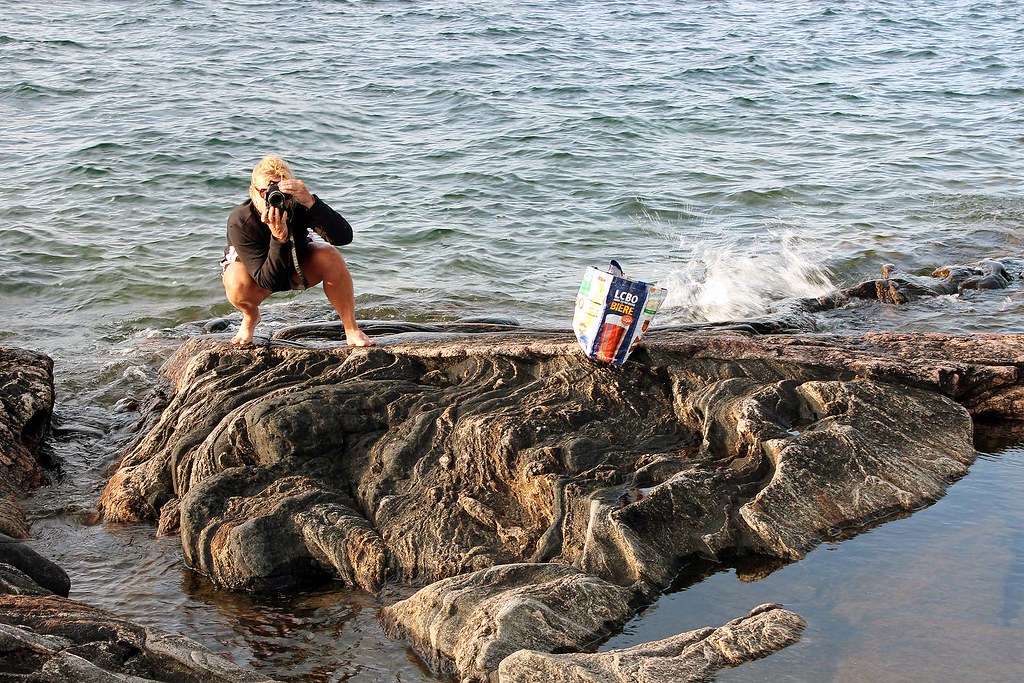
Taking photos on Wreck Island
The water was able to push up the base of the glacier and travel along the ground. The rushing torrent was filled with sharp grit, cobbles and boulders. This torrent attacked the rock surfaces of Wreck Island much like a giant sand blaster, resulting in the erosional processes evident today. The large, black boulders is one of those rocks which were bouncing along under the ice hammering the rock surfaces. These rocks are known as percussion boulders, they were swept along in a high speed sheet of water under tremendous pressure. Geologists think this incredible flow may have been short lived, lasting anywhere from only a number of hours to several days.

Amazing sunset on Wreck Island
We know that these percussion boulders have traveled a long distance; this black boulder looks very different than the bedrock on which it sits. The boulder is gabbro from far north of here and contains green epidote.

It was a wonderful evening and I took over one hundred photographs with the rock bathed with the setting sun, yet no photograph will convey the exceptional beauty of this area.

Enjoying the sunset near Wreck Island
It was getting dark and we slowly returned to the canoe. It was very hot, I was thirsty and had a few cans of still cold beer-it was so delicious and refreshing! We paddled for a while and finally reached our campsite in total darkness.

Next day we paddled back to Pete’s Access point, stopping along the way in Captain Allan Strait to eat Pickerel Weed, examine Arrowheads and look (unsuccessfully) for wild rice. At one point a group of seadoo riders suddenly showed up in the channel and kept going very fast in spite of our canoe being there. Since it was still early, we went to Moon River Marine for popsicles and beer, then sat down in wooden chairs and were watching and chatting with patrons loading their boats to depart to their cottages-well, a very busy Friday evening! In less than 30 minutes we arrived to the Pete’s Access point, packed the car and placed the canoe on the roof—just in time before a thunderstorm hit.

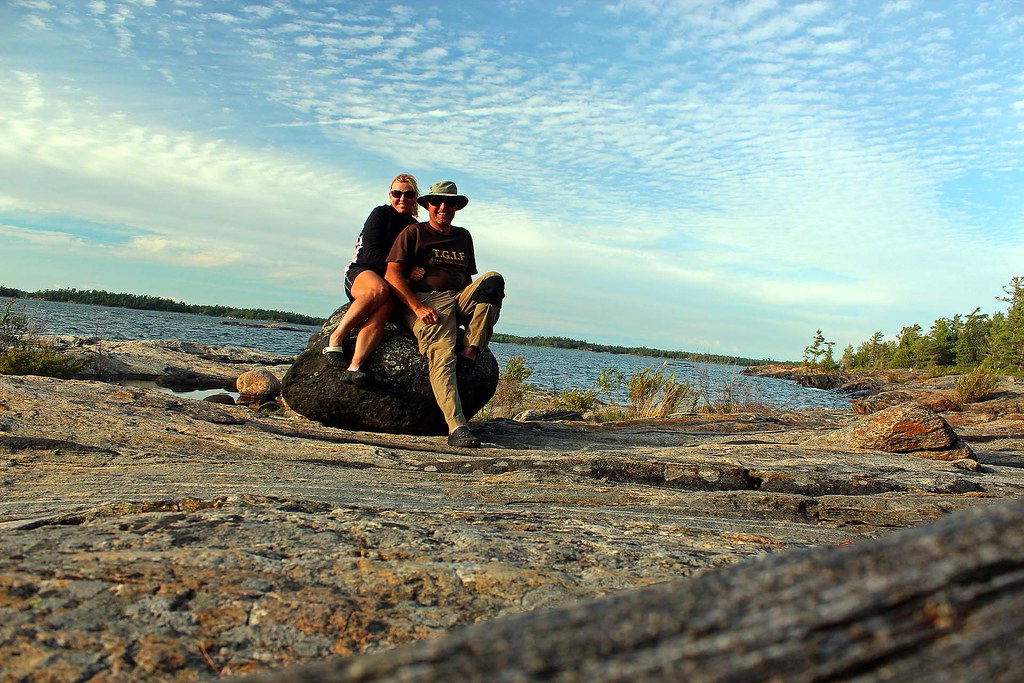
On Wreck Island-Percussion Boulder
What can I say… yet another awesome canoeing & camping trip!


Sunday, August 29, 2010

The Massasauga Provincial Park, June-July, 2010

The Massasauga Trip, June 30-July 08, 2010 


Day 1, June 30, 2010, Wednesday 

 I have visited the Massasauga Provincial Park three times over the past two years and this year I decided to organize a group event for our Meetup group, “Get Out”--sadly, no longer in existence. I called the Park Reservation Line months before to book site #509 (where we stayed last year—see blog XXX) and it was available. Another group member, Andrea, booked an adjacent site #508, which was a short paddle away from ours. Since those sites, located on Blackstone Harbour, were less than 30 minutes from the parking lot, I thought more people would be interested in this event, yet only 10 signed up. After making the reservation, I realized there were some errors made by the reservation staff and it took me many phone calls to straighten things out. Evidently, a lot of people had problems with Ontario park reservation in 2010, so much so that not long ago I got an email from Ontario Parks informing me that the reservation system would be radically overhauled due to such complains. At least somebody has taken notice!


Time indeed flies—soon, it was time to depart! But typically there was the proverbial fly in the ointment too. As Catherine and I were packing my car in the morning, one of the trip's participants', Aaron, called to inform us that his car had just broken down and that he, along with his ride, Soltera, would not be able to arrive today. Well, c'est la vie, I thought, two down but eight left to paddle. We departed around noon and after about 2 hours of driving reached Pete's Access Point in the Massasauga. Since we already had a campsite and canoe reserved, it did not take us long to complete all the administrative matters. However, just before we were about to leave the park office, we found out it would be closing at 6:00 pm—and Andrea and Jane were supposed to arrive today well after the closing time... so it would be impossible for them to rent a canoe! Luckily, we managed to reach them in Toronto (cell phone reception is excellent all over the park) and they decided to come early next morning. Another crisis averted! Eight paddlers still on the roster by my count.


As far as I remember, each time we were departing Pete's Place, it was windy—last year we had to spend one night on an unreserved campsite as it was impossible to get to our destination in such a weather. This time was no exception: it was so windy and wavy that at one point we had some reservations about putting the canoe on the water! Of course, the canoe was totally packed up over the gunwales and there was hardly any space left for us to sit, but this is quite normal—we always take too much stuff, just in case... as well as we always want to camp in relative comfort! So, before 4:00 pm we were on the water, paddling towards campsite # 509—which was almost exactly against the wind and waves! Slowly, we made progress—the fact that the canoe was quite heavy made it quite stable and not very prone to the wind. Yet it took us a while to reach our campsite and at one point we had to paddle to the right of the campsite and then take a sharp turn left in order to avoid paddling parallel to the waves. Less than one hour later, we reached the familiar campsite, set up our tent and gathered wood for the campfire. As it turned out, nobody else arrived that day, so we spent several hours sitting in front of the fire; once it started to rain a little, we went to the tent and retired for the night. Of course, we did hang our food barrel on the same tree branch we did last year—after all, in the summer of 2009 it was supposedly the worst campsite in terms of black bear activity! 

Day 2, July 01, 2010, Thursday—Canada Day


We were up at 9:00 am and soon saw a canoe coming from the direction of the channel; it was Aaron and Soltera, who parked the car at the Moon River Marina and paddled from there. We welcomed them with freshly brewed coffee and soon saw another canoe, this time coming from Pete's Place, with Jane and Andrea.


Since it was still windy, Aaron decided to paddle solo to them in case they needed any assistance—by the way, Aaron's paddling skills were outstanding! Later we visited their site; Aaron demonstrated how to hang a food barrel! We saw an interesting skeleton on a rock just off campsite #508—it might have been a fox or maybe a coyote... or even an odd-looking camper!


Apparently Aaron had been in this park before, he even stayed once with his kids on campsite #508—and he recommended that we paddle to a fall just opposite Pete's Place. Indeed, the fall was quite impressive; the turbulent white water was visible from afar and I was puzzled why I had not see that fall during my past trips to this park? Well... I got the answer a few days later!


We spent some time paddling close to the fall and enjoying the view, then made a short portage, put our canoes on the Blackstone River and started paddling up the river. It was a great paddling trip—the scenery was amazing, we had to paddle over a beaver dam, fallen trees as well as a number of rapids—that is, up the rapids! Catherine and I paddled very hard, yet our canoe was pushed back. Instead of portaging around the rapids, we made another attempt to go over the rapids—and this time we succeeded, getting to Little Blackstone Lake. After a while the others joined us and we spent some time exploring the lake—it had several very nice campsites. It was much easier to go back down the river and we quickly reached the falls. Catherine carried the canoe to Blackstone Harbour and we paddled back to the campsite. Soon all of us were sitting on our campsite around the campfire, exchanging spellbinding stories. I will never forget Aaron's description of his solo trip on the Missinaibi River up to James Bay, but especially his story about Bill—a guy whom he met before embarking on this journey, who had no kayaking or canoeing experience and who also was about to do a similar trip in his very cheap, small and plastic Pelican kayak! We were really engrossed listening to his story—it's a pity I didn't have a voice recorder with me! To make the long story short, Bill did make the trip weeks, if not months later, although his kayak got damaged, he lost most of his stuff and eventually was stranded on some island on or near James Bay; hungry, the was rescued by a native guy whose motorboat was passing by. Soltera also told us a few tales about her journeys in Latin America, which included her having to use a pepper spray to ward off potential thieves. Soltera and Aaron, both of whom spoke fluent Spanish, conversed most of the trip in this beautiful tongue (hopefully, saying only nice things about us). Unfortunately, Andrea had to work the next day, so she had to go back to Toronto in the evening and come back the next day. We 'gave her a ride' by paddling her to the parking lot in the evening. 

  Day 3, July 02, 2010, Friday


Yuri and Victoria arrived in the morning and set up their tent on campsite #508. Also Soltera apparently went for a morning swim—halfway around the bay—no mean feat, I must say! Later we paddled to the Moon River Falls, about 2 hours from the campsite. It was my third visit to the falls—unlike last year in September, the water levels were much higher and the falls were an awesome site! We spent about one hour there and then paddled back to our campsite, stopping in the Moon River Marina, where we bought beer and alcohol coolers at the LCBO outlet there and sat out watching the world... of boats go by while shamelessly downing Smirnoff and chips. It was heavenly! As we arrived at our campsite, Ian and Sue, a British expat couple, were setting up camp.


Then we picked up Andrea from the parking lot back from her “trip to Toronto for a day of work” and finally all of us (i.e., Catherine, myself, Yuri, Victoria, Ian, Sue, Aaron, Soltera, Jane and Andrea) were able to sit around the campfire on our campsite, exchanging a lot of interesting stories. Since Aaron is a commercial pilot, I was quite interested in his job and flying in general; who knows, maybe one day I will find the time to enroll in a flying course? That would certainly be something very audacious! 

  Day 4, July 03, 2010, Saturday


Aaron and Soltera packed up and left in the morning since Aaron had to attend a funeral and Soltera was flying to Mexico. After breakfast, all of us paddled to Calhoun Lodge where we explored the remaining buildings. I decided to stay at the lodge and catch up on several magazines whereas the others went on a hike. After a few hours they showed up, except for Catherine and Jane; soon we got a text message from them that they were lost. After a comical text fest Andrea and I figured out to paddle to the north of Blackstone Harbour where we spotted them out on the rocks waving us down. We brought them back in the canoe to the lodge. Catherine and Jane paddled to the Moon River Marina and got us a case of beer for our heroic effort! We spent the last night together around the fire. Yuri played Catherine's Cuban drums and Victoria regaled us with interesting stories about the life in Israel. And we drank well earned beer, of course, the British brew “Guinness” that had a plastic pellet inside each can! 
  Day 5, July 04, 2010, Sunday


It was the last day of our group event! Ian and Sue left in in the morning, Yuri and Victoria packed up their stuff and left backpacks at our campsite and apparently paddled to the falls across Pete's Place. Catherine and I paddled to Peter's Place, which was buzzing with activity, as most people were just finishing their trips and arriving in the parking lot. We put the canoe in the bushes, chained it to a nearby tree and drove to the town of MacTier, got drinking water behind the LCBO store, replenished our supplies of red wine and bought food for the next four days. We also stopped near MacTier and Catherine went for a quick swim in Lake Joseph. Then we returned to Pete's Place, loaded our canoe with new supplies and paddled again to that falls nearby—but the was no falls: yes, all the water was gone and instead of all the rapid, turbulent, white water, there was barely a trickle dripping off the rocks, as if somebody had turned in off! No wonder I had not seen it over the past years! We paddled to our campsite—everyone was gone by then, the weather was just perfect and as I was lying on the warm rock, basking in the sun like a giant iguana and taking great delight in the surrounding scenery, I simply said that this was the best time of my life! 

  Day 6, July 05, 2010, Monday 

It took us the usual two hours to pack up and just after 1:00 pm we were ready to leave our campsite and paddle to the new campsite # 211. It was a pleasant paddle, we passed through a number of lakes, passages and bays and 2.5 hours later we finally reached our campsite. Catherine remarked several times that using the GPS was invaluable.


 The campsite was very nice, located on a tip of a small peninsula, very private and sheltered from the wind. In the evening we went paddling, but our trip was aborted after 15 minutes when Catherine spied a seagull making off with our dinner, packed in a plastic bag. In her haste she had set out the pork steaks and yams to be grilled a little too soon. Amazingly, the meal was a tad too heavy for the bird and it dropped it right at the waters edge. Thus, dinner was saved and a valuable lesson learned. We spend the remaining time reading, talking, admiring the sunset and listening to my shortwave radio. We had a very nice campfire and lots of red wine, so much so that we started seeing fish jumping out of the water. Upon inspection, we discovered we were not hallucinating, but that gar pike were snapping up bugs. We fell asleep about 3 am. 

  Day 7, July 06, 2010, Tuesday


We were up at 2 pm. It was a very hot day, so we decided not to paddle; instead, we swam, I tried fishing, yet without any luck. Catherine ensconced herself under a huge pine and proceeded to read her 6 month collection of McLean's Magazines. For a few hours I observed and videotaped wasps, which were hunting spiders, then injected them with some immobilizing substance and lied eggs inside them. While the hapless spiders was awaiting his fate, the wasps were frantically digging holes in the sand on tent pads; once they finished, they dragged the spiders and buried them. Apparently once the eggs hatch, the baby wasps (or whatever is the scientific name) feed on his body and then emerge from the hole. I hope I will find the time to edit my videos... and perhaps sell the to “National Geographic”! Later, we swam again, Catherine made her 7:30 pm obligatory call home, then we had a great campfire and as always, stayed up for several hours. 

  Day 8, July 07, 2010, Wednesday 

We got up quite early, i.e., around noon and had our traditional breakfast (coffee and oatmeal). It was another very hot day, so after breakfast we set up our folding chairs on the other tent pad and were just watching the scenery and an occasional motor boat passing by. I turned on my radio—the Soccer World Cup was on, it was the semi-final, Germany vs. Spain and we managed to catch the highlights and final 15 minutes. Spain won 1:0!!! We could imagine what College Street in Toronto looked liked with all the celebrations and heat/smog alert to boot. At one point I noticed a few skinks on our campsite; they are very timid and it took me a while before I could take a few photos and videos of those beautiful reptiles—by the way, they're the only lizards in Ontario!


Around 7:30, when it became cooler, we decided to go canoeing. We paddled to a bay left of campsite #210, then up towards Cow Island—there was one campsite on the island full of young people goofing around. A swoon of ravens took off which reminded Catherine of Hitchcock's “The Birds”. After paddling around Cow Island, we proceeded to stalk a hapless beaver with the camera lens, then back to our campsite. It was getting dark and we could hardly see anything—only the ghostly white tarp over our campsite was visible from afar! We made it back to our campsite just after 10:00 pm and immediately started our last campfire, burning all the wood. 

  Day 9, July 08, 2010, Thursday


Our last day! We awoke to the hammering of industrious woodpeckers. Seemed too hot for even birds to be working, but these ones must have been hungry! We were packed up and ready to leave at about 1:00 pm, but suddenly felt gusts of very strong wind, just out of the blue! I checked the forecast on my marine radio, but it did not mention any wind. In fact the wind was so strong and sudden that it tipped over my video camera which was attached to the tripod! I was really concerned about our paddling back, as we had to traverse a few open bodies of water—but as suddenly as the wind started, it stopped. To this day I have no explanation for this weather phenomena! Several police boats passed our site and we wondered if there was an incident on the 20-something site. Then a helicopter whirred overhead and our imaginations went wild. Eventually a park boat passed with a rental canoe on its deck and 2 girls up front. We left just before 2 pm and arrived in Pete's Place at 04:30, unpacked our canoe, put it on the rack and proceeded to pepper the park guy with questions... non of which he could, but should have been able to answer. We returned to MacTier's Foodland in hopes of buying a roasted chicken and picnic fixings and were surprised to see rain puddles everywhere. We opted to sit at a patio diner next to the OPP (Ontario Provincial Police) Detachment and chatted with the waitress about a cocaine fueled break-in and then about her paralyzed son's—a very sad story, involving alcohol and cars. A deer wandered into town and several locals ran to spy on it. We were on the road by 7:00 pm and pulling into Catherine's driveway by 9:00 pm. Already reminiscing about the great time we had—and discussing our next trip to that park!