Showing posts with label Lake Erie. Show all posts

Monday, October 6, 2025

LONG POINT PROVINCIAL PARK, ONTARIO, MAY 22-26, 2023

Click below to see an interactive Google Map

CLICK TO SEE THE GOOGLE MAP OF MY ENTIRE TRIP


Discovering Long Point Again

Catherine and I “discovered” Long Point Provincial Park in 2014, and we camped there in 2015 and 2016. I also camped in this park a year or two later with Chris, also in May and on the same cozy campsite. The main reason we returned repeatedly was the lack of black flies in May. After our disastrous trip to Algonquin Park in May/June 2013—described in my blog with the self-explanatory title, “Defeated by Black Flies”—we decided never to camp up North during black fly season.

My campsite in 2015 and 2023. Still beautiful!

Located on the shore of Lake Erie, with campsites nestled in sandy dunes, Long Point offered a virtually bug-free camping experience. The windy conditions in May helped keep most flying insects away. However, ticks were abundant—as Catherine realized after lying on the sand for about 20 minutes—and poison ivy was ubiquitous, so I avoided taking shortcuts across the park. Despite these minor inconveniences, Long Point remained a reliable early-season retreat.

A photo of Catherine and me in 2015, interposed on our campsite in 2023

Long Point Provincial Park

This time, I decided to spend five days (May 22–26, 2023) at the park by myself, just after the Victoria Day long weekend, during which the park had been 100% full. The weather was perfect, although on the cool side—which was expected. After all, when camping with Catherine in 2016, it had been freezing, and we could swear we saw falling snowflakes! As long as there was no rain, I was not going to complain. My last attempt to reserve a campsite in 2019 had been canceled due to heavy rainfall flooding many campgrounds.

I took a rather circuitous route through Port Dover, which turned out to be fortunate. I realized I had forgotten to bring my citrus hand juicer—and I had plenty of lemons and oranges with me! Thankfully, the hardware store was open and carried a sturdy juicer.

My very familiar campsite (42°34'40.5"N 80°22'46.9"W / 42.577917, -80.379694) was cozy, in a sandy hollow/dune, very close to Lake Erie, and relatively sheltered from the wind. However, during my stay, for the first time, there was no wind—and because of that, I got acquainted with certain insects I had heard about but never seen before.

My car and tent were plastered with midges

At first, I thought they were mosquitoes, yet they did not bite, nor did they produce a buzzing sound while hovering around my ears. Then I was shocked when I saw my car and tent plastered with them!

Midges: annoying, but harmless

They are called “midges” and begin to appear when the Lake Erie water temperature warms. They live from a few days to a few weeks. They do not bite but can be quite annoying, emerging from the lake in large swarms; they even appear on radars! Their huge numbers create mounds of dead bugs and can be a nuisance. Yet they are vital to the Lake Erie ecosystem, serving as a major food source for fish, migratory birds, and other wildlife. Their presence is a positive sign of a healthy lake, as they require clean, well-oxygenated water to survive.

In any case, I much preferred midges to mosquitoes—or black flies—and managed to coexist with them. I could, however, understand why some campers were annoyed and reluctant to visit the park during this period in the future.

Meeting Fellow Campers and Wildlife Encounters

I brought my mountain bike and rode along the park roads, including the main road and the residential streets in Long Point. Incidentally, I had purchased the bike in May 2015, just a few days before camping with Catherine in Long Point for the first time!

Canadian Goose were quite common in the park

While riding, I noticed a car towing a small camper trailer arriving at one of the campsites. I had never seen such an original design, so I approached the young driver, and we ended up talking for a while. He had purchased it a month or so earlier in Florida. Since it was made in the United States, he did not have to pay any duties in Canada, only the HST (Harmonized Sales Tax) of 13%. The trailer was small, yet surprisingly spacious. At the time, I had just begun thinking about buying a small camper trailer myself, so I asked him plenty of questions.

The beach, as seen from my campsite. It was patrolled by park wardens, yet there were very few people

Later, a couple with a pop-up tent trailer arrived and camped not far from me. I spoke to them, and although they liked their trailer, they honestly said they wished they had bought a “regular” hard-shelled camper, which did not require any setup, was more secure and water-resistant, offered more storage space, and held its value much better. I had heard similar opinions before, and this was one reason I preferred a smaller hard-shelled camper. Besides, when traveling and camping in the Rocky Mountains, hard-shelled campers were often the only type allowed on campgrounds due to active Grizzly Bears.

During my rides, I also spotted a very small turtle, which I carefully removed from the road. I saw a snake as well, but it quickly vanished into the bushes. Once or twice, I walked along the sandy beach adjacent to my campsite, although it was too cold to swim in the lake. I also enjoyed a couple of campfires, which were particularly relaxing and peaceful.

Port Rowan and the Gallery Art Bistro

Of course, I went to Port Rowan, a town Catherine and I had visited many times in the past. First, I parked close to the Boat House Restaurant, where Catherine and I had dinner in May 2016 when it was so cold we skipped cooking at the campsite, and I took photographs of the iconic boat houses—a prominent landmark of Port Rowan.

Iconic boat houses in Port Rowan

The town had not changed much, although some stores were gone. I explored Franni's Attic Antiques, Uniques and Collectibles, a fascinating antique shop located in an old hardware store. Then I spent at least 30 minutes at the Port Rowan Thrift Shoppe. Once inside, I immediately remembered my previous visit and enjoyed a very intriguing conversation with the ladies working there. I even managed to resist my temptation to make a purchase at Twins Ice Cream Parlour, Catherine’s favorite, where she always bought a couple of scoops of excellent ice cream.

The hardly readable sign of The Gallery Art Bistro...

Whenever we had visited Port Rowan, we always went to the Port of Dollars Discount Store, where in addition to buying something, we chatted with the owner. She once told us about her young son, who was struggling with cancer and receiving treatment at the Hospital for Sick Children, where he unfortunately passed away. The store’s building had formerly been a bank, and she even showed us the remnants of the old safe.

By 2023, the discount store was gone, and another business had apparently opened and closed, leaving the building empty with renovations underway. A little online research revealed the bittersweet story behind it.

If the park thinks that people are going to litter with $1,000 bills, it's very wrong! Besides, it's almost impossible to find a $1,000 bill in Canada!

An article in Simcoe Reformer, titled “Long Road to Owning Business” by Ashley Taylor (September 04, 2019), provided many interesting details. Shauna Proctor had worked as a paramedic in Mississauga for 10 years. After a workplace injury, she returned to school, earning a Bachelor of Business Administration from Laurier University and then studying marketing for another three years at Conestoga College. In addition, she was an artist and eventually left the corporate world to focus on painting full-time.

In 2016, she purchased the property in Port Rowan to open “The Gallery Art Bistro”, and after over a year of renovations, the grand opening took place on January 25, 2019. The bistro was both an art gallery and an entertainment venue, supporting the arts and local artists. Shauna said, “We have open mic night, karaoke nights, and live entertainment. People say that they really enjoy the atmosphere.” Indeed, 17 Google reviews of the business gave it 4.9 stars out of 5, confirming its positive reception.

Catherine in 2016 and the same place in 2023. Only the colour of the bench is different now!

I had hoped to visit her bistro and gallery, but unfortunately, it was not possible. Fast forward to 2020: COVID-19, closed restaurants, and government restrictions made it impossible to continue operating (https://www.shaunap.net/). As a business owner, I can imagine the heartbreak of seeing years of planning, hard work, and financial investment vanish.

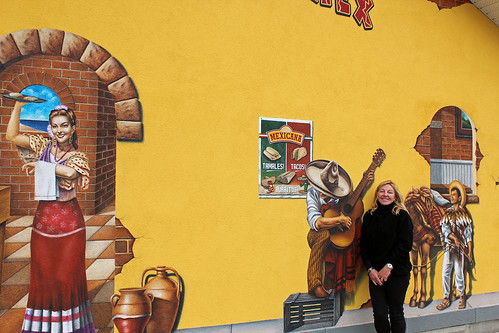
Shauna later summarized the reason behind the closure in a single sentence on Facebook: “The Gallery Art Bistro was killed by communism.” She now creates and sells her art and has permanently relocated to Mexico, citing overwhelming government overreach and violations of basic human rights in Canada. Stories like hers are a sobering reminder of how external circumstances can derail even the most carefully planned endeavors. I can only wish her luck.

The boat houses in Port Rowan

Courtland, Ontario

On my way back home, I took a number of side roads, as I always enjoy exploring small communities and stopping at various attractions. This time, I took Road 59 north, then turned right onto Road 38 (Talbot Street). After crossing the railway tracks, I parked just meters from the tracks at Courtland Collectables Antique Market, located at 1 North Street, Courtland (42°50'25.2"N 80°37'59.5"W / 42.840333, -80.633194).

Courtland Collectables Antique Market

Having always been interested in railroads, I quickly walked to the crossing and realized the tracks must have been recently abandoned, as no trains were using the line. While exploring, I ran into a gentleman with a dog and struck up a conversation. He turned out to be the owner of the Antique Market, which was for sale, and we spent almost an hour chatting about many things. He confirmed the rail line was no longer active and would soon be lifted. He also pointed to an empty piece of land across the tracks, explaining that buildings there had been demolished years ago. Google Street View photos from 2012 and 2013 even show the old buildings with silos.

We also shared stories about Cuba, a country we had both visited for vacation. It was fascinating to compare experiences of this unique destination.

Recently abandoned tracks and the Courtland Collectables Antique Market

Later, I examined a map and realized that I was quite familiar with the CNR Cayuga Spur. In 2016, Catherine and I had biked the Delhi Rail Trail, parking near Fertilizer Road where the trail commenced and riding east. Across Fertilizer Road, a Co-op Fertilizer Plant and the westbound train line from Delhi to Tillsonburg appeared to still be operating at the time, and those tracks were part of the Cayuga Spur, passing through Courtland. Perhaps once the remaining tracks are lifted, the right-of-way could become an extension of the Delhi Rail Trail, providing a new trail for walking, cycling, and other recreational activities. Such trails are excellent for outdoor enthusiasts and communities alike.

Fernlea Ivix Non-Profit Used Books

While driving along Highway 3 between Courtland and Delhi, I spotted a big sign: “Recent Used Books.” Like a magnet for book lovers, I couldn’t resist stopping.

Fernlea Ivix Non-Profit Used Books, located in an old motel

The full name of the store was Fernlea Ivix Non-Profit Used Books, located at 1269-1271 Highway 3, Norfolk (42°50'52.3"N 80°35'19.4"W / 42.847861, -80.588722), in a building that used to be a motel. I was absolutely impressed with this bookstore! Not only was the selection eclectic, but many books were rare gems, well organized, and easy to find. The entire establishment was exceptionally well-kept and uncluttered, and the personnel were pleasant and helpful.

Fernlea Ivix Non-Profit Used Books

The bookstore did not accept Readers Digest Condensed Books, textbooks, or encyclopedias, thus avoiding the accumulation of items often impossible to give away. I could have spent many hours browsing, but I deliberately limited my visit. I did, however, purchase one engrossing book: Lodz Ghetto: A Community History Told in Diaries, Journals, and Documents, edited by Alan Adelson and Robert Lapides.


It was an excellent book. While I had read extensively about the Warsaw Ghetto, this was the first time I encountered a comprehensive history of the Lodz Ghetto and its extremely controversial Jewish Council leader, Chaim Mordechaj Rumkowski. He is particularly remembered for his speech “Give Me Your Children,” delivered when the Germans demanded the deportation of 20,000 children to Chełmno extermination camp. In his September 4, 1942 speech, Rumkowski pleaded with the ghetto residents:

“A grievous blow has struck the ghetto. They [the Germans] are asking us to give up the best we possess – the children and the elderly. I was unworthy of having a child of my own, so I gave the best years of my life to children. I've lived and breathed with children. I never imagined I would be forced to deliver this sacrifice to the altar with my own hands. In my old age, I must stretch out my hands and beg: Brothers and sisters! Hand them over to me! Fathers and mothers: Give me your children!”

Fernlea Ivix Non-Profit Used Books. The bookstore is extremely well organized and it's very easy to find whatever you're looking for

I must also add that the bookstore was staffed by a team of volunteers, and its profits were used to assist schools in Haiti, particularly College Pratique and College Normalien in Fort Liberte. I greatly admire such efforts, though I also feel a sense of humility considering the extremely difficult conditions in Haiti, including violence, kidnappings, and lawlessness. Fort Liberte lies in the north of the country, relatively far from the capital where most violence occurs, so I hope the schools there have been relatively sheltered.

Reflections on the Trip

Even though I only spent four nights in the park, the trip was richly rewarding. I reconnected with familiar places, enjoyed quiet moments on the dunes, and met several interesting people along the way. The bike rides, beach walks, and campfires offered a simple yet profound sense of relaxation and connection to nature.

Canadian Goose

Exploring Port Rowan and hearing the story of Shauna Proctor reminded me of the delicate balance between passion, dedication, and circumstances beyond our control. Courtland’s abandoned rail line and the antique market revealed hidden histories waiting to be discovered. Fernlea Ivix Non-Profit Used Books offered a window into lives and struggles far from my own, connecting me to global stories in a personal, tangible way.

Poison Ivy is everywhere in the park

In the end, Long Point Provincial Park is more than a campsite; it is a place of quiet discovery, reflection, and unexpected encounters. Each visit offers something new—whether it’s the swarm of midges on a windless day, a rescued turtle on a bike ride, or the stories of the people and communities nearby. This trip reminded me that even familiar destinations hold surprises, and that traveling alone can be just as enriching, if not more so, than traveling with companions.

Courtland, Ontario. Another railway line is gone... 

As I packed up and prepared to leave, I felt a profound sense of gratitude—for the natural beauty of Lake Erie, for the small towns and their histories, and for the chance to slow down and truly observe the world around me. Long Point Provincial Park will always hold a special place in my heart, and I look forward to returning, ready to discover its next quiet wonder.

Ten blog jest dostępny również w języku polskim!

**********

NEW PERSONAL BLOG

On April 11, 2026, I launched a new blog: Autographs, Pins and Memories.

In this blog, I share my memories of Poland in the 1970s, as well as recollections from later years and from my life in Canada. I also write about my collection of autographs, photographs, pins and other objects connected with my life, including the stories behind them.

The blog is available in two language versions: English and Polish.

Wednesday, December 16, 2015

CAMPING IN LONG POINT PROVINCIAL PARK AND DRIVING/BIKE RIDING IN NEARBY AREAS, ONTARIO, MAY 18-23, 2015

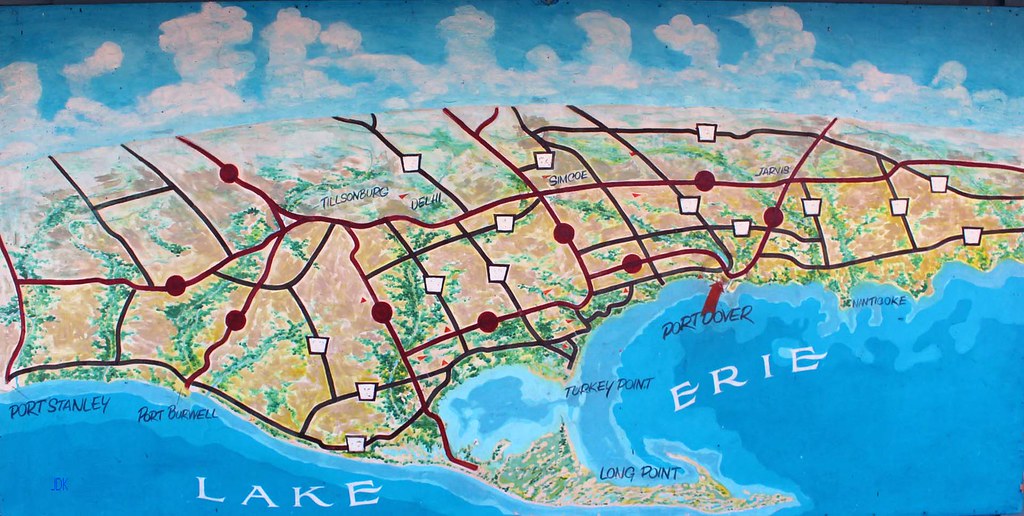
Long Point and area
In 2014 we paid a short visit to Long Point Provincial Park and decided to return the following year. Indeed, one year later, we were back, this time to spend a few days camping.
 
Poison Ivy
Although the park gets quite busy and crowded in the summer, the Victoria Day Monday on May 18, 2015 was perfect to start our vacation, as most campers were just heading home. After driving around the campgrounds and checking out campsites, we selected one in a sandy dune, somehow protected from the wind, very close to the lake. It was facing another campsite, yet during our stay nobody stayed there and we enjoyed plenty of privacy. The campsite was clean and there were abundant poison ivy plants growing around it, so we had to exercise extra caution while walking. The fire pit was conveniently located in the middle of the campsite; unfortunately, it was full of old ashes-I wished the park had removed them at the beginning of the camping season. The campsite was very close to the water tap and washroom; the latter was religiously cleaned every morning by park employees.
 
Our campsite in Long Point Provincial Park
It was sunny and cloudy during our stay as well as very windy. Fortunately, we did not see one drop of rain. Every morning we sat on the top of the sandy ridge, enjoying watching and listening to the waves; at night it was possible to see the lights on the other shore of Lake Erie, in the USA. From time to time a bulky lake freighter appeared on the horizon.


In the evenings it was getting quite cold and we cuddled together around the fire—the firewood sold by the park was excellent. Later we found out that the temperature dropped a few degrees below the freezing point at night. Catherine actually put on her down filled jacked and winter hat which seemed strange, considering it was hot and summer-like on the day we arrived. The wind, although a little annoying, provided two benefits: we could always hear the soothing sound of waves crashing onto the shore as well as we did not encounter even one mosquito or any other flying insect, which was just awesome! There were plenty of red-winged black birds, very inquisitive, often checking out our stuff that was on the table. We also saw a couple of ephemeral golden finches. Here and there we spotted a lone chipmunk, but none was interested in us (or our food). One night a raccoon came over to our campsite scattered some garbage hanging on the tree.
 
Long Point Bird Observatory
Since we brought bikes—as a matter of fact, I had just purchased a new mountain bike—a few times we went biking along the main street and side streets. We rode our bikes from the main camping area to the old campsite which was still closed for the season. We had read in the local paper that some officials were proposing that the city/county buy the property from Ontario Parks and use it as Day Use. Catherine got chatting with a park employee and mentioned this; the employee said, “that will never happen”. The Park just spent a lot of money to upgrade the facilities and convert 35 sites to electric.
 
Sandy dues and Lake Erie, just meters from our campsite
We also visited the Long Point Bird Observatory on Old Cut Boulevard, where we could watch bird banding and were able to observe many different birds up close. It was fascinating to sit a few feet away and watch the handlers weight, measure and observe the tiny birds they caught before banding and then releasing them into the wild.
 
Port Rowan
The nearby town, Port Rowan, had a few interesting stores, good thrift shop, old hardware store converted to antique shop, restaurants and an ice cream parlor as well an LCBO store and a dollar-type store which was packed to the hilt with any and everything. The information booth on main street had plenty of brochures on local attractions—as well as excellent bike trails in Norfolk County!
 
Map of the Lynn Valley Trail
Thus, almost every day we drove from the park and spent several hours biking on the Lynn Valley Trail (from Simcoe to Port Dover), Waterford Heritage Trail and Delhi Rail Trail—all of them were old rail line trails. The trails passed through forests, grasslands and farmers’ fields as well as over numerous bridges and often met up with other recreational trails. We absolutely enjoyed riding on them—there were very few other users and we did not have to worry about cars!
 
Many years ago it was a railway, now it is multi-use trail
We drove to the town of Delhi, known as the Heart of the Tobacco Country, where 100% of Canadian tobacco is grown. A lot of immigrants from different countries have settled in Delhi and thus it is a very multicultural city. We saw a Polish, German, Belgian and Hungarian halls/community centers; we were told there used to be a Portuguese and Italian center as well.
 
Polish Alliance of Canada in Delhi, Ontario
Later we visited Port Dover, which was teeming with tourists and motorcyclists—for many years it has hosted the famous “Friday the 13 Motorcycle Rally” and although it was not a Friday, we still saw a number of bikers everywhere.
 
Port Dover
On our way back home we stopped at the Nanticoke Generating Station, the largest coal-fired power plant in North America, able to provide up to 4,000 MW of power. As we approached it, we could see two tall chimneys, plenty of transmission lines... and almost nobody else around! Unbeknownst to us, the station had stopped operating in 2011 due to pollution concerns, yet the plant was still maintained for potential use with alternative fuels. We drove to the entrance and a lonely guard emerged from the security booth. We spent about 10 minutes chatting with her about the plant and its possible utilization in the foreseeable future. Since she had worked there for dozens of years, she was very knowledgeable as well as she had such a charming and unique personality that we were sure she could easily be an actress or at least work in public relations!
Nanticoke Generating Station on Lake Erie
Overall, we had an awesome time at this park, enjoyed biking very much and we are already planning a similar outing next year!


NEW PERSONAL BLOG

On April 11, 2026, I launched a new blog: Autographs, Pins and Memories.

In this blog, I share my memories of Poland in the 1970s, as well as recollections from later years and from my life in Canada. I also write about my collection of autographs, photographs, pins and other objects connected with my life, including the stories behind them.

The blog is available in two language versions: English and Polish.

Saturday, October 31, 2015

Port Burwell Provincial Park, Ontario, May, 2014

In May, 2013, we went canoeing & camping to Algonquin Park, hoping to relax, enjoy Ontario’s wilderness and serenity and especially take hundreds of photographs of ubiquitous moose wandering all over the park at that time. Well, we did not take one thing into account: black flies! There were huge swarms of those tiny insects which, along with mosquitoes, were incessantly attacking us. We were forced to cut our trip short and left the park after just two nights. Not wanting to have a similar experience, we decided to go south this time, to Port Burwell Provincial Park, where black flies are non-existent. Although the area is totally different from the northern shield country, we were looking forward to visiting this park.

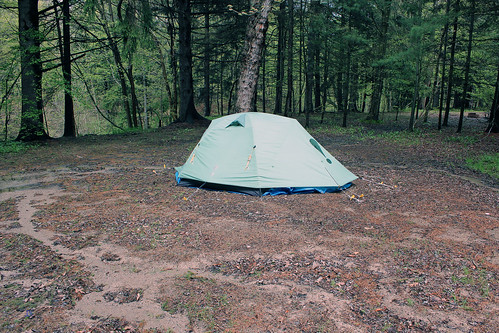
Our campsite

We left Toronto on May 19, 2014, on Victoria Day—the first long weekend of the season. After driving for an hour or so on Highway 401, we eventually took country roads and soon arrived at the town of Delhi (pronounced ‘dell high’), pulled into a pleasant town park next to the Tobacco Museum and parked across a small waterfall. Delhi has been known as the Heart of the Tobacco Country—it was here that basically 100% of Canadian tobacco is grown. Yet its production has declined over the past decades due to the dwindling of the number of smokers, thus leading to the weakening of the tobacco industry. Although there are still plenty of tobacco fields, we also saw a new, exotic crop—ginseng; it takes several years for it to mature and be harvested, but there is a great demand, especially from the Chinese community and its prices are very high.

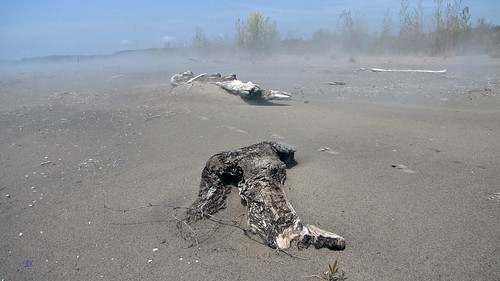
Lake Erie Beach at the park-misty and mysterious...
A lot of immigrants from different countries have settled in Delhi and thus it is a very multicultural city. We saw a Polish, German, Belgian and Hungarian halls/community centers; we were told there used to be a Portuguese and Italian center as well. When we stopped at a garage sale (Catherine’s de rigeur stops), the vendors were of Dutch origin. We noticed a black flag in front of the Polish Hall; later I found out it was due to the death of Bazyli Piekarski, who used to be the manager of the Polish Hall.

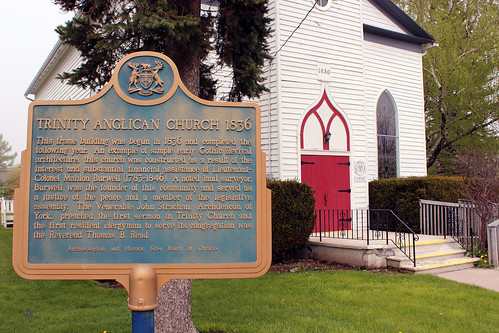
Trinity Anglican Church in Port Burwell

Our next stop was the town of Vienna. When Catherine had been doing her research, somehow she got the impression that the town resembled the capital of Austria (she was told this in a phone conversation by a park office employee). I did not want to put her right and instead told her that indeed, there was an impressive Opera building and even Bizet’s “Carmen” was on. Catherine got quite excited about attending this performance.

“Why did not you tell me that in Toronto?” she asked, “I’d have brought more formal clothes.”

Once we got to Vienna, I had a great laugh! It was a very small, farming community, with just a few dozen stores. Pointing to a bigger, barn-like dilapidated building, I asked her,

“Perhaps this is the opera house?”

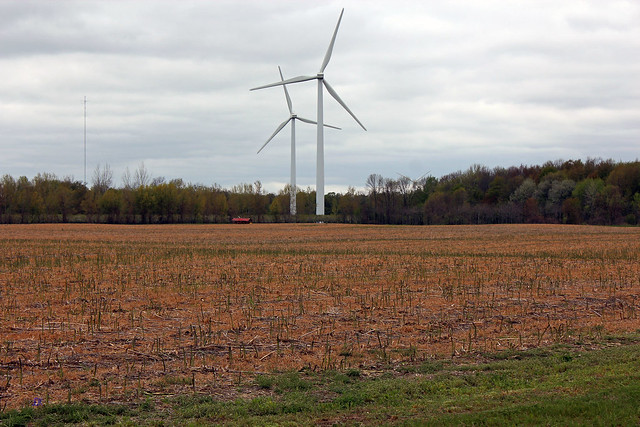
Plenty of wind turbines!

Yet there was another thing that might have put this town on the map: the Edison family once had lived there. Thomas Alva Edison’s father, Samuel Edison, had to escape to the United States after the Mackenzie Rebellion of 1837; otherwise Thomas Alva Edison might have been born in Canada! The young Thomas Edison spent many summers in Vienna with his grandfather. Interestingly, the original Edison homestead was moved to the USA by Henry Ford in the 1930s!

We also dropped in on a grocery store located at in intersection of two country roads. The store was doing a brisk business and it was also selling Mexican food and fabrics, mainly to the Mennonites living in the area. We were fairly surprised to see that they were using credit cards and driving all-wheel vehicles, not horse-drawn wagons!

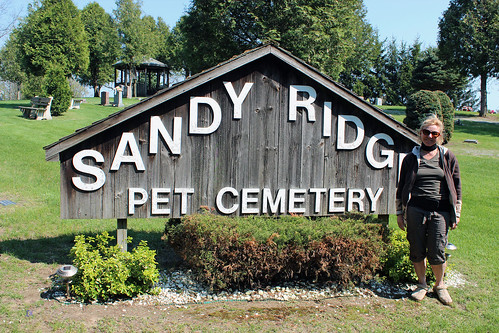
Pet Cemetery
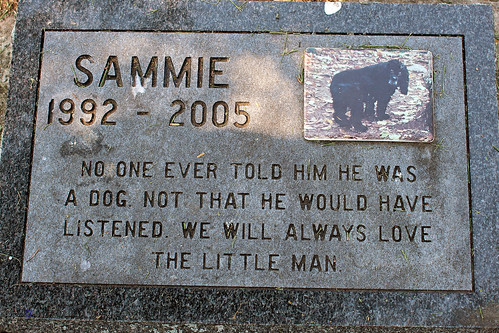
We also stopped at a unique cemetery for pets only (Sandy Ridge Pet Cemetery, south of Tillsonburg). There were plenty of nice headstones and tributes to the Rovers and Fidos of the world and a few fitting remembrances to the feline crowd. There were even inscriptions in Polish, Jewish, Russian, Chinese and other languages. While reading those poignant words, you could immediately feel that they were so genuine, flowing from the heart.

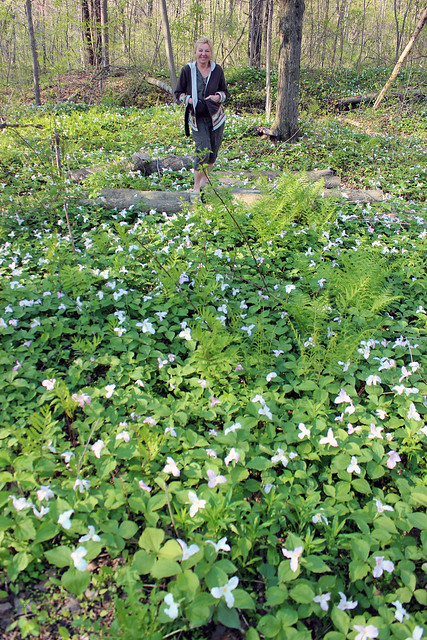
Upon arriving at Port Burwell Provincial Park, we went to the empty registration office. According to the posted information, we were supposed to pick a campsite and self-register. The park was virtually empty and we drove to campsite #118, covered with trillium flowers, but it backed on a factory nearby. So, we continued to search for the perfect non-reserveable site and finally found a very good site no. 36.


As I said before, the park was almost deserted (5 sites taken out of 356) and even though there were plenty of campsites around, we had been enjoying total privacy… until three college-age girls arrived and set up their tent at the adjacent campsite and proceeded to play nonstop talk radio on site even when they were off site! Honestly, sometimes I do not understand people…

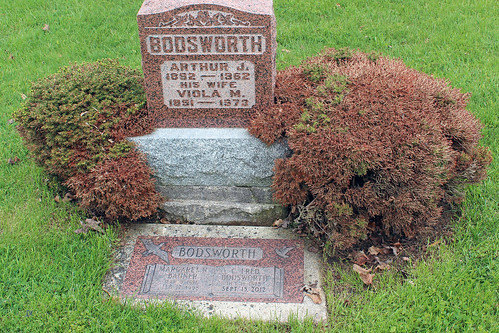
Fred Bodsworth's grave in Port Burwell

The town of Port Burwell had a very distinct lighthouse (one of Canada’s oldest), Trinity Anglican Church and a cemetery where many descendants of the town’s founder, Mahlon Burwell, were buried. While camping in Port Burwell in 2006, I had seen an announcement at the local library about Fred Bodsworth, a well-known author, journalist and naturalist who was born in Port Burwell in 1918 and who was going to visit his birthplace and sign his books. Although I was not going to be in Port Burwell at that time, I managed to buy one of his most famous books, “The Last of the Curlews” (with his autograph!). Fred Bodsworth passed away in 2012 and we visited his grave at the cemetery.

The Trinity Anglican Church was the gift of Colonel Mahlon Burwell. After John Strachan’s inaugural service at Trinity on May 22nd, 1836, the church was officially opened. Unfortunately, it was closed and we were unable see its interior.

In the nineteenth century Port Burwell was well-known for its shipbuilding; in additions, a number of fisheries operated from Port Burwell, albeit their success fluctuated, depending upon the fish stocks, which eventually declined and in 2014 only one fishing tug operated from Port Burwell—it was still possible to buy fresh fish directly from fishermen.


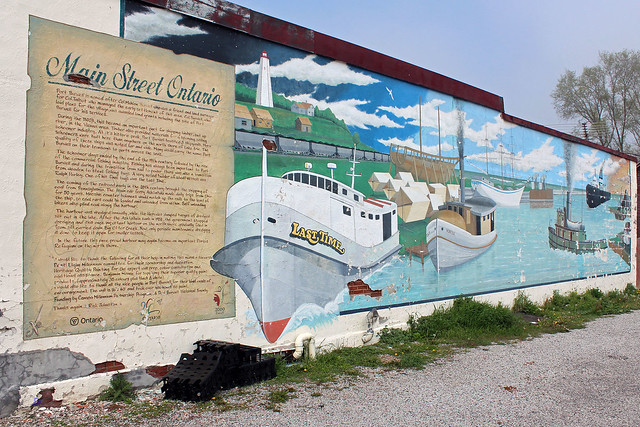
However, one of the most memorable industries in Port Burwell was coal shipping. From 1906 to 1950 a car ferry called The Ashtabula (the name is derived from ashtepihəle, which means 'always enough fish to be shared around' in the Lenape language), with built in track to transport railcars across the lake, made round trips from Ashtabula, Ohio to Port Burwell, shipping coal across Lake Erie to Canada and carrying newsprint and limestone from Canada to the United States. The coal was then transported by rail to such areas as Tillsonburg and Woodstock and often used in kilns to dry tobacco leaves. By 1955, the Ashtabula made 12,000 round trips, up to 250 trips per year in the postwar period. Eventually coal shipping stopped when diesel engines became popular. On September 18, 1958, the Ashtabula collided with the Ben Moreell, a bulk freighter, near its port in Ohio. Although there was no loss of live, her damage was so extensive that she was scrapped. At the time of the collision she was captained by Louis Sabo, who had spent 31 years, half of his life, on the Ashtabula. The preliminary inquiry by the Coast Guard accused Sabo of various infractions that led to the accident. The night before the full inquiry for disciplinary action was to be held, Capitan Sabo went to his garage, turned on his car and was found on the floor in the morning, asphyxiated. In addition, an insurance inspector, while examining the Ashtabula, fell through a hole to his death. Thus, two deaths were indirectly caused by the accident.

Mural in Port Burwell, depicting the port and the Ashtabula 

Today it is still possible to see rotted ties at the mouth of the Big Otter Creek, where the railway terminal used to be located. The rail tracks had been lifted long ago and a narrow path marks the old train route. About ten years ago I went to Port Stanley; there was a train operated by volunteers that took tourists to St. Thomas and back. One of the train’s engineers told me that he had driven the last train from Port Burwell.

We also went to the beach (on Lake Erie). Since it had rained previously, thick mist was enveloping the dunes and driftwood — the whole area resembled a scene from a horror movie! Catherine decided to go for a walk and soon vanished in the dense mist, only to re-appear after thirty minutes.

In front of a Mennonite store in Aylmer
The next day it was raining and we drove to the town of Aylmer, where we spent a few hours at a farmers’ market a.k.a. flea market, where we bought some vegetables and sausage. Quite a few of the vendors were Mennonites. Then we drove to a nearby Ontario Police College; every police officer in Ontario must spent 13 weeks training there. We received visitors’ passes and wandered around the building. There was a small police museum and a memorial dedicated to policemen killed in the line of duty—some of them I remembered as their shootings were on the cover pages of newspapers for many days. We also saw a lot of students—all were uniformed and even carried guns, albeit not real (as I suspected—I would not like to be a teacher arguing with armed students over their grades!). Outside there was a fake mall, firing range and driving training facilities. The college was erected on the grounds of the former Royal Canadian Air Force Station, constructed during the Second World War.

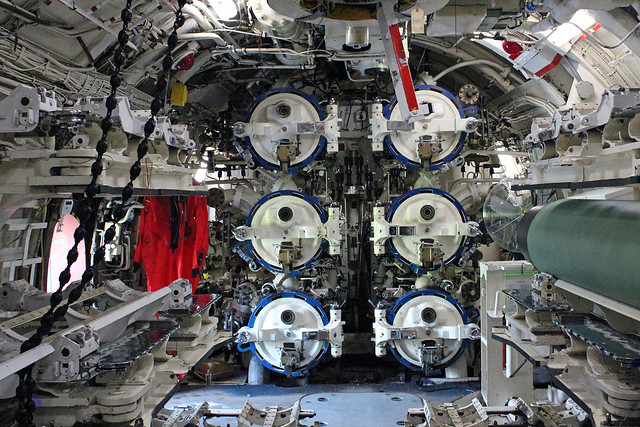
Torpedo room
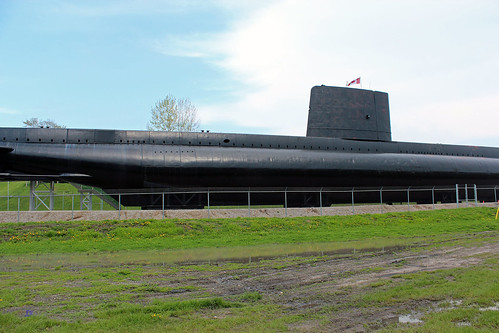
Yet the absolute highlight of this trip was a new attraction that awaited us in Port Burwell—namely, a real submarine! It was the HMSC Ojibwa, an Oberon-class submarine that served in the Royal Canadian Navy, mainly spying on the Warsaw Pact navy. After being decommissioned, in 2012 it arrived in Port Burwell and is open for visitors.

The Submarine in Port Burwell
We started in the forward torpedo room and our very knowledgeable guides told us a lot of fascinating details about torpedoes and the firing procedures. It was only possible to take photographs in that room. Then we proceeded to the Control Room, Engine Room, Motor Room and the Stern Torpedo Room. It was an absolutely captivating tour—finally I was able to personally see what I had only watched on TV! It was unbelievable how little privacy the crew had. There were six-foot bunks and there were more people on-board than regular bunks —after all, there was never time when everyone was asleep, so you slipped into any bunk that was unoccupied. Only the captain had a private stateroom—if you can call that a room, as it resembled a tiny cubbyhole-I am sure that inmates in Canadian penitentiary institutions enjoy bigger cells! The washrooms cubicles were so small that it was impossible to fit in without leaving the door open. Even though the submarine was decommissioned in 1998, the whole interior was permeated with the smell of diesel (which made Catherine feel nauseous). And then there was the motor room—according to the tour guide, the noise there was comparable to that of a jet taking off; those working there invariably suffered serious hearing loss. I could go on and on… the whole tour lasted just over 1 hour and cost just under $20, but other, more comprehensive tours are offered, which I would love to take in the future. In any case, I do not think I would be able to serve on a submarine, especially living there for months… I still prefer my canoe!

At Port Burwell Provincial Park--among Trillium grandiflorum, the
official flower of the Province of Ontario
We also drove along the shores of Lake Erie and arrived at Long Point—a very long peninsula, which is famous for bird migration and habitat—and checked out Long Point Provincial park. The open area, used mainly by RVs, was not very impressive, yet Catherine absolutely fell in love with much more cozy campsites close to the lake—they were sandy and much more secluded. Well, I know where we are going camping next May! Later we went to Turkey Point Provincial Park, with a long beach, albeit totally empty.

Overall, it was a very nice camping trip which allowed us to discover a new part of Ontario—and explore a real submarine! Although we still prefer the rugged Canadian Shield, we will certainly visit the shores of Lake Erie in the following years, especially in May or June.


More photos: https://www.flickr.com/photos/jack_1962/albums/72157660215430430

**********

NEW PERSONAL BLOG

On April 11, 2026, I launched a new blog: Autographs, Pins and Memories.

In this blog, I share my memories of Poland in the 1970s, as well as recollections from later years and from my life in Canada. I also write about my collection of autographs, photographs, pins and other objects connected with my life, including the stories behind them.

The blog is available in two language versions: English and Polish.