Blog in Polish/w języku polskim: http://ontario-nature-polish.blogspot.com/2020/08/varadero-kuba-dwa-tygodnie-w-hotelu-roc.html
More photos from this
trip: https://www.flickr.com/photos/jack_1962/albums/72157715579022731

I had never been too thrilled to go to Varadero, expecting to see almost 100 various hotels & resorts, sandy beaches—and nothing else. Fortunately, I was wrong! Granted, it is true that many hotels, located in the eastern part of Hicacos Peninsula (more-less east of Calle 64) might be much more luxurious, bigger and offer a much higher standard, yet they are ‘in the middle of nowhere’ and unless you take a taxi or a bus, there is not much else to see or explore. Yet the western part of Varadero resembles a small town. And our hotel, the Roc Barlovento, was located very close to the bridge over the Kawama navigation channel, at the very beginning of the Hicacos Peninsula. Thus, this turned out to be an EXCELLENT location, enabling us to make a number of strolls directly from the hotel. We often walked on Varadero’s main street (Avenida 1ra) for several kilometers and explored various restaurants, shops, parks, hotels, private homes and other landmarks—there was even a Canadian Consulate a stone’s throw from our hotel! We also walked along the channel in the evening, where plenty of Cubans were fishing, and saw Al Capone’s mansion, the Casa de Al (although it is almost certain that Al Capone had never been there). Yet the best walking excursions were to the town of Santa Marta, located just past the bridge.
 |
| Cubans fishing near the bridge connecting Varadero to the rest of Cuba |
It was our 14th trip to Cuba in 10 years (November 4-18, 2018). We picked the Hotel Roc Barlovento mainly because of numerous glowing reviews posted on TripAdvisor—and certainly we were not disappointed. Well, the manager was a German man—maybe that was one of the reasons it was quite well-run (although I know it would take much more than just one German manager to put things right in Cuba…).
 |
| We had our meals outdoor in the building on the left-and every morning participated in exercises in the building to the right |
The hotel is well designed in a Spanish style and quite cozy, no much walking is required to get around. Plenty of nice palm trees & gardens. And it is for adults only—no disruptive and screaming kids!
 |
| Morning yoga with Zahilys |
Approximately 60% of tourists were Canadians (English & French speaking), 30% Germans and some from Spain, Italy and other countries.
There were 3 pools; the very shallow one had no water. There was a Jacuzzi in the center of the pool closer to the beach, but it was not hot.
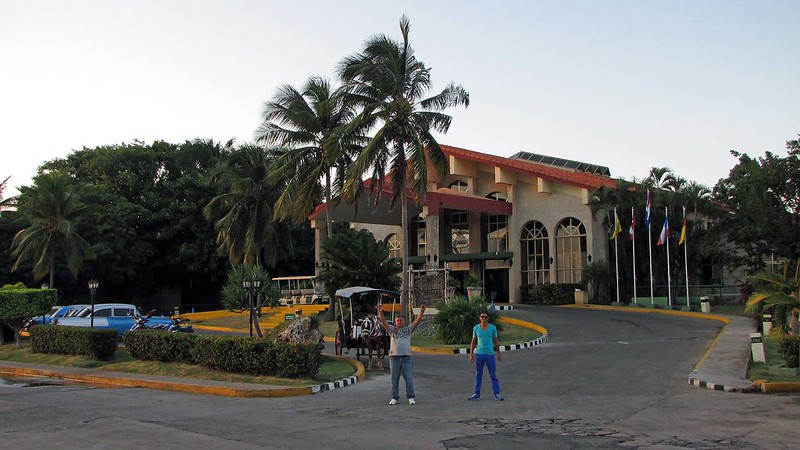 |
| Entrance to the Hotel Roc Barlovento |
There is a tienda (shop), with various beverages, rums, vodkas, souvenirs, shampoos, shirts, hats, toiletries, etc. Another stand near the lobby sells books, postcards and stamps—the mail box is at the lobby. On a couple of occasions I saw an artist painting and selling his works.
The exchange rate at the hotel was very poor—just 68 CUC for $100 CAN, whereas the bank offered about 73.50 CUC. Not fair!
 |
| The Beach at the Roc Barlovento Hotel |
A number of very friendly (and chubby) cats roamed the property, especially the outdoor dining area during meal service—and they even had their own ‘cat café’. Unsurprisingly, they were picky eaters!
At 10 am there was half hour yoga/stretching on the stage of the entertainment area, conducted by Zahilys, a very friendly & outgoing woman, who worked at animation and conducted other activities as well. Bring our own towel! Yet there were not too many guests interested in doing the exercises, and quite often we were the only participants.
 |
| Roc Barlovento-our room number 333 |
There was a gym, but we never used it, preferring our morning workouts and swimming in the ocean.
Towels can be obtained from ‘the clubhouse’ near the main square. The club house also has a small library of books in English, French and German. We donated 4 of our books.
 |
| We ALWAYS had our breakfast, lunch and dinner outdoors, never inside--that was one of the most important advantages of this hotel. |
Every evening there is entertainment, but the only one we attended was the aquatic show (Thursdays) and it was impressive! The Elvis Show sounded great from our room on Saturdays.
Scuba diving excursions/lessons are available, there is an information stand set up every day in the main square.
 |
| Catherine enjoying her very healthy breakfast-of course, oudoors! |
Various tours are offered in the lobby area. At the end of our stay there was information about a very cheap bus to Havana—I think it was 40 CUC both ways, or 25 CUC one way per person.
We had sent an email to the hotel two weeks before arrival, asking for a quiet room on the top floor and indeed, our request was granted—we got room number 333. From our window we could see part of the tennis court—otherwise there was plenty of foliage that made the view quite pleasant. We could hear the traffic from the main street and occasionally caught a whiff of oil/petrol—about 1 km from our hotel, in Santa Marta, we saw two oil derricks.
 |
| View from our room #333 |
The balcony was very small, but it was possible to sit there and enjoy the sun. There was a small bathtub—later the maid brought a plug. The room was quite contemporary, with 2 double beds, HD TV with about 25 channels. There was the CNN channel (devoting 95%+ of its air time to Trump—boring—another 4% to US affairs and only 1% to international news—worse than TV programs in the Soviet Union!) and a Canadian channel (CTV) in English, albeit from Montreal. We had to pay for the safe (2 CUC per day, 28 CUC for 2 weeks). We always had hot and cold water, the air conditioner worked perfectly and it was easy to remotely change the air flow or temperature. The small fridge was really cold and the hair dryer worked. We had some minor problems on 3 occasions (with the safe and falling curtains rod)—within 10 minutes of reporting them a technician came and fixed them. On a few occasions our magnetic cards stopped working and we had to go to the lobby to have them re-programmed. The maid, Norian, was great, always keeping our room spotlessly clean and creative.
 |
| Casa de Al-supposedly, Al Capone used to live here, but according to my research, it is very doubtful that he even visited Varadero |
The beach was large, with white sand. Lots of palapas and chairs, so there was no need to ‘reserve’ them in the morning, some were always available. We could also observe nice sunsets. The water was quite shallow for about 30 meters. At the end of our stay it became windy, the waves got quite big and there was a yellow-and then red flag (no swimming). Once an unexpectedly big wave swept the first row of palapas, catching many relaxing vacationers (and their belongings) by surprise. I saw some people snorkel, but there was nothing to see—just some small fish. Kayaks, pedal watercraft and sail boats were available for hotel guests. Beach assistants was great, he quickly brought us loungers.
 |
| The 'famous' Polish Fiat 126p is still relatively popular in Cuba. Apparently, it's not a very good car... |
Another reason that we picked the hotel was the outdoor dining, which surprisingly was hardly used. Not even once did we dine inside! The food was slightly repetitive, but varied and good—often even delicious. For breakfast I always had eggs & bacon—the egg station cooks were very efficient and quick—as well as plenty of fruits, juice and yogurt. Usually we skipped lunch, but when we had it (twice), it was excellent—in addition to the regular fare inside the restaurant, there was a big grill outside, serving delicious steaks, hamburgers, hot dogs and other grilled food. At dinner I always went to the cooking station offering sumptuous grilled pork and beef as well as several kinds of fish, shrimps, calamari, squids and mussels. Another cooking station served spaghetti and pizza. There were also scrumptious stews, chicken, prosciutto, cheese and salads. I did not see any tomatoes, however, which I like very much. I never had to line up for more than a few minutes at the cooking stations and the food was plentiful. Our servers were Leonardo & Janet (breakfast) and Raul (dinner). They always brought us plenty of coffee, juice, wine or beer to our outdoors dining table. There was a snack bar near the beach, serving basic food—hamburgers (very good), hot dogs, ham & cheese sandwiches, fruits and lettuce. Next to it was a bar serving cold beer and drinks and most of the time it was manned by the always smiling Pedro. There were also bathrooms in the back of the bar.
 |
| Sunday Farmers' Market in Santa Marta. Pork costs 25 CUC per lb, or one US dollar |
The small Bar El Traguis near the wooden ramp to the beach was nice, but the seating area was limited and the beer cost 1 CUC. Mixed drinks were free.
 |
| Sunday Farmers' Market in Santa Marta |
The lobby bar was OK, but there were frequently buses or taxis pulling up, so it was noisy and smelled of exhaust fumes. It was almost always crowded. In the evening there was often live music—I loved the violin & guitar players, they were fantastic (they played only on Mondays and Tuesdays, from 7 to 9 pm). The bar in the square (adjacent to the Mexican Restaurant) was great, lots of tables & chairs and never any lineups—we often spent some time there on our way from the beach. We never had an a ’la carte dinner. Once we wanted to go to the sushi bar, yet we were told that it did not server any sushi anyway and it opened at 11:00 pm.
 |
| Catherine in a Cuban store with cigars and alcoholic beverages |
The gardeners often bring coconuts to a stand between the beach and lunch area and can cut them for you.
Out of the 15 days, 12 or 13 were quite sunny and it was hot (over +30 C). It rained a few times, but it was still very warm & humid and it was not a big deal. Since we often kept the room’s balcony door open, we did see several mosquitos in our room, but otherwise I did not encounter any insects anywhere else.
 |
| The famous Beatles bar in Varadero |
We often walked from our hotel to the town of Santa Marta—it took us about 2 minutes to walk to the bridge, we crossed it, turned left and a few minutes later we were walking along the town’s streets. It is a very nice town, with plenty of restaurants, cafes and casas particulares. Most restaurant offer very varied menu at reasonable prices. Some parts of this town have impressive homes. Following a very valuable recommendation of TripAdvisor’s poster, SWNova, on Sunday morning we went to the Farmers’ Market—what a fascinating experience! There were plenty of fruits and vegetables sold by farmers, all prices were in CUPs (i.e., Moneda National, 25 CUP = 1 CUC = $1 US) and were very cheap. I bought beer served in small cups, for about 6 CUPs per cup, it was quite good and very different from that sold commercially. We also purchased some delicious food from a street vendor.
 |
| Very attractive Casa Particular in Santa Marta |
There were plenty of casas particulares and we visited one of them. The owner spoke English, he had even visited Canada (upon invitation of some tourists whom he had befriended) and told us a lot of interesting stories about this town. Certainly, it was quite well-off, as many of its residents had worked at hotels in Varadero.
 |
| Cubans fishing under the bridge in Varadero |
We also went to a private coffee shop a few times and had very good coffee and pastry. It was a new venture, all the equipment was brand new and ‘made in Italy’.
In the evening we often took a stroll along the canal—usually there were groups of Cubans fishing. We also walked on Avenida 1ra, even to the famous The Beatles Bar, visiting some restaurants, cafes and tiendas along the way. Once we went to the bank to exchange money, there were over 10 tourists inside and we had to wait for almost one hour—passport was also required to complete the transaction.
 |
| The easternmost tip of Varadero-what a luxury! |
We tried to walk as much as possible, but when we were tired, there were always plenty of taxis, coco taxis and horse-drawn carriages, offering rides. Beware: once a horse-drawn carriage driver quoted us the price of 5 CUC—but later said it was… per person!
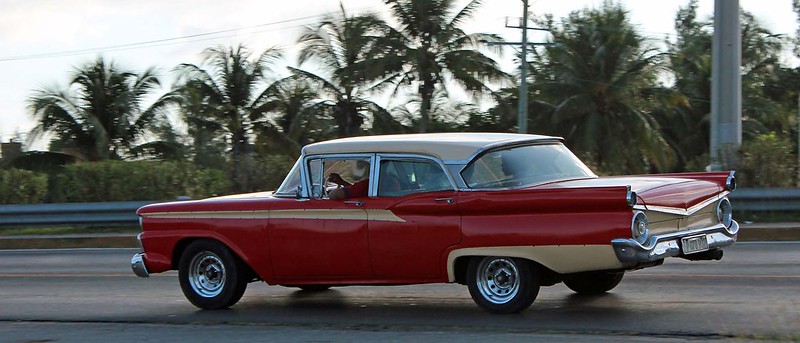 |
| Pre-revolutionary, antique cars are a common sight in Cuba |
Twice we took advantage of the hop-on-hop-off bus. It had its last stop just a minute away from the hotel (near the La Sangria Restaurant), it ran every 20 minutes (less frequently in the evening), cost 5 CUC per person and took us to the very end of the Hicacos Peninsula.
 |
| Matanzas, Cuba--Libertad Square |
There were trips to Havana offered from the hotel, but since we had spent a week exploring this beautiful city 10 years ago, we decided to just visit the city of Matanzas, which is approximately between Havana and Varadero. We managed to find a nice taxi for 30 CUC and it dropped us off at Libertad Square. Catherine went to the Pharmaceutical Museum and I explored a government building (a City Hall?); initially the staff did not want to let me in, but I explained that all I wanted to do was take a look at the photographs on the walls. They depicted Fidel Castro’s visit to this town. There was a de rigueur statue of Jose Marti in the center of the square.
 |
| Matanzas-Teatro Velasco |
Then we went to a restaurant at the Hotel El Velasco, adjacent to the Teatro Velasco and afterwards walked on Calle Milanes toward the sea. Plenty of people congregated near the Catedral de San Carlos Boromeo. Eventually we reached the Teatro Sauto, which was apparently being renovated. There were old streetcar tracks in front of the theatre. The theater opened in 1863 and it has been a symbol of the city. Such famous performers as French actress Sarah Bernhardt, Russian dancer Anna Pavlova, Italian opera singer Enrico Caruso, and Spanish guitarist Andrés Segovia.
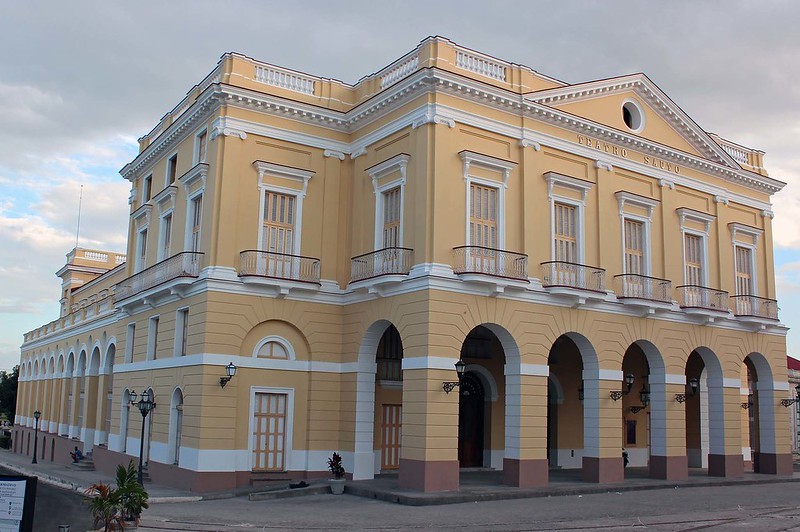 |
| Teatro Sauto |
There was also the Museo de los Bomberos (Firefighters Museum) near the theatre, but we did not go there. We spent some time at the Cafe and Cremeria Atenas, vis-à-vis the theater and had a few drinks which were quite reasonably priced. By the way, it was very hot and humid and I had 9 cans of beer during the whole day! We sat outside and had a great view of the theatre and the city life. There were two bridges over the Rio San Juan nearby.
 |
| Teatro Sauto, Palace of Justice and other historical buildings. |
We walked around the theatre, hoping that perhaps we could peek inside (no luck, though) and proceeded on Calle 272, more-less along the coast. There were some railways tracks along the shore and in the middle of the streets—I was sure they had been abandoned long ago, they looked old and rather broken, yet we were told that trains still ran on them! If this is indeed so, it a miracle! Just past Calle 270 there was a Cuban eatery on a small ‘peninsula’, all prices were in CUPs. We ordered a box of fried shrimps—as far as I remember, 10 of them cost about 30 CUPs and they were delicious! I think we were in the Haitian part of Matanzas and on a couple of occasions saw Cubans with rather peculiar facial features—perhaps they were of Haitian origin.
 |
| Matanzas. Probably this is the 'Haitian' part of the city |
In the evening we walked along Calle 97, along the Rio San Juan and stopped at the Lolo Galeria-Taller. It was amazing! There were a myriad of works of art—sculptures, paintings, statures, ceramics—by various artists.
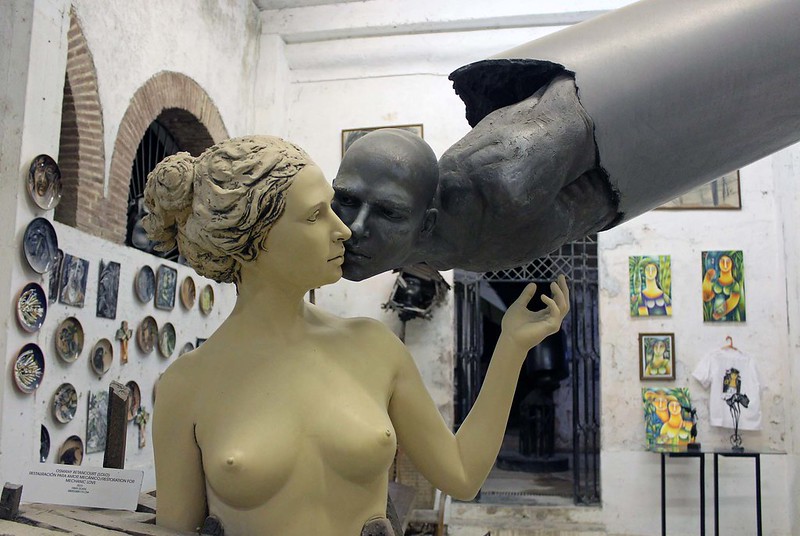 |
| Galleria Taller |
Some works were kind of scary, yet very creative. I liked many paintings and would not hesitate to hang them in my home or office. Unfortunately, the prices (at least the sticker prices) were quite high; I hope it would be possible to negotiate them with the artists.
 |
| Galleria Taller |
Eventually we ended up near the Cathedral again, there was some kind of celebrations and a group of people, dressed in fancy outfits, proceeded to the main square. We also visited a chess club, named after a famous Cuban chess prodigy, José Raúl Capablanca y Graupera (1888 – 1942), who was world chess champion from 1921 to 1927.
 |
| Chess club, named after a famous Cuban chess prodigy, José Raúl Capablanca y Graupera |
It was getting late and we were trying to catch a taxi (or any other mode of transportation) to take us back to the hotel. While looking for one, a Cuban man started talking to us and sensing what we were trying to do, immediately offered his assistance to us, probably expecting some profit (not that we really wanted his services). We walked with him for a while and eventually saw a private taxi; after a brief discussion, we negotiated a price of 25 CUC (we could see that the driver was not very thrilled about it) and also gave a few CUCs to our intermediary.
 |
| Matanzas' streets at night |
It was a very old car, the only things that appeared to work was the engine and the head & tail lights. As we were sitting in total darkness, we could not even conduct a conversation because of the noise and the interior of the car reeked of gasoline fumes, which must have been seeping through numerous cracks. Before entering Varadero, there was a police checkpoint and the police stopped the car—the driver got out of the car and the policeman officially clicked his heels and saluted, probably accentuating that it was an official police business. They talked for a while and then the driver was let go. I asked him if the cop wanted a bribe, but he said he did not. In any case, we got back to the hotel and gave him 30 CUC. By the way, if we were staying in a hotel farther up the peninsula, I am sure the price would be significantly higher, as it would take extra time to get there—as I said before, our location had plenty of advantages!
 |
| An old man at Libertad Square |
For many years I had been very reluctant to go to Varadero, thinking that I would be surrounded by only other resorts and hotels. It was not so—the location of the Roc Barlovento allowed us to explore many nearby areas and we never felt we were in a tourist enclave. We absolutely loved the hotel & its pleasant staff and had a wonderful time there. On the last day of our vacation, while on the bus to the airport, we spoke to many tourists about their vacation. Remarkably, we got an impression that we had a much better time at the Roc Barlovento than most of them in their often more superior hotels.
P.S.--December 22, 2021
After the Varadero Trip, we went to Cuba again, our 15th time, to the Carisol los Corales Resort in January, 2020 (see my blog). The day we arrived back in Toronto, January 22, 2020, the first COVID-19-infected "patient zero" also arrived in Toronto from China... We were, however, optimistic and remained quite confident that we would visit the Roc Barlovento in November, 2020; of course, it was impossible. We could not go in November, 2021, either. Then we hoped to go to Cuba in January, 2022, but now we're glad we did not book the trip due to the Omicron variant wrecking havoc everywhere. Our next potential trip to Cuba-most likely to the Roc Barlovento--would be in November, 2022. But at this point, we don't want to make any plans, as the situation keeps changing so much so quickly.
 |
| Bye, bye, Varadero-see you soon! |
Blog in Polish/w języku polskim: http://ontario-nature-polish.blogspot.com/2020/08/varadero-kuba-dwa-tygodnie-w-hotelu-roc.html
More photos from this trip: https://www.flickr.com/photos/jack_1962/albums/72157715579022731
NEW PERSONAL BLOG
On April 11, 2026, I launched a new blog: Autographs, Pins and Memories.
In this blog, I share my memories of Poland in the 1970s, as well as recollections from later years and from my life in Canada. I also write about my collection of autographs, photographs, pins and other objects connected with my life, including the stories behind them.
The blog is available in two language versions: English and Polish.