Friday, August 21, 2020

MICHIGAN, INDIANA AND ILLINOIS, USA: CAMPING & BIKING IN INDIANA DUNES NATIONAL PARK, WARREN DUNES STATE PARK AND VISITING CHICAGO, MAY/JUNE, 2019

Blog in Polish/w języku polskim: http://ontario-nature-polish.blogspot.com/2020/08/michigan-indiana-and-illinois-usa.html 

More photos from this trip: https://www.flickr.com/photos/jack_1962/albums/72157715578116311  and  https://www.flickr.com/photos/jack_1962/albums/72157715579544908


Indiana Dunes National Park-our campsite 45D

Traditionally, the month of May in Ontario signifies the beginning of the camping season and many parks open on Victoria Day. In the recent years had I spent a week camping in Long Point Provincial Park, on Lake Erie—there had been no bugs and even though it had snowed on one occasion and the temperature at night had been several degrees below the freezing point, we had still enjoyed our stays: we had cuddled in front of campfires and then jumped into the tents, bundling up in 4 sleeping bags, which had kept us very warm. 

Warren Dunes State Park-our "Oak Cabin"

Although I had reserved a campsite in Long Point Provincial Park for May, Catherine, who lived in Minnesota, was unwilling to drive to meet me at the park—and I would be unwilling to drive to her place either (about 1,600 km one way). Thus, we decided to compromise and meet halfway—literally! Namely, there was Indiana Dunes National Park located just at the south shores of Lake Michigan. This newest National Park, created in 2019, was located exactly halfway between our cities, so each of us could get there by car in one day. Even though I am not keen on driving—especially alone, on highways/freeways, as I find it extremely boring—I was looking forward to going to that park and relaxing for a week and did not really mind spending about 10 hours behind the wheel. 

Some campsites in Warren Dunes State Park turned into pools of water after rain. We were so glad that we decided to stay in the cabin!

I left Mississauga in the morning of May 28, 2019 and headed towards Sarnia, Ontario. The traffic was very light even as I was approaching the border, but then it slowed down as there were plenty of cars and trucks trying to get to the USA, I spent at least 40 minutes just on the bridge. The US Customs officer asked me a couple of questions regarding the purpose of my visit to the U.S., about my occupation and the content of the cooler (which contained only plastic bottles with frozen water). Probably disappointed that he did not find anything suspicious, he let me into the United States of America. I stopped at the Visitor Centre just a few kilometers from Sarnia, picked up a few brochures and got back on highway 69. After several hours I turned into highway 94, stopping only once in Michigan in a city called “Paw Paw”, named for the pawpaw trees which once grew along the Paw Paw River. I went to McDonald’s for a quick bit, bought gas and my next stop was Warren Dunes Park in Michigan. 

Biking around Beverly Shores

Several days ago, as we were planning our trip, we made some changes in our initial itinerary. Because the forecast had called for two days of rain, we had decided to seek roofed accommodation for the couple of days. Fortunately, Warren Dunes State Park had three cabins—and we booked one, called “Oaks”, number 51—it cost $104 for 2 nights plus the reservation fee of $8.00. When I arrived at the park, nobody was at the office and the park phone did not work, but the lady at the park store told me that the warden had just been there—and indeed, I saw him driving by. I bought the park sticker (“Recreation Passport” for non-residents, $33 for the whole year) and was given the key code for entry to the cabin. 

I got a phone call from Catherine, who was still in the Chicago area, stuck in traffic (I was lucky that I did not have to drive through any major city) and she arrived quite late, at about 8:00 pm, very tired and sleepy. 
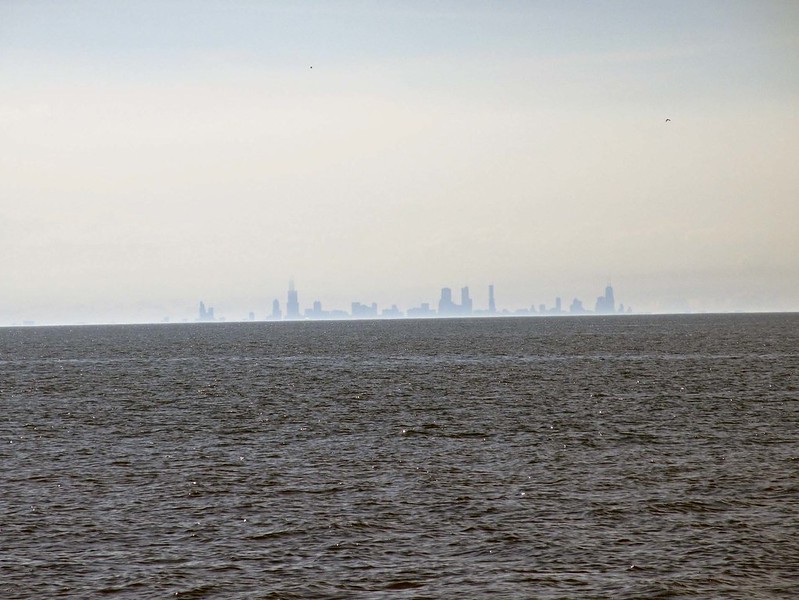
Chicago, Illinois, as seen from Indiana Dunes National Park

The cabin was simple, yet nice—it had bunk-beds for up to 6 people, a heater and a bench. Outside was a fire pit and a porch. Yet the most important and welcoming part of the cabin was certainly the roof—at night we heard thunders and saw plenty of lighting, it was pouring cats and dogs! When we got up in the morning we were shocked to see that many campsites (including several adjacent to the cabin) were completely flooded—and I mean totally—it would be impossible to find any dry space! Even for RVs staying on such campsites it would be a problem, but I just can’t imagine campers with tents, they would be literally drowning in all the water and would have to relocate in the middle of the night to other campsites! I think the park should do something about this by filling the hollow campsites with sand—and in the meantime close some campsites off, at least for tenting. It rained again the second night, so we were once again congratulating ourselves on booking the cabin.

There were not many people in the park, so we could enjoy solitude. There was an alcohol ban in effect at the Park from March 1 to September 30—it was a little inconvenient, but perhaps it makes it more family-oriented. The park store sold wood for $6 per bundle. On several occasions we saw deer and raccoons wandering in the park. 

Warren Dunes State Park

The next day we went for a stroll along the dunes and met a very interesting gentleman with whom I engaged in an interesting conversation for the next 20 minutes—it seemed that our views were similar on many subjects. 

Of course, Catherine had to visit a Goodwill store in Benton Harbor and, among other bargains, she got this horse for her granddaughter, over which she had to fight with another customer!

We also decided to go to the nearby town, Benton Harbor, to do some shopping. The Orchards Mall, adjacent to highway 94, had plenty of stores and we went to Walmart, Aldi and Goodwill. Instead of taking the highway back to the park, we drove around this town, crossed the St. Joseph River and entered St. Joseph. Well, we immediately noticed that there was a big difference between those two adjacent cities, separated only by a river. Once I had access to the Internet, I did some more research and this is what I found (https://datausa.io):


Benton            St. Joseph

Harbor


Population            9,944               8,301

Median household     

income                 $20,157           $55,975

Poverty rate          48%                 10.2%

Median property

value                    $56,200           $166,300


The racial makeup                              


Black or African

American              84.8%              4.55%

White                   8.55%              87.4%

Hispanic or Latino  4.15%              2.8%

Asian                    0.8%                3.59%


According to www.bestplaces.net, the crime comparison between the two cities is as follows [crime is ranked on a scale of 1 (low crime) to 100 (high crime)]:


       Benton       St. Joseph   USA

                       Harbor


Violent Crime    95.2            15                22.7

Property Crime  68.7            31.2             35.4               


Last, but not least, I found a news item on News Talk 94.9 WSJM (www.wsjm.com) dated October 4, 2018 titled “FBI: Benton Harbor Is State’s Most Violent City Per Capita. It says, “Benton Harbor is ranked as the state’s most violent city for 2017… The violent crime rate in Benton Harbor is 22 crimes per 1,000 residents, ahead of Detroit’s rate of 20. The city had three murders, 23 rapes, 36 robberies and 156 cases of aggravated assault last year, with a population of 9,899 people.” 

In any case, we did not experience any problems in either city and safely drove back to our campsite in the park! 

Two days later we packed up and drove to Indiana Dunes National Park. This time we forwent the highway and drove on other roads, passing through a number of small towns. 

We wanted to bike on the Calumet Trail, but after the recent rains it was unusable

When we arrived at the Park, we spoke to the host—a very nice gentleman from Texas, who was staying in the park in his camper and also volunteering in the office. We chatted with him for a while and then drove on the park’s roads, checking out campsites—we picked number 45D, in the Douglas Loop, which was nice and close to the bathrooms. There were not too many people in the park, but more and more arrived over the weekend. 

Indiana Dunes National Park not long ago had been known as the Indiana Dunes National Lakeshore, until it was designated the newest (61st) national park in the United States on February 15, 2019. The park runs for nearly 40 km along the southern shore of Lake Michigan; it contains approximately 15,000 acres. Located in the park are sand dune, wetland, prairie, river, and forest ecosystems. 

Beverly Shores-"Florida Tropical" (Century of Progress)

We spent some time in the impressive Visitor Center (located several kilometers from the campground) where we could learn about the park’s history and pick up plenty of very interesting and informative brochures and maps. Since there was a bike trail nearby (Calumet Trail), both of us had brought our bikes. Unfortunately, we were told that because of the very wet spring, the trail was almost unusable. Indeed, there were huge puddles and pools of water on the trail and only hard-core mountain bikers would probably be still willing to ride on it and test their skills. 

A few hundred meters from our campsite, almost in the park, was St. Ann of the Dunes Roman Catholic Church. It was built in 1954 and since then has undergone major renovations. On Saturday we went to the evening mass—I was glad that in spite of the short distance we drove, as it was raining when we emerged from the church after mass. 

Over the next few days we spent several hours biking. First of all, we rode to a very nice town of Beverly Shores. Again, some statistics: It had a population of just over 613 and the racial makeup of the town was 96.6 white, median household income of $89,375, poverty rate of 3.75% and median property value of $456,900; its violent crime was 11.8 and property crime 24.3 [crime is ranked on a scale of 1 (low crime) to 100 (high crime)]. It started as a planned resort community. Robert Bartlett purchased hundreds of previously plotted home sites in 1933. He named the entire development after his daughter Beverly. Later he purchased and relocated sixteen structures from Chicago's 1933-34 Century of Progress World's Fair, four of which were transported by barges on Lake Michigan. A resurgence of development took place during the 1990s and 2000s, when many million-dollar-plus houses were built on the dunes near the lakefront. Since it is easily accessible from Chicago, Beverly Shores s a second home to many Chicagoans. 

Swamps and wetlands near Beverly Shores

We loved biking to this town and then riding on its streets! Of course, we went to the Century of Progress Architectural District to see five buildings from the Homes of Tomorrow Exhibition, part of the 1933-34 Chicago Century of Progress Expositions. The homes were very innovative; modern technology, new materials and building methods were used in their construction. 

The town is located on the shores of Lake Michigan and is almost surrounded by wetlands and marshes and we loved riding on Beverly Drive, especially on its part west of South Broadway. Some of the side roads led to… nowhere and eventually Beverly Drive was closed off to traffic—but not to bikes! So we rode on the still asphalted road, albeit sometimes flooded and overgrown, among swamps, ponds and forests. We took another disused road and finally ended up at the crossing of the Calumet Trail and E State Park Boundary Road. Later we were told that some of the properties had been demolished so that nature could again take over and thrive—thus the semi-abandoned roads and streets leading to nowhere! On a satellite map, it is still possible to see outlines of old roads and properties, but they have been successfully absorbed by wilderness. 

Beverly Shores Train Station, several hundreds meters from our campsite

We also drove to the town of Chesterton, parked the van and biked on the Prairie Duneland Trail. The trail followed a straight branch of the former Elgin, Joliet and Eastern Railway. It was an easy, paved trail. We stopped at Tate’s Place, a small restaurant with outdoor patio and had a couple of drinks. The trail ended at County Trail Road in Hobart, or rather became a new trail, the Oak Savannah Trail, on which we rode for a while and then turned back. 

Train station in Beverly Shores was operating on a self-serve basis--100%!

One evening, when it was raining and we could not have a campfire, we drove to Michigan City, which was just a few kilometers from the park. I knew that many residents were of Polish origin, so no surprisingly, there was a Polish restaurant, called “Polish Peasant” (“Polski Chłop”), where we had our supper. It was a small and cozy place. We got some traditional Polish food which was very good, but the soup of the day (plum soup) I had was disappointing (I do not thing it was really THAT popular in Poland) and was hoping to have a more genuine Polish soup, like white borscht (“bialy barszcz” a.k.a. “żurek”), chicken noodle soup (“rosoł”), tripe (“flaki”), red beetroot soup (“barszcz czerwony”) or mushroom soup (“zupa grzybowa”). Perhaps the owner or his descendants come from a region of Poland where that particular soup was popular. 

Restaurant "The Polish Peasant" (Polski Chłop) in Michigan City

Just past the church there was a Beverly Shore train station, served by South Shore Line trains. It was built in 1925 in the “Insull Spanish” architecture style used for stations along the electric railroad lines. There is a large neon sign “Beverly Shores”. South Shore Line operates about 20 passenger trains daily, most running from Chicago’s Millennium Station to Michigan City or South Bend Airport. Because Catherine had never visited Chicago—and my visit had never included Chicago’s downtown—we decided to take advantage of this opportunity and go to Chicago for one day. 

South Shore Line was the most convenient and inexpensive way to get to Chicago from Indiana Dunes National Park!

The one-way fare from Beverly Shores to Millennium Station was $10 (half for seniors) and it could be purchased at the station, from a vending machine (what we did), or on the train. Since trains only stop at this particular station if passengers request so, we had to push a button to activate strobe light. Similarly, we had to notify the conductor to disembark the train on our way back. While waiting for the train, we talked to a woman who had come biking with a group, but decided to return home, along with her bike, by train—there was a special car designed to transport bikes. The train arrived on time—unfortunately, the conductor informed her that she was not allowed to bring the bike at this station (it was possible do to so at the next station) due to the station’s platform design and safety regulations. Since it was Sunday, the next train was scheduled in 2 hours or so—well, at least she had plenty of time to get to the next station… There were not too many passengers on the train and we got window seats. Soon the conductor showed up to check our tickets. When I looked at his badge, I immediately noticed his surname. 
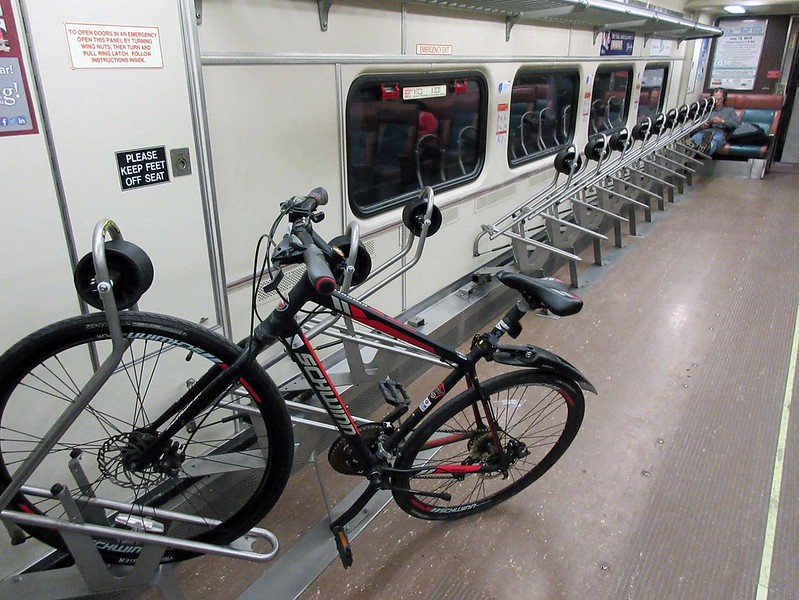
It was also possible to get the bike on the train

            “A very original name, Przybyłowski”, I said, surprising him with the correct pronunciation of his last name, which I bet not to many people could do! There was a special rack-equipped car, in addition to regular seating, so that passengers could ride in this car near their precious bikes and keep an eye on them at all times. I think that the special car could accommodate up to 14 bikes. My friend got quite interested in this bike-friendly train concept and kept asking the conductor questions. “But what if there are more than 14 people with bikes on the train, how do you keep track of that?” she asked. A little exasperated, he looked at her and said, “Madam, I think I know how to count to 14!” The whole trip took about 90 minutes. 

Gary, Indiana--the impressive City Hall, as seen from the train. It used to be a thriving city, in many ways competing with Chicago. Alas, not anymore...

The train stopped at many stations—one of then was in Gary, Indiana. From the train’s windows I could see the imposing buildings of Gary’s City Hall and the Courthouse. Currently the population of Gary is 80.2% Black or African American, 11.8% White, and 5.84% Hispanic or Latino. In the 1930s it was the reverse, it was about 80% White. At one point Gary was the second biggest city in Indiana and its entertainment establishments and restaurants competed with those in Chicago. Since the late 1960s Gary has suffered a significant population loss, unemployment, decaying infrastructure and plenty of crime problems. It has had one of the highest crime rates in the USA and one-third of all houses in the city are unoccupied or abandoned. I had watched a couple of documentaries on Gary—at one point there were over 460 businesses on the main street (shops, restaurants); nowadays it was doubtful if there were 40 and most closed before dark. Michael Jackson was born in Gary and the house is still there, so some of his fans still go there to take a look. 

Chicago!

We got off at Millennium Station, in the heart of Chicago. After wandering for a while along Michigan Avenue, we got on the hop-on-hop-off bus (about $40 per person) and spent the next 5 hours riding it. It took us to various landmarks, offering 13 stops. We disembarked a few times and overall did two full loops, taking three different buses with different guides—each guide added something new and unique to the tour. I do not want to go into details, but all I want to say is that Chicago is a beautiful city, with amazing architecture and it requires several days to see just the most prominent landmark. Of course, Chicago’s downtown is very different from its suburbs—some (like the infamous ‘South Side’) are rather off-limits even during the day and do not resemble anything we saw downtown. 

The Cloud Gate

At the end of the tour we went to Millennium Park to see the Cloud Gate—a sculpture by Indian-born British artist Sir Anish Kapoor. Its stainless-steel surface reflects the activity and lights of the park and surrounding city skyline, inviting visitors to touch and interact with its mirror-like surface and see their image reflected from a variety of perspectives. It is really amazing and Catherine and I took a lot of photos of our reflections! It was getting dark and slowly we headed to the nearby train station, where our train had already been waiting for us and in less than 2 hour we arrived at Beverly Shores Train Station and drive to our campsite. It was an amazing day trip! If we again go to Indiana Dunes National Park—and yes, we are planning to do so in May, 2020—we should once more go to Chicago and see other landmarks or take a different tour. 

Catherine and I, reflected in the Cloud Gate

We parted on June 4, 2019 and I drove straight to Canada, stopping just twice to have a snack and buy gas. Going back to Canada through the border was problem-free—after all, I only brought one bottle of vodka, just slightly over the limit. 

It was a very nice trip, I really needed to take some time (and mind) off my work. We are already planning to meet at the same park next May—hopefully the weather will be much better, as this spring (and summer) was very wet and rainy.

Blog in Polish/w języku polskim: http://ontario-nature-polish.blogspot.com/2020/08/michigan-indiana-and-illinois-usa.html 

More photos from this trip: https://www.flickr.com/photos/jack_1962/albums/72157715578116311  and  https://www.flickr.com/photos/jack_1962/albums/72157715579544908

VARADERO, CUBA: TWO WEEKS IN THE HOTEL ROC BARLOVENTO, TRIPS TO SANTA MARTA AND MATANZAS, NOVEMBER, 2018

Blog in Polish/w języku polskim: http://ontario-nature-polish.blogspot.com/2020/08/varadero-kuba-dwa-tygodnie-w-hotelu-roc.html 

More photos from this trip: https://www.flickr.com/photos/jack_1962/albums/72157715579022731


I had never been too thrilled to go to Varadero, expecting to see almost 100 various hotels & resorts, sandy beaches—and nothing else. Fortunately, I was wrong! Granted, it is true that many hotels, located in the eastern part of Hicacos Peninsula (more-less east of Calle 64) might be much more luxurious, bigger and offer a much higher standard, yet they are ‘in the middle of nowhere’ and unless you take a taxi or a bus, there is not much else to see or explore. Yet the western part of Varadero resembles a small town. And our hotel, the Roc Barlovento, was located very close to the bridge over the Kawama navigation channel, at the very beginning of the Hicacos Peninsula. Thus, this turned out to be an EXCELLENT location, enabling us to make a number of strolls directly from the hotel. We often walked on Varadero’s main street (Avenida 1ra) for several kilometers and explored various restaurants, shops, parks, hotels, private homes and other landmarks—there was even a Canadian Consulate a stone’s throw from our hotel! We also walked along the channel in the evening, where plenty of Cubans were fishing, and saw Al Capone’s mansion, the Casa de Al (although it is almost certain that Al Capone had never been there). Yet the best walking excursions were to the town of Santa Marta, located just past the bridge. 

Cubans fishing near the bridge connecting Varadero to the rest of Cuba

It was our 14th trip to Cuba in 10 years (November 4-18, 2018). We picked the Hotel Roc Barlovento mainly because of numerous glowing reviews posted on TripAdvisor—and certainly we were not disappointed. Well, the manager was a German man—maybe that was one of the reasons it was quite well-run (although I know it would take much more than just one German manager to put things right in Cuba…). 

We had our meals outdoor in the building on the left-and every morning participated in exercises in the building to the right

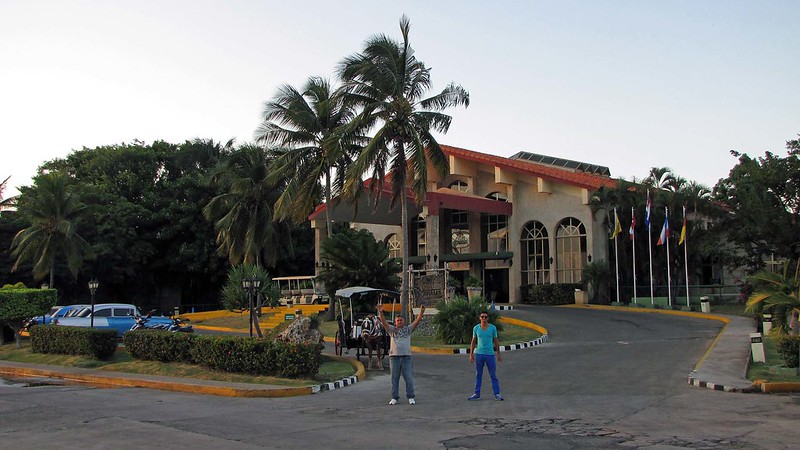
The hotel is well designed in a Spanish style and quite cozy, no much walking is required to get around. Plenty of nice palm trees & gardens. And it is for adults only—no disruptive and screaming kids!

Morning yoga with Zahilys

Approximately 60% of tourists were Canadians (English & French speaking), 30% Germans and some from Spain, Italy and other countries.

There were 3 pools; the very shallow one had no water. There was a Jacuzzi in the center of the pool closer to the beach, but it was not hot.

Entrance to the Hotel Roc Barlovento

There is a tienda (shop), with various beverages, rums, vodkas, souvenirs, shampoos, shirts, hats, toiletries, etc. Another stand near the lobby sells books, postcards and stamps—the mail box is at the lobby. On a couple of occasions I saw an artist painting and selling his works.

The exchange rate at the hotel was very poor—just 68 CUC for $100 CAN, whereas the bank offered about 73.50 CUC. Not fair!

The Beach at the Roc Barlovento Hotel

A number of very friendly (and chubby) cats roamed the property, especially the outdoor dining area during meal service—and they even had their own ‘cat café’. Unsurprisingly, they were picky eaters!

At 10 am there was half hour yoga/stretching on the stage of the entertainment area, conducted by Zahilys, a very friendly & outgoing woman, who worked at animation and conducted other activities as well. Bring our own towel! Yet there were not too many guests interested in doing the exercises, and quite often we were the only participants.

Roc Barlovento-our room number 333

There was a gym, but we never used it, preferring our morning workouts and swimming in the ocean.

Towels can be obtained from ‘the clubhouse’ near the main square. The club house also has a small library of books in English, French and German. We donated 4 of our books.

We ALWAYS had our breakfast, lunch and dinner outdoors, never inside--that was one of the most important advantages of this hotel. 

Every evening there is entertainment, but the only one we attended was the aquatic show (Thursdays) and it was impressive! The Elvis Show sounded great from our room on Saturdays.

Scuba diving excursions/lessons are available, there is an information stand set up every day in the main square.

Catherine enjoying her very healthy breakfast-of course, oudoors!

Various tours are offered in the lobby area. At the end of our stay there was information about a very cheap bus to Havana—I think it was 40 CUC both ways, or 25 CUC one way per person. 

We had sent an email to the hotel two weeks before arrival, asking for a quiet room on the top floor and indeed, our request was granted—we got room number 333. From our window we could see part of the tennis court—otherwise there was plenty of foliage that made the view quite pleasant. We could hear the traffic from the main street and occasionally caught a whiff of oil/petrol—about 1 km from our hotel, in Santa Marta, we saw two oil derricks. 

View from our room #333

The balcony was very small, but it was possible to sit there and enjoy the sun. There was a small bathtub—later the maid brought a plug. The room was quite contemporary, with 2 double beds, HD TV with about 25 channels. There was the CNN channel (devoting 95%+ of its air time to Trump—boring—another 4% to US affairs and only 1% to international news—worse than TV programs in the Soviet Union!) and a Canadian channel (CTV) in English, albeit from Montreal. We had to pay for the safe (2 CUC per day, 28 CUC for 2 weeks). We always had hot and cold water, the air conditioner worked perfectly and it was easy to remotely change the air flow or temperature. The small fridge was really cold and the hair dryer worked. We had some minor problems on 3 occasions (with the safe and falling curtains rod)—within 10 minutes of reporting them a technician came and fixed them. On a few occasions our magnetic cards stopped working and we had to go to the lobby to have them re-programmed. The maid, Norian, was great, always keeping our room spotlessly clean and creative. 

Casa de Al-supposedly, Al Capone used to live here, but according to my research, it is very doubtful that he even visited Varadero

The beach was large, with white sand. Lots of palapas and chairs, so there was no need to ‘reserve’ them in the morning, some were always available. We could also observe nice sunsets. The water was quite shallow for about 30 meters. At the end of our stay it became windy, the waves got quite big and there was a yellow-and then red flag (no swimming). Once an unexpectedly big wave swept the first row of palapas, catching many relaxing vacationers (and their belongings) by surprise. I saw some people snorkel, but there was nothing to see—just some small fish. Kayaks, pedal watercraft and sail boats were available for hotel guests. Beach assistants was great, he quickly brought us loungers. 

The 'famous' Polish Fiat 126p is still relatively popular in Cuba. Apparently, it's not a very good car...

Another reason that we picked the hotel was the outdoor dining, which surprisingly was hardly used. Not even once did we dine inside! The food was slightly repetitive, but varied and good—often even delicious. For breakfast I always had eggs & bacon—the egg station cooks were very efficient and quick—as well as plenty of fruits, juice and yogurt. Usually we skipped lunch, but when we had it (twice), it was excellent—in addition to the regular fare inside the restaurant, there was a big grill outside, serving delicious steaks, hamburgers, hot dogs and other grilled food. At dinner I always went to the cooking station offering sumptuous grilled pork and beef as well as several kinds of fish, shrimps, calamari, squids and mussels. Another cooking station served spaghetti and pizza. There were also scrumptious stews, chicken, prosciutto, cheese and salads. I did not see any tomatoes, however, which I like very much. I never had to line up for more than a few minutes at the cooking stations and the food was plentiful. Our servers were Leonardo & Janet (breakfast) and Raul (dinner). They always brought us plenty of coffee, juice, wine or beer to our outdoors dining table. There was a snack bar near the beach, serving basic food—hamburgers (very good), hot dogs, ham & cheese sandwiches, fruits and lettuce. Next to it was a bar serving cold beer and drinks and most of the time it was manned by the always smiling Pedro. There were also bathrooms in the back of the bar. 

Sunday Farmers' Market in Santa Marta. Pork costs 25 CUC per lb, or one US dollar

The small Bar El Traguis near the wooden ramp to the beach was nice, but the seating area was limited and the beer cost 1 CUC. Mixed drinks were free. 

Sunday Farmers' Market in Santa Marta

The lobby bar was OK, but there were frequently buses or taxis pulling up, so it was noisy and smelled of exhaust fumes. It was almost always crowded. In the evening there was often live music—I loved the violin & guitar players, they were fantastic (they played only on Mondays and Tuesdays, from 7 to 9 pm). The bar in the square (adjacent to the Mexican Restaurant) was great, lots of tables & chairs and never any lineups—we often spent some time there on our way from the beach. We never had an a ’la carte dinner. Once we wanted to go to the sushi bar, yet we were told that it did not server any sushi anyway and it opened at 11:00 pm.

Catherine in a Cuban store with cigars and alcoholic beverages

The gardeners often bring coconuts to a stand between the beach and lunch area and can cut them for you. 

Out of the 15 days, 12 or 13 were quite sunny and it was hot (over +30 C). It rained a few times, but it was still very warm & humid and it was not a big deal. Since we often kept the room’s balcony door open, we did see several mosquitos in our room, but otherwise I did not encounter any insects anywhere else. 

The famous Beatles bar in Varadero

We often walked from our hotel to the town of Santa Marta—it took us about 2 minutes to walk to the bridge, we crossed it, turned left and a few minutes later we were walking along the town’s streets. It is a very nice town, with plenty of restaurants, cafes and casas particulares. Most restaurant offer very varied menu at reasonable prices. Some parts of this town have impressive homes. Following a very valuable recommendation of TripAdvisor’s poster, SWNova, on Sunday morning we went to the Farmers’ Market—what a fascinating experience! There were plenty of fruits and vegetables sold by farmers, all prices were in CUPs (i.e., Moneda National, 25 CUP = 1 CUC = $1 US) and were very cheap. I bought beer served in small cups, for about 6 CUPs per cup, it was quite good and very different from that sold commercially. We also purchased some delicious food from a street vendor. 

Very attractive Casa Particular in Santa Marta

There were plenty of casas particulares and we visited one of them. The owner spoke English, he had even visited Canada (upon invitation of some tourists whom he had befriended) and told us a lot of interesting stories about this town. Certainly, it was quite well-off, as many of its residents had worked at hotels in Varadero. 

Cubans fishing under the bridge in Varadero

We also went to a private coffee shop a few times and had very good coffee and pastry. It was a new venture, all the equipment was brand new and ‘made in Italy’.

In the evening we often took a stroll along the canal—usually there were groups of Cubans fishing. We also walked on Avenida 1ra, even to the famous The Beatles Bar, visiting some restaurants, cafes and tiendas along the way. Once we went to the bank to exchange money, there were over 10 tourists inside and we had to wait for almost one hour—passport was also required to complete the transaction.

The easternmost tip of Varadero-what a luxury!

We tried to walk as much as possible, but when we were tired, there were always plenty of taxis, coco taxis and horse-drawn carriages, offering rides. Beware: once a horse-drawn carriage driver quoted us the price of 5 CUC—but later said it was… per person! 

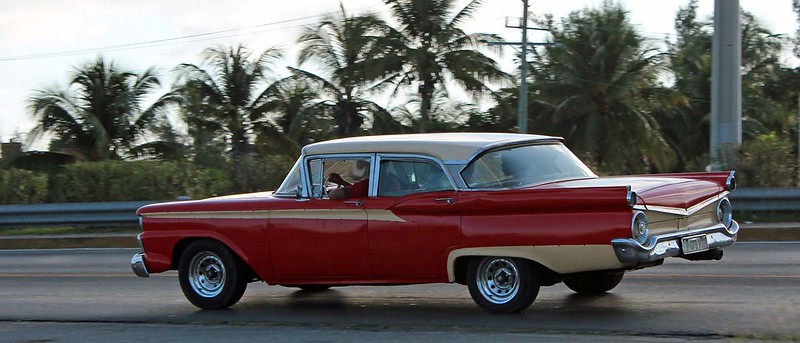
Pre-revolutionary, antique cars are a common sight in Cuba

Twice we took advantage of the hop-on-hop-off bus. It had its last stop just a minute away from the hotel (near the La Sangria Restaurant), it ran every 20 minutes (less frequently in the evening), cost 5 CUC per person and took us to the very end of the Hicacos Peninsula. 

Matanzas, Cuba--Libertad Square

There were trips to Havana offered from the hotel, but since we had spent a week exploring this beautiful city 10 years ago, we decided to just visit the city of Matanzas, which is approximately between Havana and Varadero. We managed to find a nice taxi for 30 CUC and it dropped us off at Libertad Square. Catherine went to the Pharmaceutical Museum and I explored a government building (a City Hall?); initially the staff did not want to let me in, but I explained that all I wanted to do was take a look at the photographs on the walls. They depicted Fidel Castro’s visit to this town. There was a de rigueur statue of Jose Marti in the center of the square. 

Matanzas-Teatro Velasco

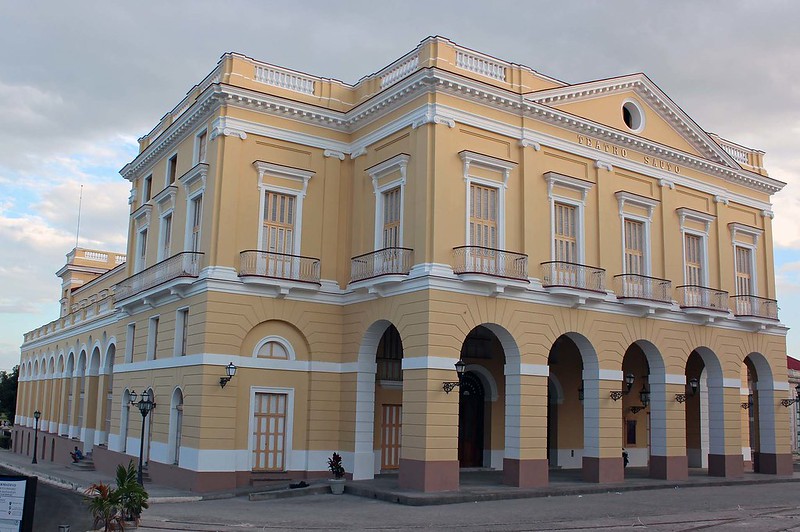
Then we went to a restaurant at the Hotel El Velasco, adjacent to the Teatro Velasco and afterwards walked on Calle Milanes toward the sea. Plenty of people congregated near the Catedral de San Carlos Boromeo. Eventually we reached the Teatro Sauto, which was apparently being renovated. There were old streetcar tracks in front of the theatre. The theater opened in 1863 and it has been a symbol of the city. Such famous performers as French actress Sarah Bernhardt, Russian dancer Anna Pavlova, Italian opera singer Enrico Caruso, and Spanish guitarist Andrés Segovia. 

Teatro Sauto

There was also the Museo de los Bomberos (Firefighters Museum) near the theatre, but we did not go there. We spent some time at the Cafe and Cremeria Atenas, vis-à-vis the theater and had a few drinks which were quite reasonably priced. By the way, it was very hot and humid and I had 9 cans of beer during the whole day! We sat outside and had a great view of the theatre and the city life. There were two bridges over the Rio San Juan nearby. 

Teatro Sauto, Palace of Justice and other historical buildings. 

We walked around the theatre, hoping that perhaps we could peek inside (no luck, though) and proceeded on Calle 272, more-less along the coast. There were some railways tracks along the shore and in the middle of the streets—I was sure they had been abandoned long ago, they looked old and rather broken, yet we were told that trains still ran on them! If this is indeed so, it a miracle! Just past Calle 270 there was a Cuban eatery on a small ‘peninsula’, all prices were in CUPs. We ordered a box of fried shrimps—as far as I remember, 10 of them cost about 30 CUPs and they were delicious! I think we were in the Haitian part of Matanzas and on a couple of occasions saw Cubans with rather peculiar facial features—perhaps they were of Haitian origin. 

Matanzas. Probably this is the 'Haitian' part of the city

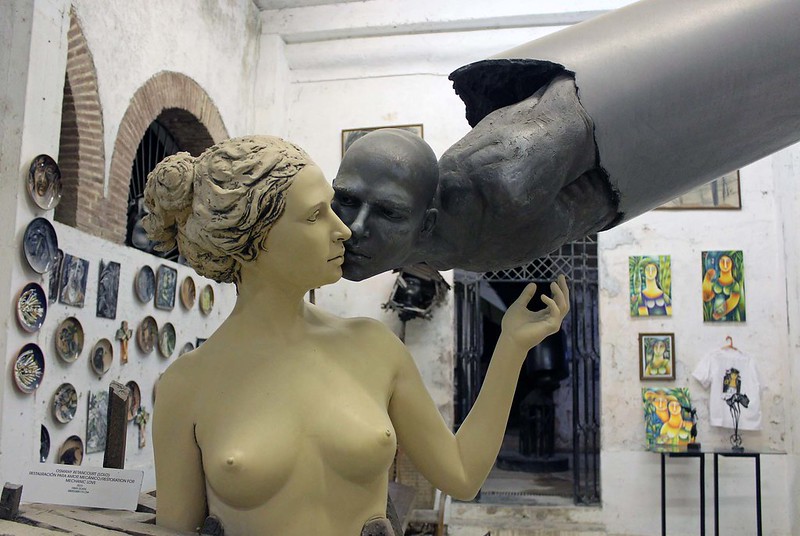
In the evening we walked along Calle 97, along the Rio San Juan and stopped at the Lolo Galeria-Taller. It was amazing! There were a myriad of works of art—sculptures, paintings, statures, ceramics—by various artists. 

Galleria Taller

Some works were kind of scary, yet very creative. I liked many paintings and would not hesitate to hang them in my home or office. Unfortunately, the prices (at least the sticker prices) were quite high; I hope it would be possible to negotiate them with the artists. 

Galleria Taller

Eventually we ended up near the Cathedral again, there was some kind of celebrations and a group of people, dressed in fancy outfits, proceeded to the main square. We also visited a chess club, named after a famous Cuban chess prodigy, José Raúl Capablanca y Graupera (1888 – 1942), who was world chess champion from 1921 to 1927. 

Chess club, named after a famous Cuban chess prodigy, José Raúl Capablanca y Graupera

It was getting late and we were trying to catch a taxi (or any other mode of transportation) to take us back to the hotel. While looking for one, a Cuban man started talking to us and sensing what we were trying to do, immediately offered his assistance to us, probably expecting some profit (not that we really wanted his services). We walked with him for a while and eventually saw a private taxi; after a brief discussion, we negotiated a price of 25 CUC (we could see that the driver was not very thrilled about it) and also gave a few CUCs to our intermediary. 

Matanzas' streets at night

It was a very old car, the only things that appeared to work was the engine and the head & tail lights. As we were sitting in total darkness, we could not even conduct a conversation because of the noise and the interior of the car reeked of gasoline fumes, which must have been seeping through numerous cracks. Before entering Varadero, there was a police checkpoint and the police stopped the car—the driver got out of the car and the policeman officially clicked his heels and saluted, probably accentuating that it was an official police business. They talked for a while and then the driver was let go. I asked him if the cop wanted a bribe, but he said he did not. In any case, we got back to the hotel and gave him 30 CUC. By the way, if we were staying in a hotel farther up the peninsula, I am sure the price would be significantly higher, as it would take extra time to get there—as I said before, our location had plenty of advantages! 

An old man at Libertad Square

For many years I had been very reluctant to go to Varadero, thinking that I would be surrounded by only other resorts and hotels. It was not so—the location of the Roc Barlovento allowed us to explore many nearby areas and we never felt we were in a tourist enclave. We absolutely loved the hotel & its pleasant staff and had a wonderful time there. On the last day of our vacation, while on the bus to the airport, we spoke to many tourists about their vacation. Remarkably, we got an impression that we had a much better time at the Roc Barlovento than most of them in their often more superior hotels.

P.S.--December 22, 2021

After the Varadero Trip, we went to Cuba again, our 15th time, to the Carisol los Corales Resort in January, 2020 (see my blog). The day we arrived back in Toronto, January 22, 2020, the first COVID-19-infected "patient zero" also arrived in Toronto from China... We were, however, optimistic and remained quite confident that we would visit the Roc Barlovento in November, 2020; of course, it was impossible. We could not go in November, 2021, either. Then we hoped to go to Cuba in January, 2022, but now we're glad we did not book the trip due to the Omicron variant wrecking havoc everywhere. Our next potential trip to Cuba-most likely to the Roc Barlovento--would be in November, 2022. But at this point, we don't want to make any plans, as the situation keeps changing so much so quickly.

Bye, bye, Varadero-see you soon!


Blog in Polish/w języku polskim: http://ontario-nature-polish.blogspot.com/2020/08/varadero-kuba-dwa-tygodnie-w-hotelu-roc.html 

More photos from this trip: https://www.flickr.com/photos/jack_1962/albums/72157715579022731