Wednesday, February 15, 2012

Cienfuegos, Cuba. January 13-20, 2012

Polish version of this blog/polska wersja: http://ontario-nature-polish.blogspot.ca/2012/02/cienfuegos-cuba.html
More photos: http://www.flickr.com/photos/jack_1962/sets/72157629906109508


“So, where are we going to go to Cuba this time?”

We asked ourselves this question many times over the past few weeks. On one hand, there were a lot of places to visit in Cuba; on the other hand, since we did not want to get stuck the whole week in a remote resort and spend most of the time on the beach and the hotel, we had to do some further research and find a destination that would suit our needs.

Varadero, Santa Lucia, Manzanillo, Cayo Coco, Cayo Largo... all have superb resorts and excellent beaches, but getting from them to a nearby town is often cumbersome, expensive and often even impossible.

“Maybe we can go to Cienfuegos, also known as “La Perla del Sur”, the Pearl of the South?”—I said, having studied the map of Cuba for serveral minutes.

Two years ago we stayed near the town of Trinidad and landed at the Cienfuegos airport, but never got to see the city itself. http://www.tripcentral.ca/ , the travel company we had used in the past, offered several packages in hotels around Cienfuegos. Two of them were south of the city, on the ocean, with sandy beaches, but getting to the city would require a daily taxi transport—Cienfuegos is located on the Bay of Cienfuegos, formerly called Jagua Bay (Bahia de Cienfuegos or Bahia de Jagua) and not directly on the ocean. But there was one hotel, the Jagua, on a peninsula (Punta Gorda) that cuts into the bay. Although there is no beach, it has a swimming pool and its guests can enjoy amazing view of the bay, ocean and the city. The city center is about 3 km. away, so getting there should not be a problem.

The price of the package was a little on the high side, over $900 per person per week. We were hoping that the price might fall over time, it was only September and we were planning to go in January, but soon it went up by another $200...

“Well, we can always go to the Hotel Tropicoco,” I said.

Even though we spent many hours exploring Havana during our 2009 trip, we had not seen everything. The Tropicoco Hotel, where we stayed at in 2009, was only about 30 minutes from Havana's downtown and it made a perfect 'base camp' for our daily trips. It is also on the ocean with a decent beach so there is a two-for-one added value, although the weather in January in this area can be cool, windy and rainy. The Tropicoco is an OK hotel, although opinions expressed in reviews posted on www.TripAdvisor.com range from 'excellent' to 'hell on earth'. Nevertheless we liked the hotel and would have no problem going there again. Besides, plenty of packages were available for the Tropicoco and the price was reasonable, about $600.
Still, I kept watching the ever-changing deals at Tripcentral.ca... and finally I saw something that made me almost jump our of my chair. I immediately called Catherine.

“Have you seen the prices today?”, I shouted.

A bunch of new packages to the Jagua had been added, all of them at much better prices. Now we could go for one week for $605 per person, with breakfast included in the price (we could pay an extra $100 to get dinner). We did not want to lose this offer, so we had to quickly make a decision. We called Rien from TripCentral who had handled our travel arrangements in the past and several minutes later we booked our vacation. Rien also informed us that we were going to fly Air Cubana, the official Cuban Airlines. Later I did some online research and found out that Air Cubana had one of the worst safety records; the only consolation was that most of the accidents have happened on domestic flights or those flying to South American countries.

Needless to say, Cuba is a very peculiar country and often not everything works out the way it is supposed to work. Tourists who do not realize that often get quite shocked and disappointed. The expression, “Es Cuba!” should always be kept in mind! Yet we were ready for whatever Cuba was going to throw at us... although did not expect that “Es Cuba!” would begin just minutes after making the reservation and months before our scheduled departure.

Our friend Lynn has been a flight attendant for many years and regularly flies from Toronto to Hong Kong. It is a non-stop flight, almost 16 hour long and it is currently one of the longest passenger flights (the longest is about 19 hours). The duration of flights from Toronto to Cuba should normally be just over 4 hours. But one should never underestimate the Cuban airlines! When a confirmation came by email, it clearly stated that our flight from Toronto to Cienfuegos was departing at 3:00 pm on Sunday from Toronto and arriving at Cienfuegos at 7:00 pm... the NEXT day, i.e., on Monday. In fact, it was clearly written on the confirmation that 'it was a non-stop flight and that the length of the flight was 28 hours.' Thus, our vacation not only included a trip to Cuba, but probably a plane trip around the world—as well as we were to beat the world duration record for a regularly scheduled non-stop passenger flight! Well, even the United States cannot achieve that—but Cuba can!
Alas, it was just a misprint... and I already imagined our names in the Guinness Book of World Records and elaborate welcome ceremony at the Cienfuegos airport, with even Fidel (or Raul) Castro in attendance!

As it turned out, it was not the ONLY error—later the date of our trip was changed to... Friday the thirteenth and another confirmation totally mixed up the arrival and departure time. We only hoped that by the time our trip actually starts, everything will have been straightened out,

CIENFUEGOS, CUBA, JANUARY 2012


Friday, January 13th, 2012... the Air Cubana plane was almost on time, departing before 09:00 pm. Some of the Canadian tourists decided to start their Cuban vacation on the plane and soon became quite drunk and even rowdy—I was sorry for those passengers who had to sit close the them, they were visibly upset by their loud swearing. Some people said that Cuban planes were not allowed to fly over the US territory, but it was not true, they could and if there was an emergency, they could land on the US soil. As I was walking in the aisle to my seat, I noticed a stack of newspapers in the overhead compartment—it was the English edition of the weekly newspaper Granma. While in Cuba, it was not that easy to get even the Spanish edition of Granma (published daily), let alone the English one.

As we were circling around Cienfuegos, I could clearly see the bay (Bahia de Cienfuegos), the peninsula of Punta Gorda and the Jagua Hotel! We landed at Cienfuegos just after midnight—it was so nice to emerge from the plane into a warm, humid weather. We went very quickly through the customs. At the airport in Toronto I had bought “The New York Times” which was prominently sticking out from my carry-on luggage.

“Can I see it?”, one of the custom officers asked me.

I thought that maybe he wanted to quickly read it, but he was acting in his official capacity: he flipped several pages, looked at the date and called somebody on his radio; luckily, the reply must have been positive as he let me keep it. I do not think there was one tiny article about Cuba in this issue.

There were several coaches waiting in front of the airport.

“Which one goes to the Jagua Hotel?”, we asked.

“Go to that one”, somebody pointed towards a bus at the very end of the parking lot.

The driver showed up and put our baggage on the bus. We were the only ones onboard, but gradually more and more tourists came. All the other buses left, but ours was still waiting. We even saw our plane take off for Havana, yet we were still waiting for something or somebody. A few fellow tourists, originally from Croatia, were sitting next to us; they said that their luggage must have been put on the wrong plane and it was missing, even though the whole plane had just been searched. No wonder they were quite upset. Eventually a tourist showed up, got on the bus and we were finally ready to go.

“It’s not my fault”, he said apologetically, “I almost got arrested”.

I never found out what happened, but all of us were glad we were on our way.

Most of the tourists—as a matter of fact, all of them except for us—were heading to the Rancho Luna and Faro Luna (located on the beach), we were the only ones staying in the Jagua Hotel and it was where the bus went first. It was almost 2:00 am, yet we saw quite a few people in the streets (it was Saturday) and soon we could admire Cienfuegos’ neoclassical architecture. We took the Malecon (Paseo del Prado, a.k.a. Calle 37), passed a beautiful white building (the Cienfuegos Yacht Club) and arrived at the hotel. The reception staff were quite surprised to see us at this time of the night. We asked for a room on the seventh floor, but none was available and we ended up getting a room on fifth floor, #502.

CIENFUEGOS, CUBA, JANUARY 2012


“Cinco?”, I asked.

“Si, cinco”, replied the receptionist.

The room was almost at the end of a long, open hallway. The magnetic card that was supposed to open the room door did not work; we kept inserting it different ways, but the door did not budge. After a few minutes of fruitless attempts we heard a voice coming from inside the room:

“You’ve got the wrong room number”.

We checked the document we got from the receptionist... and well, ours was number 402, on the fourth floor (yet we clearly heard “Cinco”). This time we had no problems opening the door. Once inside the room, we had to insert the card into a special device, enabling us to turn on the lights.


CIENFUEGOS, CUBA, JANUARY 2012


The room was quite pleasant—it had two beds, TV, telephone, a small fridge, air conditioning, bathroom—as well as a balcony where we could sit and see the hotel’s swimming pool, dock, Bay of Cienfuegos and the whole city; from the hallway we had had a wonderful view towards the south of Punta Gorda—a peninsula on Bay of Cienfuegos—as well as one of the most impressive buildings in the whole city, Palacio de Valle. On the other side of the bay protruded a huge dome of the never-completed nuclear power plant. I was terribly thirsty, so we went down to the bar (open 24 hours per day) and bought two cans of beer “Bucanero”. Usually the beer sells for 1 peso; we paid 6 pesos for 2 cans in the hotel bar—and it was our first and last visit in the bar. We were back in our room around 3:00 am and soon fell asleep.

CIENFUEGOS, CUBA, JANUARY 2012


The Hotel Jagua was built just before the Cuban Revolution by president Batista’s brother. There were also plans to set up a casino in the adjacent Palacio de Valle (in fact, the Palacio’s garden used to be at the present site of the Jagua). Before the Cuban Revolution Punta Gorda was one of most expensive areas of Cienfuegos—to this day it has an undeniable charm, houses are well-kept and many rent rooms to tourists (casas particulares). Incidentally, according to a plaque in the hotel, Fidel Castro visited the hotel shortly after the Revolution:

 „In this room on August 18, 1960 comrade Fidel Castro Ruiz talked about the vital importance of the Jagua Hotel for the development of tourism in the central region of the island”.

CIENFUEGOS, CUBA, JANUARY 2012


The hotel was very popular with various organized groups travelling across Cuba; almost all tourists spent just one or two nights there and moved on. That was why we could always see buses in front of the hotel, with tourists arriving and departing. As a matter of fact, we were the only hotel guests who stayed at the hotel for one full week—even Rien, our Canadian travel agent from http://www.tripcentral.ca/ , said he was not aware of any other travelers who booked this hotel for one week. Well, tourists who buy week-long packages to Cuba usually stay at all-inclusive resorts, close to the beach; on the other hand, Hotel Jagua was in Cienfuegos, about 3-4 kilometres from the city center. Only breakfast was included in the package price—no other meals, no ‘free’ drinks! Every morning we enjoyed excellent omelettes or eggs, fresh bread, salads and three kinds of enormously delicious cheese! Unfortunately, the coffee machine worked the “Cuban way”—sometimes I was getting black coffee and no milk, sometimes just milk and no coffee and I did not have one decent cup of coffee during the whole trip, but since I am not a big coffee drinker, it was not a big deal. Otherwise we liked the hotel—the elevators were working, there was hot water, the maid cleaned the room every morning, the fridge kept our food and beer cool, the staff spoke English and the location was ideal.

CIENFUEGOS, CUBA, JANUARY 2012


Across the street from the hotel (Calle 37) there were two restaurants which offered the same beer that could be bought in the hotel, but for a fraction of the price (i.e., one peso vs. three pesos plus tips the hotel bar charged); in addition, there was a supermarket on the same street (about 600 meters north of the hotel, on the east side of the street, just past the gas station and north of Avenida 20) which had plenty of liquors and liqueurs, mineral water, beer, cheese and many other items. We went to that store a couple of times and bought several bottles of mineral water and plenty of beer. It was also possible to do some shopping at the smaller store at the back of the gas station and sit at the table outside.

CIENFUEGOS, CUBA, JANUARY 2012


Even though we did not sleep much, on Saturday, January 14, 2012 we were up early, had breakfast and then walked across the hotel’s parking lot to the Palacio de Valle which we could see every day from the hotel’s hallway. It was indeed a remarkable building! Built in 1917 by Don Acisclo del Valle with a mixture of architectural styles, it had ornate walls, ceilings, stairs and many other decorations. In fact, the hotel was built on what used to be the Palacio’s garden. As we entered, we saw an older Cuban lady, wearing very distinct and colourful clothes and had, playing the piano.

CIENFUEGOS, CUBA, JANUARY 2012


Of course, it was Carmen Iznaga, who for many years had been a fixture at this place! I really liked the way she played the piano and sang; after a few minutes she got up, went up to Catherine and showed her a bunch of CDs with her music. We bought one disk which she kissed, leaving an imprint of her lipstick! I am really glad we bought it—it was a very special kind of music. After taking a few photographs with her, we continued walking on Calle 35 towards the end of the peninsula. The houses were quite pretty, there were a few immaculately spotless American antique cars from the 1950s and I took a lot of photos. I was told by one local resident that during hurricanes the peninsula was battered by the wind and waves; if I understood him correctly, he said that sometimes the water was everywhere, flooding the homes.

CIENFUEGOS, CUBA, JANUARY 2012


Just near the hotel, at the intersection of Avenida 0 and Calle 35, a bicycle taxi (bicitaxi, a.k.a. rickshaw) driver approached us and offered a ride. We were not interested in going anywhere at that time, but struck up a conversation with him—mostly in our super-basic Spanish, as he only knew a few English words. His name was Alain and he told us that it was his private bike and he had to obtain a license to operate it. He paid a certain amount to the government (in Convertible Pesos, or CUC) and also a percentage of his total earnings (although I never figured out how such amount was supposed to be determined—taxi drivers never issued any receipts). He was quite a nice fellow and we told him to be in front of the hotel at 5:00 pm—at that time we wanted to go to town. We went back to the hotel room and took a nap, getting up just before 5:00 pm.

CIENFUEGOS, CUBA, JANUARY 2012


As promised, Alain was waiting for us. He was not the only bicycle taxi driver—there were plenty of those bike taxis in front of the hotel, in addition to regular taxis. As we found out, all the drivers recently were permitted by the government—well, almost encouraged—to set up their own businesses. During my last visit in Cuba in November 2010, I had talked with some people about the recent Cuban government decision to lay off hundreds of thousands of government employees. Since the government could not provide them with employment, the only reasonable alternative was to encourage them to become self-employed—and thus a lot of people have taken advantage of this new opportunity, working ‘por cuenta propia’ (‘on their own account’).

CIENFUEGOS, CUBA, JANUARY 2012


That new policy was evident everywhere—we saw a lot of private bike taxis, horse-drawn carriages, regular taxis, repair shops, speciality stores (many operated right out of buildings’ windows), vegetable and fruit stands—as well as a lot of people were offering to take us to newly opened private restaurants. They were not the infamous ‘jinteros’ or hustlers—they actually worked for those restaurants, often wore uniforms and gave us business cards. Invariably, we made use of this very helpful Spanish expression: “Acabamos de comer en el hotel” (we’ve just eaten in the hotel) and in most cases they left us alone. Welcome to Marketing 101, Cuban style! And we did see a lot of shops selling good quality western apparel, food items, appliances, home renovation equipment and many others things—meaning that at least some people did have money and could afford such articles. In a nutshell, this country was certainly changing for the better. If the changes continue, in several years it will be a very different country from what it is today.

CIENFUEGOS, CUBA, JANUARY 2012


We came across a lot of other independent tourists from all over the world. Most of them were staying at Casas Particulares and many were travelling across Cuba in rental cars. Undoubtedly, it was a very convenient way to explore Cuba. I met a young gentleman from, I believe, Australia, who travelled with his wife by car and stayed in a Casa Particular.

CIENFUEGOS, CUBA, JANUARY 2012


“I love Cuba”, he said. “People here are so happy and surprisingly well-off. The socialist system works quite well here.”

Then he went on telling us how well Cubans lived and that they had basically everything—the fridge, car, washing machine, nice house, cell phone, stereo equipment, modern TV sets... I was curious how he met those people.

“I’m talking about the family that owns the Casa Particular we stay at”, he said.

Well... when I am on vacation, I do not feel like engaging in any political arguments, but I was very eager to point out to him that the ‘well-off’ Cubans he was referring to were, for all intents and purposes, business people, ‘who made a living by converting part of their house into a small bed-and-breakfast style hotel. And whenever we saw the distinctive sign on the building indicating a casa particular, without fail such a house was very elegant, well-maintained, with a fresh coat of paint and had a lovely garden.


In other words... capitalism seemed to work in Cuba, even on a relatively such a micro scale! That is why I sincerely hope that the new rules will allow many Cubans to engage in various profitable activities and result in an rise in their overall standard of living. It is a given that there will be some inequality and ensuing problems—already the hiatus between self-employed Cubans, ‘cuentapropistas’, and the others is expanding—but hopefully the government will not stifle new businesses with excess taxation and over-regulation.

CIENFUEGOS, CUBA, JANUARY 2012


Alain took us along Paseo del Prado (Calle 37) to Avenida 54 (a.k.a. San Fernando). As we were approaching the intersection, we saw a gay man ostentatiously strolling along the boulevard. He triggered a lot of glances and smiles from almost everybody. Alain said that not long ago it had been illegal to be a homosexual in Cuba, but now was legal. Another sign of progress! We got off the rickshaw, paid him about 3 pesos and headed towards the main square.

CIENFUEGOS, CUBA, JANUARY 2012


Paseo del Prado, running accross the city to Punta Gorda in the south, is the longest street of this kind in Cuba. We were surrounded by very remarkable neoclassical buildings with colourful column. There was a bronze life-size statue of Benny Moré at that intersection; he looked as if he was taking a nonchalant stroll down the Prado. Benny Moré, who was one of the most famous Cuban singers, was born close to this town and Cienfuegos was always his beloved city. This evening and many other times during our stay in the city we spent a lot of time walking along the boulevard and observing Cuban life.

CIENFUEGOS, CUBA, JANUARY 2012


Leisurely, we were walking along Avenida 54 and reached Parque Jose Marti, with a statue of the ever present Jose Marti, an arch and a rotunda. The buildings around the square were probably the most beautiful buildings in Cienfuegos: La Catedral Purisma Conception, Colegio San Lorenzo, the Teatro Tomas Terry (where among others, Caruso, Bernhardt and Pavlova performed), the Palacio de Ferrer, with a beautiful tower on the corner (we did not climb it, though) and the most impressive building, the Antiguo Ayuntamiento: in the past it was town hall, now a provincial administarion building.

CIENFUEGOS, CUBA, JANUARY 2012


Before the trip I had found a photograph of Fidel Castro making a speech there on January 6, 1959, just when he was heading to Havana after the triumph of the Revolution; the speech lasted for several hours. Each building had such a rich history and probably it could take us the whole day to visit all of them, but since it was already getting dark, we just walked around and took photos. Over the next few days we would visit the square several times, often dropped off there by Alain (who, I should add, became our only bicycle taxi driver—each time we were leaving the hotel, he was already waiting for us, telepathically knowing that we were coming; near the end of our trip, we met his young wife and their child). That night, fascinated by the buildings and the city life, we walked along Paseo del Prado to our hotel and probably we were the only tourists doing so. I bought a few cans of beer along the way (“Bucanero”, 1 peso per can). Around Avenida 26 we saw a lot of young people congregating along the Malecon, there was a restaurant and probably a free dancing/concert. All this time we felt very safe—I had two cameras with me and a small camcorder—I do not think I would venture to walk like that in Toronto! We went to a small eatery and ordered a pizza; they were out of peppers and onions, but overall the pizza was good.

CIENFUEGOS, CUBA, JANUARY 2012


Just before reaching our hotel we passed by a very impressive, white building—it was Cienfuegos’ Yacht Club, built in 1920, with imposing twin domes. There were pre-revolutionary photographs in the main hall, showing the club members winning various sailing trophies. We went upstairs to take a look at a rather stylish restaurant; noisy music was coming from somewhere in the basement. The club was still used for sailing, there were a number of boats docked in front of it. We could see from our hotel window the club’s domes as well as a big sailing boat moored about 100 meters from the shore, it had a Swiss flag—from time to time we observed people going back and forth between the boat and the shore in a small dinghy.

CIENFUEGOS, CUBA, JANUARY 2012


Although we did not use the hotel’s swimming pool, we were often sitting on the patio chairs near the dock, had a bottle of rum or liqueur and admired the sun setting on the other side of the bay. We were surprised to see a lot of tourists from the United States. They told us they were coming to Cuba legally, on special ‘educational’ or ‘religious’ tours and they visited, among others things, a variety of religious buildings and communities (the people we met were from Los Angeles, they were Jewish and they were going to visit synagogues and other places of worship). Of course, such tours were very expensive; when we told them how much we pay to come to Cuba from Canada (just over $600 per person), they were quite shocked!

CIENFUEGOS, CUBA, JANUARY 2012


The part of Punta Gorda south of the hotel was also one of our frequent destinations. There were many casas particulares, bed-and-breakfast style private hotels, located in very well kept and tidy houses. We would often sit on the embankment, watching boats passing by and drinking rum. One evening Catherine dropped her sun glasses into the water, but she quickly found a way to descend into the bay, walked for several meters in the shallow water and picked them up. At the very end of Punta Gorda was a small parking lot and an entrance to the park, with a round patio on the very tip of Punta Gorda. Near the park’s entrance there was a house with a casa particular (Tony y Maylin) and a newly open, private restaurant called Villa Lagarto (Lizard) [Calle 35 #4B, e./Ave. 0 y Litoral, La Punta, Punta Gorda, villagarto_16@yahoo.com, tel. (53) (43) 519966]. A waiter standing in front of the house/restaurant was inviting us to come inside and have dinner. We spoke with him for a while—not long ago he had been a school teacher and now he had a new career, waitressing in this restaurant (as well as trying to get guests inside). His English was quite good and we told him that we would certainly come to this restaurant for dinner. By the way, the average monthly wage in Cuba is just below $20—yet those working in the private sector can make more in a day... that was why our next waiter, cook, rickshaw or taxi driver might not long ago have been a doctor, teacher or accountant! Indeed, later that evening we did have a very nice dinner there.
CIENFUEGOS, CUBA, JANUARY 2012


We were pleasantly surprised by this new establishment—it was very stylish, we were sitting next to a (swimming?) pool, the server was very professional, the food was very good and it was probably one of the highlights of our trip. The dinner cost 16 pesos each, plus red wine and tips—we paid almost 50 pesos, but it was certainly worth it.
CIENFUEGOS, CUBA, JANUARY 2012


Over the next few days we made several trips to Cienfuegos, each time using Alain’s rickshaw services. For me, just walking along the streets and looking at the neoclassical buildings was a treat. I especially enjoyed snapping photos of buildings, old cars, people and kids in their distinct school uniforms. Unfortunately, many of the buildings were in bad shape, if not in ruins, ready to collapse at any time. As a matter of fact, while we were in Cienfuegos, a building in Havana did collapse, killing a number of its inhabitants.

CIENFUEGOS, CUBA, JANUARY 2012


We visited a catholic church, around Avenida 60 and Calle 41. There was a memorial plaque in the wall of the church in Spanish, which I tried to translate into English:

Fr. Regis Gerest, O.P. [Order of Preachers—Dominican], 1886-1941. Priest, educator. Orator and exemplary man. Association of Dominican Alumni. Nov. 28 1941.

We talked to the ladies inside and they were telling us something about the church, the adjacent building and Br. Regis Gerest. I could barely understand them, but I think this priest was responsible for founding or leading a Dominican school which used to be located in the adjoining building. I took a few photos and they gave us some pamphlets; it was a pity we were not able to attend a mass. They also told us about the Pope’s upcoming visit to Cuba, but he was not going to visit Cienfuegos. Later I found out that the Dominican order was restored in Cuba in 1898 and the same year the French Dominicans of Lyon established a mission in Cienfuegos. Realizing that the sugar industry, badly damaged in the war of 1895, was vital for the Cuban economy, they decided that it should also be reorganized and based on scientific basis. And so the Dominican Friar Regis Gerest helped starting first Sugar Chemistry courses in Cuba and personally developed teaching programs. In 1909 father Gerest founded the first School of Sugar Chemistry in Cuba and the Dominicans were able to provide it with the most modern and sophisticated equipment and French laboratories.

In fact, Cienfuegos was settled in 1819 by French immigrants and its original name was Ferdinand de Jagua, in honour of Ferdinand VII of Spain. That is why there are so many French influences in Cienfuegos; apart from its neoclassical architecture, it is even possible to see Cubans with distinct French features.

CIENFUEGOS, CUBA, JANUARY 2012


Cienfuegos had two cemeteries and we decided to visit one of them, Cementario la Reina, in the western part of the city, at the end of Avenida 50. On our way to the cemetery we saw a small outdoor railway museum with several old locomotives; old rusty train tracks were still visible, apparently not used for a very long time. At one time there must have been some kind of train repair shop—now it was converted into residences. We saw a lot of various tracks in Cienfuegos. According to an excellent website by Allen Morrison (http://www.tramz.com/cu/cf/cf.html ), Cienfuegos had its first streetcars in the early 1900s and the last tramway ran the tracks in 1954. But some of the tracks were certainly railway tracks, also abandoned long ago.

CIENFUEGOS, CUBA, JANUARY 2012


While walking along the street leading to the cemetery, we were invited to a Jehovah Witness temple for a conversation (and a possible conversion) and later stopped in a bar for a beer. There was a stray horse grazing on the grassland along the road. Passing horse buggies were crammed with Cubans and we did not see any other tourists. There was a deserted, open field in front of the cemetery, setting it apart from all the other buildings and making it look quite desolate. The cemetery was founded in 1837 and contained tombs of soldiers from the War of Independence. Some of the marble statues were very fine-looking; one of the statues, called Bella Durmiente, honoured a young woman who died over 100 years ago of a broken heart.

CIENFUEGOS, CUBA, JANUARY 2012


Apparently it is the only cemetery in Cuba where bodies were interred above ground due to the high groundwater levels (it is located close to the bay). Some of the tombs had caved in and were full of water, yet there were signs of restoration taking place.

CIENFUEGOS, CUBA, JANUARY 2012


On our way to the cemetery (and basically whenever we were walking), a lot of bike taxis and horse-drawn ‘taxis’ passed us by and almost each time the drivers offered us their services; invariably we would say, ‘Gracias, pero preferimos caminar” (thanks, but we prefer to walk). Nevertheless one horse-drawn cab driver must have spotted us entering the cemetery and he was waiting in front of the gate, hoping that we would decide to hire his cab. He guessed correctly—we were much to tired to walk anymore and rode back to the hotel in his cab. Since horse cabs were not allowed on the main street, he took Calle 39, adjacent to Paseo del Prado and we had to walk the last 200 meters to the hotel.

CIENFUEGOS, CUBA, JANUARY 2012


In the 1990s after the collapse of the Soviet Union and the cessation of its subsidies, the island was hit with severe economic problems and there were shortages basically everything—between 1989 and 1993 the Cuban economy shrank by 35%. During this “Special Period” (El Periodo Especial) Cuba was forced to adapt a number of austerity measures to keep the economy alive, albeit barely, and literally prevent people from starvation (it is estimated that on average each Cuban lost 22 lb over that period due to reduced calorie intake and increased physical activity). A few years ago we met a hotel worker who told us about her experience at that time.

“I was a student and normally I was supposed to commute to and from school daily. But there were very few working buses or trucks on the roads and very often there was not gasoline available. That’s why we had to live in the school for several weeks at a time and only occasionally going home for a visit. It was very difficult to get enough food, there were blackouts, we did not have school supplies, many things broke down and could not be fixed.”

As she was telling us this story, I saw tears in her eyes...

CIENFUEGOS, CUBA, JANUARY 2012


Transportation became one of many problems facing this country. In order to alleviate this situation, the government introduced a very peculiar contraption, a homemade double-humped ‘bus’, made of two shells welded together and pulled by a tractor-trailer. The ‘camello’, as it was called by Cubans, was a common sight on Cuba’s streets for many years after the fall of the Soviet Union. It was quite ugly and when crammed with hundreds of people—and usually it was packed—was like a hot oven, as well as a made a perfect setting for molesters and thieves. Besides, the tractor-trailers hauling this contrivance were not designed for frequent stops and constant city driving; as a result, they often overheated or broke down.

CIENFUEGOS, CUBA, JANUARY 2012


When I went to Cuba for the fist time in January, 2008, I only saw one camello near Matanzas, while going from the Varadero Airport to Havana; there were none to be seen in on the streets of the capital. I asked a few Cubans what had happened to the camellos.

“They’re gone”, they said, visibly relieved.

“You didn’t like them?”, I asked them jokingly.

They only rolled their eyes.

I found out later that in 2007 the government decided to phase them out and replace them with new Chinese made Yutong buses. Indeed, the name ‘Yutong’ could be seen on many buses in service in Cuba, whereas it seemed that the camello had become a thing of the past. So you can only imagine my surprise when I did see the famous camel bus in Cienfuegos, in Parque Villuendas, parked on Calle 41! I spoke to the driver and almost got a ride inside the driver’s cab...

CIENFUEGOS, CUBA, JANUARY 2012


Even though very few Cubans that we met knew any English, all of them were very nice, polite and helpful. Some of them invited us inside their modest dwellings and showed us photo albums—many of those photos had been taken by and with tourists (some of them Canadian) whom they had met. We were lucky to run into one gentleman who was an English teacher and we spent about one hour inside his house talking about tourism, the Cuban economy, new changes and life in Cuba in general.

CIENFUEGOS, CUBA, JANUARY 2012


CIENFUEGOS, CUBA, JANUARY 2012


When we were walking by a terribly dilapidated building, whose roof must have collapsed long, long ago, an exposed brick wall caught my eye and I started taking photos. Somebody was inside and he immediately waved to me to come in; soon Catherine followed and we were inside his... well, dwelling: it was in a corner of a former hotel. The rest of the hotel was completely abandoned and looked as if it had been hit by a missile. In no time three of his friends showed up, one had a guitar and very soon he was playing the guitar and they were singing the famous Cuban song “Guantanamera”! I managed to immortalize this amazing performance on my video and have watched it several times since then.


The guitar player said he would be playing in a band at a restaurant located at Parque Jose Marti, at the corner of San Fernando (Avenida 54) and San Luis (Calle 27). An hour later we went there and spent over 30 minutes, drinking beer and listening to the performance by him and his other friends. I took a bunch of photos of them and promised to mail them in a couple of months.

CIENFUEGOS, CUBA, JANUARY 2012


Once I saw a beautiful, immaculate old American car and started taking photos. The driver was more than happy to show me the inside of the car—apparently the car had a new engine, power windows and plenty of new equipment.

CIENFUEGOS, CUBA, JANUARY 2012


“My grandfather bought it before the Revolution”, he said, “Then he gave it to my father and my father gave it to me”.

“And you will give it to your kids”, I said.

Smiling, he replied, “Si!”

Only in Cuba!

CIENFUEGOS, CUBA, JANUARY 2012


I always liked photographing propaganda posters and other signs pertaining to the Revolution. On September 5, 1957 a rebellion against Batista took place; as a result, the city was bombed and many people died—we saw plaques and other memorials commemorating those events. Here and there we could spot a big poster of Che Guevara, Fidel Castro, Raul Castro and other revolutionaries.

CIENFUEGOS, CUBA, JANUARY 2012


Usually I did not talk about politics, but once I asked a Cuban about Fidel Castro: is he in hospital?

“Yes”, he said, “he’s quite old and infirm now”.

“I know he still writes a column in Granma [the official newspaper of the Central Committee of the Cuban Communist Party] called Reflexiones de Fidel”, I said.

He looked at me and smiled.

“Yeah, Fidel is an old man... you know... he talks and talks... always socialismo.... blah, blah, blah... socialismo... blah, blah blah... socialismo.... blah blah, blah.... socialismo...”

That was the only discussion I had with Cubans about Fidel and politics.

CIENFUEGOS, CUBA, JANUARY 2012


Since Cienfuegos lies on the shores of a large bay which is connected with the ocean through a channel, there used to be a fortress at the mouth of the bay, the Castillo de Jagua. It was built by king Philip V of Spain in the 1740s. From that excellent vantage point it was possible to defend the bay from pirates and keep all passing ships in check. We knew that a ferry ran from Cienfuegos to the Jagua Fortress a few times a day, but nobody could provide us specific information, except that it departed ‘sometime around noon’. So, we went to the ferry terminal and yes, it was departing at, I think, 1:00 pm and leaving the Fortress at 3:00 pm, thus giving jus just one hour for sightseeing. Because the departure would not be for a few hours, we just wondered around the streets. We got to a fire station, met several firemen and took photos—they let Catherine wear their helmet!

CIENFUEGOS, CUBA, JANUARY 2012


When we did come to the ferry dock, the place was swarming with people, over 99% of them Cubans. Fortunately, we got on the ferry—it was crowded, people were sitting everywhere and we ended up standing on the bottom deck. The trip took almost one hour—we passed close to our hotel (in fact, sometimes we had seen the ferry from our hotel), could see the distinct Punta Gorda peninsula and then were crossing the vast waters of Bay of Cienfuegos. The ferry stopped twice, some passengers got off and finally it docked at Castillo de Jagua. Across the bay a big, Soviet-style hotel (Islazul Hotel) spoiled the scenery. We walked up the narrow street to the Jagua Fortress.

CIENFUEGOS, CUBA, JANUARY 2012


There were two big cannons in front of the castle as well as a real moat (sans water). Inside we saw an old prison cell; then we climbed the spiral stairs and reached the top. We saw the bay, ocean, city of Cienfuegos as well as the big dome of the Juranga Nuclear Power Plant (which was also visible from the hotel). In the early 1980s Cuba, with the cooperation of the Soviet Union, started building this nuclear plant. In the early 1990s the Soviet Union collapsed and the construction ceased. Later there were some further attempts to complete it with a cooperation of other countries, including Russia, but apparently the cost became prohibitive. Moreover, there was a lot of opposition from the United States due to potential safety issues and at the end the Cuban government decided to abandon the whole project. Since no nuclear material had ever been placed there, at least this white elephant did not pose any radiation danger. By the way, a few years back we met a hotel employee who used to study Nuclear Science in Bulgaria, but later found out that his profession was rather superfluous.

CIENFUEGOS, CUBA, JANUARY 2012


It was very hot and I bought a couple of cans of beer in a nearby store and then we went back to the dock. I was watching a colourful eel and so-called ‘pen-fish’, very long and thin. The lady living in a house next to the ferry terminal had cages with guinea pigs. This time the ferry was quite empty; on the spur of the moment Catherine decided to get on the ferry’s bow and I followed her at the last second. It was an excellent idea—we ended up on the bridge and once the ferry was on the open water, the captain—a very charming, dark-skinned gentleman who had been working on the ferry for over 30 years—allowed us to go into the wheelhouse and even steer the ferry! We had a lot of fun, talked to the crew and enjoyed the whole journey very much.

CIENFUEGOS, CUBA, JANUARY 2012


Since there is no beach in Cienfuegos, we (or, I should rather say, Catherine) wanted to spend some time on the beach. We knew there was a public beach between Hotel Rancho Luna and Hotel Faro Luna (called Playa Rancho Luna); this time we could not use Alain’s bicycle taxi (unless we were willing to squander the whole day riding the rickshaw and risk working him to death from exhaustion), yet he quickly called his friend who showed up in no time and took us to the beach. It was a very sunny, hot day and the beach was quite nice—there were both tourists and Cubans. Catherine walked to the Rancho Luna, but was not impressed by what she saw. We spent some time talking to a Cuban guy who worked on the beach, his English was quite OK. There were a number of stray dogs; one of them decided to lie down next to us. Using a stick, I was scratching his back and he loved it! Later we went to one of two restaurants on the beach, had two mojitos and returned home, this time using a regular taxi which turned out to be 4 pesos cheaper than Alain’s contact who had taken us there for 12 pesos.

CIENFUEGOS, CUBA, JANUARY 2012


We went to the same beach again the day before our departure, just for a few hours (in the morning we extensively explored the city). I bought a few Cuban movies for 2 pesos and purchased a coconut. Later the guy who had sold me the coconut asked Catherine if he could use her towel to cover himself since he was cold. He was very pleasantly surprised when she said that he could keep the towel! Around 6:00 pm we observed the sunset and went to the other restaurant where Catherine had a quick dinner. This time we told the driver what time we would be leaving; he arrived at least one hour earlier—he did not want to lose business! Well, he made over 20 pesos that day—and I do not think his ‘taxi’ was licensed either.

CIENFUEGOS, CUBA, JANUARY 2012


Before we knew, it was Friday, January 20, 2012 and our trip was coming to an end... On that day we were up very early, packed up and wanted to just take a walk in the streets around our hotel. As always, Alain was waiting for us, took us there and then waited for us in front of a government store at the corner of Avenida 34 and Calle 43. We walked around, met a few nice people, took photographs and gave away some of the remaining gifts.

CIENFUEGOS, CUBA, JANUARY 2012


Cienfuegos, Cuba: Ration Card
At the same time a government worker was going from house to house fumigating for mosquitos (Dengue Fever). It looked like one house was on fire, as smoke was pouring out from all sides but it turned out to be the powder dust used in the fumigation. I wonder to what extend this chemical us a health hazard in itself? Finally, we returned to Alain, who was waiting in front of the store. The store staff liked my stickers and asked for me; as a gift, they gave me.... an old ration card booklet ! Most Cubans still rely on the Libreta de Abastecimiento (Supplies Booklet) distribution system, introducted in 1962. It allows each person or family to buy various food products at special stores at subsidized prices. The libreta contains a page for every month and Cubans are required to present the libreta each time they buy the rations. Cetainly, it was a very original gift! Then Alain took us back to the hotel where we gave me the remaining gifts and say ‘goodbye’; he also gave us a Cubana magazine and a small Cuban flag, which had been attached to the front of his rickshaw.

CIENFUEGOS, CUBA, JANUARY 2012


The bus arrived around 1:00 pm—it had already picked up tourists from the Rancho Luna and Faro Rancho—and soon we arrived at the Cienfuegos Airport. I bought a few bottles of rum in the airport store. An hour later our Air Cubana plane, Airbus 310, landed (it was coming from Havana), let some passengers off and we went on board. I got another weekly edition of Granma (in English), but was too tired to read it on the plane. In less than 4 hours we arrived in Toronto, quickly passed through the customs and immigration and got into a limousine. The driver, originally from India, was a very nice and talkative chap and we had a very interesting conversation with him about his life, his job, India and Canada. We were very glad that there had hardly been any snowfall while we were gone—actually, it was one of the most ‘snow-less’ winters in history!

It was our fourth trip to Cuba. Whenever I am asked about my vacation in Cuba, I say that each and every trip was excellent and I can rate them between an “A” and an “A+”. This one deserved an “A+”!


Polish version of this blog/polska wersja: http://ontario-nature-polish.blogspot.ca/2012/02/cienfuegos-cuba.html
More photos: http://www.flickr.com/photos/jack_1962/sets/72157629906109508

Tuesday, October 18, 2011

Bon Echo and Algonquin Parks.Radio Observatory. Black Bear's Visit on Our Campsite. Ontario, October 04-11, 2011

Blog in Polish/Blog po polsku: http://ontario-nature-polish.blogspot.com/2011/10/w-parkach-bon-echo-i-algonquin-ontario.html 


The previous year’s weather in September & October, 2010 had been very rainy. However, this year autumn was warm, and the weather forecast promised pure sunshine itself, nor a drop of rain, and even relatively high temperatures during the day (at night frosts were expected, but this was not a problem due to us having several warm sleeping bags). The plan was as follows: First, spend a few days in a tent in Bon Echo Park, then go to Algonquin Park, where we had reservations (along with other group members) at a radio observatory facility, and finally, depending on the weather, a plan to canoe to Bates Island on Lake Opeongo in Algonquin Park, the site of a black bear attack 20 years ago and spend one night on that very campsite… if we dared!


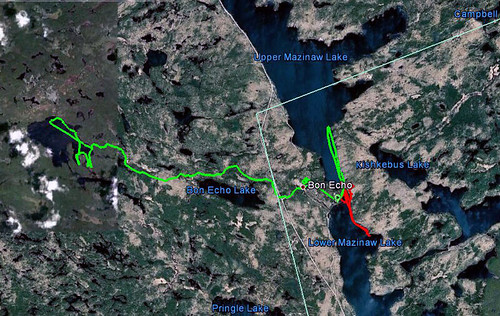
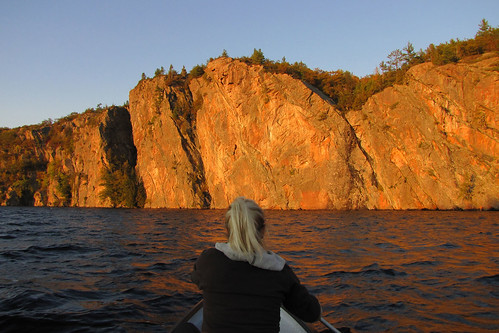
Bon Echo Park ... how much I could write about this magnificent Ontario park, my favourite park, which I have visited over 20 times since 1991, sometimes alone, often with a few friends, twice with a MeetUp group and I always loved going there. This is one of the larger provincial parks (about 55 square km), its main attraction is a magnificent 30-meter high rock, emerging majestically from the lake, which has one of the largest collections of Indian rock drawings (pictographs), apparently created several hundred years ago. At the beginning of the twentieth century, long before this place was turned into a park, there was a well-known and exclusive hotel, run by Flora MacDonald Denison. She hosted well-off tourists wishing to enjoy a true Canadian wilderness. Ernest Hemingway was one of the guests—at that time he was working for a Toronto newspaper, as well as a group of Walt Whitman lovers (who in 1919 forged a rock engraving still visible today with verses from a collection of poems Whitman, “Leaves of Grass”) frequented this unique place. After the death of Flora MacDonald Denison, her son, Merrill Denison (1893-1975), a Canadian writer, donated the property to the government of Ontario to establish the park (and all of us should be forever grateful to him for that; otherwise, it would probably have become somebody’s big cottage, off-limits to the public).

 
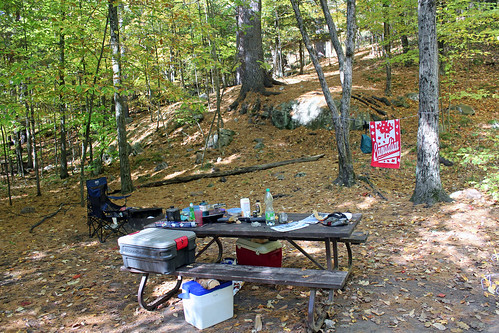
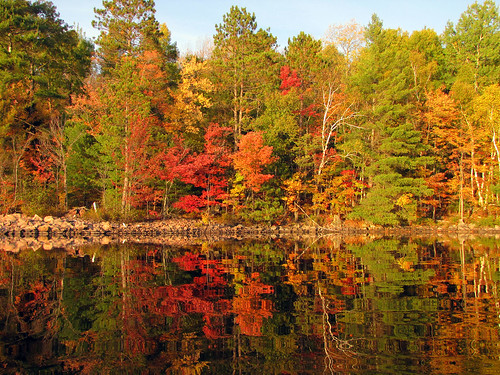
The park has over 600 camping sites (often all of them are occupied), the majority located near Lake Mazinaw, but in my opinion the best campsites are in the middle of the park (5-6 km from the main gate), at Hardwood Hill. Most of them are completely sheltered and private, you cannot hear the road traffic as well as that area is much quieter because usually families with young children prefer to camp closer to the lake, where the campsites are much more ‘open’, yet closer to the museum, showers, canoe rental place and the amphitheatre. Unfortunately, the campsites at Hardwood Hill closed on the Monday after the September Labour Day weekend, so we had to settle for the campground closer to the lake (the park remains open until the Thanksgiving Weekend in October). Although they did not offer too much privacy, it was not a problem because the park was almost empty. After perusing the area, we chose site no. 16. It was located at the bottom of a rocky hill and we were surrounded by trees with falling leaves of different colors which created a beautiful, picturesque leafy carpet! Despite the fact that our site was generally open and bordered with other campsites, it was not a problem as no one else arrived to camp around us, except for a giant school bus whose driver was totally lost en route picking up school aged campers.


This time we did not bring our canoe and decided to rent one, hoping for cheap rates. Indeed, the canoe rental place, operated in the park for over 20 years by the same gentleman was open and offered a great deal—for just $ 30.00 we could use a canoe for 4 days on Lake Mazinaw (where the canoe rental hut was located) and on Joeperry Lake, located in the middle of the park, where several canoes were already waiting for us! I had never canoed on Joeperry Lake due to a one-kilometre portage from the parking lot.


We paddled twice on Lake Mazinaw, canoeing along the Bon Echo Rock, admiring Indian pictographs, impressive rock formations, cedars growing on almost bare rocks (some more than 1000 years old, thus forming one of the oldest forests in North America) and the inscription on the rock, containing a few verses from the poetry of Walt Whitman. We were lucky to paddle near the Rock at the sunset, when the setting sun’s rays illuminated the rock; this is certainly a very exceptional phenomenon, when the whole rock becomes bathed in sun and turns orange. In the summer a lot of tourists show up at the beach, watching this amazing show. At the beginning of the twentieth century Flora MacDonald, the proprietress of this place, published a publication called “Sunset of Bon Echo”—although the term “Sunset” was derived from the name of a local Indian Chief, it was the most appropriate name indeed! The day when we were canoeing, when the rock was almost shimmering with astonishing orange colours, it was also very windy and the lake was quite rough; even though Catherine bravely paddled, I could hardly take photos, as I had to grab the paddle and position canoe so that the waves would not tip it over.


We also managed to climb to the top of that massive rock. There are two ways of ascending it—one is climbing on the sheer wall of the rock, reserved only for the courageous members of the mountaineering club; the other—which we had chosen—is a walking trail, used by the remaining 99.99% of tourists. The trail is not difficult, in some places metal stairs were installed (as well as the remains of the old stairs can be seen, which were used in the early twentieth century). It took us less than one hour to reach the summit of the rock. From there, a beautiful view of Upper and Lower Lake Mazinaw unfolded—two parts of the lake separated by the so-called ‘Narrows’, a strait. There are unconfirmed legends about the battle fought by Indian tribes at the top of this rock, where defeated warriors threw themselves (or were pushed) into the depths of Lake Mazinaw… It is also believed that the tribe who controlled the top of the rock wielded power over the canoe routes in the area. Somewhere at the top of the rock supposedly was a bunch of stones, arranged in a specific way by Indians, but I could never find them. In any case, this impressive rock was certainly a very special, sacred place for the Native People and the existing hundreds of pictographs attest to the exceptionality of this place. At the beginning of the twentieth century a hotel was built there and prospered for many years (Bon Echo Inn, burned down in the thirties of the twentieth century); a bridge was also built over the Narrows, allowing tourists to get to the other side and climb to the top of rock. Currently, a small boat frequently operates from the park, carrying tourists to the opposite shore. A lot of well-known photographers and painters visited Bon Echo and produced beautiful images of the rock (among them were members of the famous Canadian “Group of Seven” and Malak, the photographer whose photo of the tulips in front of the Parliament Building in Ottawa for many years had graced one side of the one dollar bill—and on the other side of the bill was the photograph of Queen Elizabeth II, taken by his brother Karsh). In 2007, during one of my meetings at my naturalist club, I talked with an older gentleman, who recalled how in the 1960s he and his wife chose to swim naked in the evening in the lake near the ‘Narrows’ at Bon Echo! He also mentioned a writer whom he met and who was at that time living at the park; of course, it was Merrill Denison, who had the right to live in his home until his death (currently his home is a museum and gift shop). When I went to the club’s first meeting in the fall of 2011, it turned out that he had recently passes away. I will always remember his stories about Bon Echo Park!


Of course, we also went paddling on Joeperry Lake. Indeed, the lake was located quite far from the parking lot and neither I nor Catherine would have been willing to carry even a light canoe to the lake (and back), so we were very happy to use one of the rental canoes, already placed on the shore of the lake. Joperry Lake turned out to be very picturesque and we were surrounded by brilliant autumn colors. A number of interior campsites dotted its shores, yet only one was apparently occupied. We wanted to paddle around a big island, but the narrow passage was too shallow even for a canoe, so we simply paddled all over the lake, admiring the spectacular autumn colours and came ashore at sunset, as it had already darkened. Using flashlights, we walked to the car and in complete darkness we drove the 8 km. to our campsite. 

 
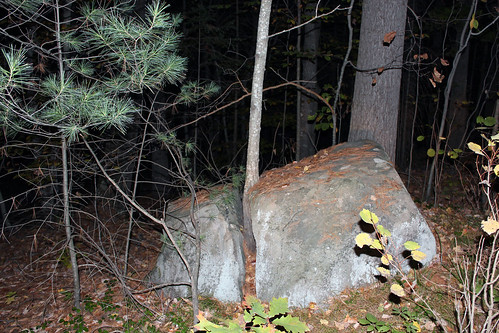
At one point I stopped and showed Catherine a very interesting rock near the road: probably due to the weather conditions, it had broken in two and in the middle of this chasm grew a beautiful tree! I had spotted the rock for the first time in the early 1990s and have been observing it since! 


Every night a bunch of racoons visited our campsite and even our cooler, wedged under the picnic table, was a fair game for them and they tried to open it. Besides, they always barked loudly and fought among themselves, waking us in the middle of the night. Catherine did not sleep as soundly as me and several times flew out of the tent at night to shoo them away; it was practically a nightly ritual.


On October 7, 2011, after paddling for a few hours on Lake Mazinaw for a few hours, we left the park and took road number 41 north up to Algonquin Park, to the Radio Observatory. On our way we stopped in the town of Pembroke where I decided to try MacDonald’s coffee; unfortunately, it was so bad that I returned it and later drove to Tim Horton’s, for a cup of delicious coffee!


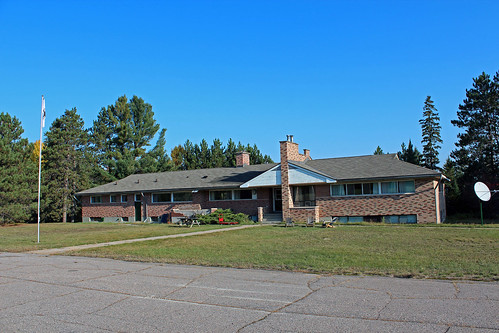
We arrived at our destination at dusk. Somehow Catherine had thought the trip commenced on the Friday evening, as was the usual OCEY (The Outing Club of East York) club scenario. However, we were told that we were a day early! We considered putting up our tent nearby, but Caroline, a most gracious host, happily put us up for the night in a small room which reminded Catherine of her 1960s teenaged flower power bedroom (hot green with modern furniture). Unfortunately, the 140.00/night room rate did not reflect the 1960's economy! By the way, the building we stayed in formerly served as a hotel and canteen for scientists who worked there.


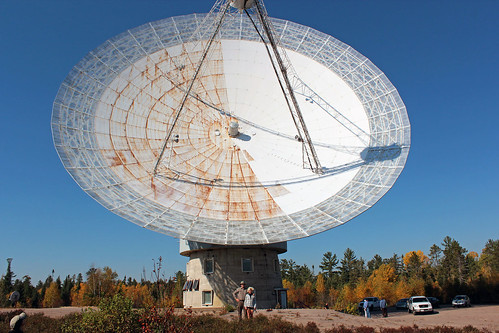
The site consisted of the huge radio telescope, built in the 1960s, can be used for observation of distant astronomical objects using radio waves plus a 1960’s style house with 10 plus guest rooms, unisex bathrooms, dining area and lounge. The radio telescope was built in the sixties and has 46-year-meter parabolic antenna. For some time it was not used and even there were rumours of its demolition, but it eventually it was taken over by a private company, Thoth Technology, Inc., which hopes to restore it back to its ‘former glory’ (http://thothx.com/home) and incidentally to earn a little bit on this project. The CEO and the director are a married couple, Canadian and British; they both met while studying at Oxford. He has a PhD in astrophysics and is a professor at York University; his wife holds a doctorate in English and also teaches at York University.


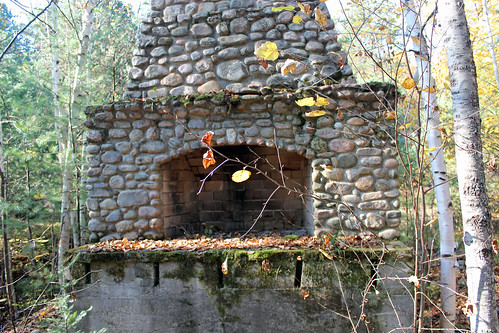
This trip was organized by the Outing Club of East York of Toronto and altogether almost 20 people arrived; I had met some of them during past camping and canoeing events. The observatory was situated in the heart of Algonquin Park, on Lake Travers. Right next to our building, on a small peninsula, were fairly well-preserved ruins of five fireplaces. These were the remnants of “The Booth Turtle Club”, built in 1933 by the JR Booth family. The club was built in the shape of a turtle and the 5 fireplaces were the legs and tail of a turtle. Rudolphus John Booth (1827-1925) was a multimillionaire, ‘Lumber Baron’, which bought the logging rights in this area. At that time there were so many trees, so much wood, that it was said it would last for hundreds of years; alas, in the beginning of the twentieth century all the trees were gone! JR Booth also built the railway line leading from the town of Parry Sound on Georgian Bay to Ottawa. The line passed through Algonquin Park as well as through the town of Wilno, the first Polish settlement in Canada, and at that time was mainly used for transporting timber. At one time it was the busiest railway line in Canada—every 20 minutes a train passed on its tracks. In 1933, because of a washed bridge, rail traffic was significantly reduced and eventually the line was abandoned in 1959. In Algonquin Park its right of way was converted into a pedestrian trail; a rail bridge still remains in Wilno; a train station and a water tower can be still seen in Barry’s Bay. In Algonquin Park there was once a very picturesque hotel, the Highland Inn, located just meters from the rail platform where thousands of tourists visiting the park disembarked from the train. Today one can see several meters of the tracks and original little platform in front of the small hill where the hotel used to stand.


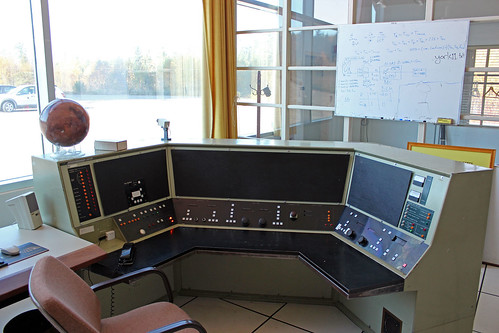
The most interesting point on the agenda was a visit to the observatory; our guide was, of course, Ben. After driving for a few minutes, we arrived and saw the huge dish, it looked really impressive! First, we went to the ‘control center’ from which the canopy of the telescope can be operated. The control panel, as well as most of the instruments came from the sixties and looked at least slightly outdated in 2011! From the building we went down to an underground tunnel leading to the base of the telescope. Everywhere there was a lot of the old measurement equipment from the fifties and sixties; at that time all the equipment was considered to be extremely advanced; today it was more fitting to belong to a museum. For me, it was for me a great place to take pictures! The Observatory also had a huge atomic clock, locked in a special room with controlled temperature and additional power supply in the form of batteries, in case of power supply interruption. Then we visited the rooms located around the base of the telescope and then climbed on the terrace around the telescope, from where a marvellous view of Algonquin Park unfolded! We learned many interesting things about this telescope and I hope that this undertaking will be successful.


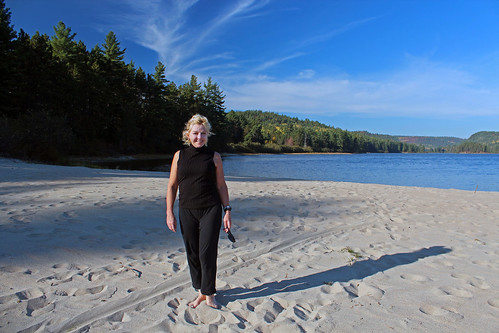
We took advantage of the available canoes and on Saturday we paddled on Lake Travers, reaching a number of campsites. Some of them had beautiful sandy beaches; considering that the temperature during the day reached +25 C (in October!), we almost thought we were in Cuba. After paddling for a while, we reached the end of the lake, where it narrowed and turned into a river (Petawawa River). The next day, on Sunday, we decided to paddle up that river as far as possible. Incidentally, the Petawawa River, after leaving Algonquin Park, runs through the town of Petawawa and the Petawawa military base. From this base a lot of Canadian soldiers depart on their missions to Afghanistan; sadly, some never return… Eventually we reached rocky rapids and it was not possible to proceed any farther without portaging the canoe.


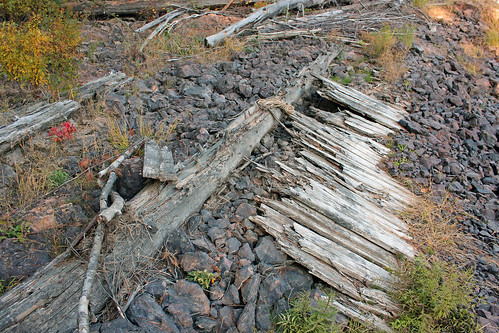
Nearby we saw the remains of ‘log chutes’, special shafts used to transport logs over water in the late nineteenth and early twentieth century. This year Thanksgiving Day in Canada fell on Monday, October 11, yet a traditional turkey dinner was to be held on Sunday since everyone was leaving on Monday morning. It was quite late and we were still about 10 km. from our ‘hotel’ and did not want to be late for this traditional meal.


On the way back Catherine and I paddled very hard, without taking any breaks; it was quite exhausting, but we did arrive on time and soon sat down with the others at the dinner table. According to my GPS, we paddled on the way back with an average speed of 6 km per hour, not bad! After the meal we all watched an Australian movie “The Dish”. It was about a radio observatory in Australia during the first US moon landing in the 1960s. The ‘dish’ portrayed in the movie was very similar to the one in Algonquin Park. It was a good movie, partially based on true events. 


After breakfast on Monday morning we said goodbye to our hosts and the other participants and set out on the third leg of our journey, to Lake Opeongo, located also in Algonquin Park, but in its southern part, near highway 60 (in a straight line it was just 40 kilometres from us, but the park does not have many roads and thus we had to take a very circular route). We stopped briefly at Barron’s Canyon where Catherine walked to the spectacular cliffs as well as visited the Archway Campground. The park’s interior campsites are open for the whole year, but on this very day all drive-in campgrounds, except for Mew Lake, were closing, so there was plenty of activity at Archway, with families packing and leaving the park. Once the Canadian National Railway, built in 1915 and dismantled in 1995, crisscrossed Algonquin Park and ran through the Archway Campground; now its rail bed is used as a hiking and cycling path. We also visited a small, old wooden house which once housed park wardens who worked in the park. One of the wardens who occupied this building was Tom Thomson, the famous Canadian painter, whose paintings nowadays sell at auctions for record-breaking prices. Tom Thomson is always associated with the famous Canadian group of painters, “Group of Seven”, as well as with Algonquin Park, where he worked, canoed, painted his famed paintings and where he mysteriously drowned in Canoe Lake. Although my GPS supposedly calculated the fastest route, some of the roads it selected were quite rough; one of them initially seemed to be quite nice and picturesque, but after driving for several kilometres, it became too rugged for my car and we had to turn back, deciding to stick to main roads instead. Eventually we reached highway 60, drove through Wilno and Barry’s Bay and after a few hours we arrived at Lake Opeongo…


Our intention was to rent a canoe and paddle to Bates Island on Lake Opeongo and spend one night at a very specific site. Well, exactly to the day, 20 years ago (11 October 1991), a couple camped on Bates Island on that campsite and probably on that very first day they were attacked by a black bear. They both died and only after 5 days did anyone realize what had happened. When the park staff arrived at the island, the bear still was at their campsite, guarding their bodies... It was the last fatal black bear attack in the park since then.


As it turned out, canoe rental was more expensive than we expected; even though we were going to rent a canoe for less than 24 hours, we were required to pay for two full days. It was also widely advertised that a rental was only $14.95 if you were staying in the park campground, but it turned out that interior camping did not count as a park site so the price immediately started at the regular rate of $20.99 for an aluminum canoe. All told we calculated our 18 hour rental would have been close to $60.00—what a rip off! It was not really about money, we simply felt this deal was not fair, especially considering it was the last day of the seasons and the prices should reflect that. After talking with the manager, who insisted that we pay the full price and did not want to give us any discount, we decided to opt out of paddling to the interior site on Bates Island and instead camp at some drive-in campsite in the park.


It is interesting, but over the past 15 or so years I have encountered many similar situations in Ontario. For example, 13 years ago, in late September/early October, we wanted to rent a cottage (and due to the bad weather, at least 90% of all the cottages were vacant). The owner graciously said that she would give us a 10% discount... off the full price of $800 per week... Another owner got visibly upset and unpleasant when we presented her a flier (which she must have created, approved and distributed), advertising a special fall rate of ‘$350 per cottage per week for 2 people’ (by the way, during our stay all the other cottages remained vacant). Or when 12 years ago we wanted to rent a fishing boat, again at the end of September, the price was firm $100 plus gas—and we also had to be back by 5 pm. Or when we tried to rent a cottage relatively close to Toronto, again in early October—even though we had all the linens, the owner quoted a ridiculously high price, which I would have probably been reluctant to pay in the peak season; when I asked him for a discount, he said, „I don’t make money by giving discounts”. Well, he certainly did not make ANY money then! I could certainly throw in many other similar examples. On the other hand, while travelling in the USA, I was so surprised at how it was possible to negotiate prices of motels or rentals. Apparently, the attitude towards business in the USA is... well, more business-like and customer-oriented! Considering that in Ontario most of the tourists are gone after the long Labour Day weekend in September, it would be only natural to see substantial discounts offered then.


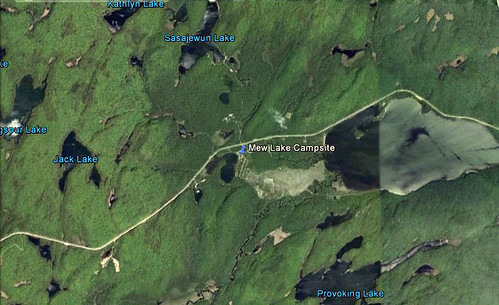
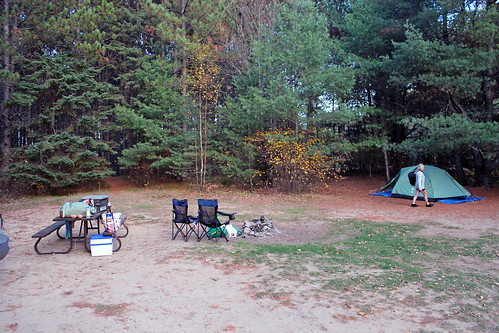
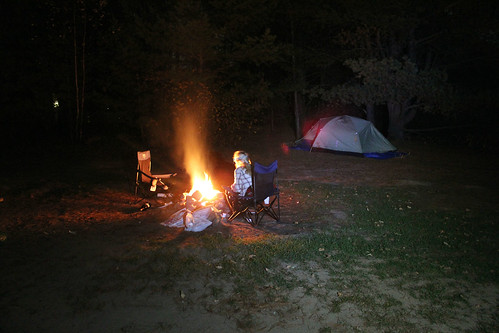
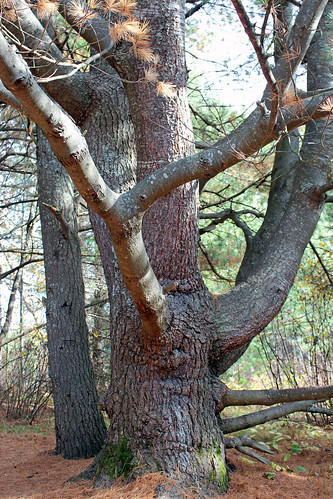
We went to the park office adjacent to the store to inquire about campsite availability, yet the park employee gave us completely wrong information: she said that several other campgrounds were still open and (supposedly!) called one of them, confirming it was open. When we arrived there, it was closed and after unnecessarily driving to and fro, we eventually discovered that all campgrounds but Mew Lake were closed for the season. So, we finally reached Mew Lake, which is open all year (some people live there in RVs throughout the winter and Catherine spent the previous winter weekend in one of the yurts). We got campsite no. 68; its location was below-average: it was very close the campground’s roads, we could also see (and hear) the traffic on highway 60, it was exposed and there were a few other campers around us. But we did not care that much, we were supposed to spend only one night there and it was to be the last camping night of the season. We pitched the tent under an interesting tree with plenty of branches, started a campfire and sat around it for a long time as it was quite warm at night, about +14C. In general we were extremely lucky with the weather: for 8 days, every day was sunny, there was not one drop of rain and daily temperatures were reaching +25C (after arriving in Toronto the next the day, it began to pour!). Before midnight we went to the tent and turned in. Practically, we had no food left and we did not even bother putting away our stuff into the car; we even forgot that there was a coffee cream in the cooler (which Catherine bought today for the morning coffee).


 ”Jack, there is a bear at our campsite!” 

At 2:15 in the morning I woke up and heard Catherine getting out of the tent, as well I pick up some noises coming from outside—same noises as we heard nightly in Bon Echo. Raccoons again, I thought, half-consciously turning on the other side and heard Catherine chasing them away and shouting, “shoo, shoo”. But in a few seconds she came back to the tent. “Jack, there is a bear at our campsite”, she said calmly. Immediately I woke, grabbed my glasses and reached for the flashlight. “A bear? Are you sure”, I asked. “Maybe it’s just a big raccoon?” Some raccoons are so adept in stealing food from tourists at campsites that they become obese and look like little bears, especially in the dark. In the 1990s a park warden in Bon Echo park told me that many times he had been contacted by frighten tourists who reported seeing a bear at their campsite; once he arrived to investigate, it turned out that this ‘bear’ was just an overfed, fat raccoon. “No, it’s a bear”, she said. I scrambled out of the tent, without even putting on the shoes. It was full moon; my car and the park bench were fairly well lit—they were about 8 meters from us. From the other side of the car, where I could see the white bottom of the cooler, came a crackling sound, but I did not see its source, everything was drowning in darkness, hidden in the shadow of the car. I decided to see the perpetrator of this noise and quietly walked to the cooler. Indeed, I saw a black object near the cooler which looked like a bear, but it did not appear too big or scary. I quickly walked back to Catherine. “Maybe it’s a small bear”? “No, it’s not a small bear, it’s a big bear”, she firmly said. Big one. Admittedly it was a clear sky, full moon and Catherine is not given to wild imagination or hysterics unless it involves crawling bugs in the bed. We did not know what to do. The bear ostensibly relished the coffee cream, as it was the only thing in the cooler. I had a bear banger with me, but did not feel that I had to use it. However, the bear spray, which would be the most appropriate device to drive away the bear in case of further problems and which I ALWAYS kept in the tent, this time—and probably for the first time—was locked somewhere in the car, because we had not even thought about the possibility of having to use it here! So, while we stood helplessly around the tent, staring at the bear, he leisurely drank the coffee cream. We were patiently waiting until he would finish it. Indeed, after a few minutes we heard a different kind of noise… and suddenly a huge, black hulk appeared from behind the car. Undoubtedly, a black bear! He went over to the park bench where more of our equipment was all over the table and standing up on his hind legs, he started to nose through our stuff. We could see him perfectly now. It was definitely a BIG bear. He certainly was aware of our presence—after all, when Catherine initially approached it, thinking it was a bunch of raccoons, she was no more than 2 meters from it and he must have seen and heard her—but he was totally not interested in us. His front paws rested on the table and he was checking the content of our plastic box, where we usually kept our kitchen equipment and other similar implements. Although we did not keep any food in the box, for some reasons a bag of dried prunes was there, which of course he found. Nevertheless I have to admit that the bear was a gentleman—after all, he could have dumped the whole box on the ground and gone over everything then, picking what he needed, but he did not do so, instead sniffing all over the box on the table. It lasted for maybe two minutes.


“Perhaps we should climb the tree?”, Catherine suggested, “and observe the bear from there?” She had never been close to a bear before except at a dumpsite and relished the idea of spying on him from 10 feet away The tree under which we set up our tent had ideal branches for climbing and we could have done it very easily. I’m glad we did not, though; I have read that the bear, seeing something moving up the tree, might become curious and climb the tree himself to further investigate. I began to regret that I did not have my camera handy, yet I do not think it would be possible to take photos without flash. Once the bear found the bag of prunes, it grabbed it with his teeth and walked to the same place as before, i.e., the other side of my car. Soon we heard the rustling noise of the aluminium bag and loud munching. Interestingly, I was not afraid, even though the whole spectacle was a bit surreal. Generally, black bear attacks on humans are extremely rare and if they do take place, then the culprit usually is so-called ‘predatory bear’, mostly a solitary male, who had been watching and following his intended victim for some time and then silently approaches and attacks the hapless individual when he least expects it. This bear, on the other hand, was a typical ‘campsite bear’, accustomed to people, cars, campfires, tents, coolers—he simply was searching for food, left by irresponsible tourists who did not hide it in the car or who did not hang it on the tree… The campers themselves, in the culinary sense, were not of any interest to the bear. “What happens when he finishes eating the prunes”, I loudly asked myself. “Are there any other food items in the box?” We were not sure; sometimes a bag of powdered soup could have gotten mixed up with the other stuff and we did not remember about it, as we totally forgot about the bag of prunes. “You know, we should go to the car”, I said. Quickly I ran to the tent, grabbed the car keys and slowly we headed towards the car’s front passenger door (just near the driver’s door, on the other side of the car, the bear was having his snack) and quietly got inside the car. From the side window I had a perfect view of the big bear. He was sitting maybe a meter from the car, almost touching it. He was utterly disinterested in our presence (he must have heard the slamming of the car’s door) and kept devouring the prunes. We decided to stay in the car and simply wait for his next move. After a few minutes he finished the bag of prunes and headed back toward the bench, climbed onto the table and sniffed the box. This time we saw him very clearly in the moonlight. He was pitch-black and once again we could admire his grandeur. Apparently he did not find anything else that was edible; as though not knowing what to do next, he looked left, right, at the car… and slowly headed in the direction of our tent, whose door was unzipped and wide open. Of course, we did not keep any food inside the tent—but after all, the bear could not know that! Who knows, maybe he would want to make a tent ‘inspection’, after which, besides holes in the mattresses, the tent would gain several extra doors, windows and even a permanent sunroof? “Hey, buddy, the last thing we need it to have our new tent destroyed”, I said, started the car and slowly drove back. The bear immediately vanished in the darkness; we did not even see which direction it ran. I switched off the car’s engine, opened the windows and we were listening for any clatter, but there was complete silence. In a tent at the adjacent campsite a few people were sleeping, not realizing what had just taken place just a few meters from them. We stayed in the car for a few additional minutes and then went to the tent. The bear made a small hole in my cooler with his teeth—well, a great memento of this event—and a warning for the future! In spite of this highly unusual and remarkable experience, we quickly fell asleep and nothing bothered us anymore this night.


The next day morning Catherine went (alone!) for a walk along a hiking trail, located in the old railway bed (‘right of way’) of the JR. Booth Rail, relatively close to our campsite. Along the way she saw several bear poop. She met a couple who had camped at the Mew Lake Campground for decades and told them about the bear encounter. They were extremely surprised, as they had never seen a bear at this campsite! We were really lucky!


From my modest experience I can say that in the vast majority of cases, bears avoid contact with humans. Very often I see their fresh poop, but I hardly ever see bears—yet I am sure that they do see and observe us! For example, two years ago we were camping in the Massasauga Park and when we were away from our campsite for several hours, it turned out that a small black bear was wandering all over our site (a warden, who was in his boat nearby, saw it). Since all of our food was hung on a tree, the bear did not do any damage, did not take anything and had we not had the conversation with the warden, we would have never suspected that we had this furry visitor! While camping on Philip Edward Island, one night I heard crackling noises, as if somebody were breaking tree branches. I was sure it was a bear; when in the morning we left the campsite, we saw a bear standing on the shore. Bears do not seek any contact with people and when they sense their presence, they hide and at the most, watch them from afar, themselves remaining invisible and might visit their campsites in search of food at night or when campers are gone. At garbage dumps in Ontario one can sometimes see over 20 bears, rummaging everywhere and they totally ignore people coming there, engrossed in their food-finding mission. However, there have been cases when hikers startled bears or, even worse, mother bear with cubs (that is why it is suggested that lone hikers should loudly talk, sing or wear special bear bells) During such unexpected encounters bears might start puffing, snorting or stand on their hind legs and even make bluff attacks. In fact, such behaviour means that the bear does not want to harm us, but just wants us to go away—if they really wanted to attack us, they would have done it immediately. Considering our aborted plans to canoe to and camp on Bates Island, the 20th anniversary of the tragic bear attack on the island and the fact that it was our last camping of the year, it was a very exciting conclusion of our camping and canoeing season! We were also taught a very good lesson to keep our food either in the car or hang it on the tree and keep all our foodstuff in one place. 


Friday, September 30, 2011

Restoule Provincial Park, Ontario, September 15-21, 2011

Blog in Polish/Blog po polsku: http://ontario-nature-polish.blogspot.com/2011/09/restoule-provincial-park-on.html
More photos:
http://www.flickr.com/photos/jack_1962/sets/72157628606261077


Restoule Provincial Park, Ontario, September 2011

Restoule Provincial Park, Ontario, September 2011

In the past I had visited Restoule Provincial Park twice—in September 1999 and 2000, also with Christopher, with whom I went there this year. Our both trips were not very successful—in 1999, on the second day after our arrival, the temperature plummeted in the morning to below 0C and soon it started raining—after two miserable nights we rented a cottage on Lake Commanda where we spent the next ten days. It turned out to be a great decision since it would rain very often and once a power storm, with lighting and thunder, kept us awake for hours—but at least we were not roughing it in a tent! In 2000 our trip was nicer, but because we did not have a boat or canoe, we had to rely on renting them which was not an easy task: plenty of resorts had already been closed, those that rented boats were quite expensive and we had to travel far from the park, even to Lake Nipissing, to rent fishing boats—and frequently we were not satisfied with them. This year, however, we brought with us a canoe, so at least we knew we would be able to spend a lot of time on the water and do some fishing.

Restoule Provincial Park, Ontario, September 2011

When we left Toronto on September 15, 2011, it was so windy that I was somehow reluctant to drive on the highway (400) with the canoe attached to the roof. In fact, strong gusts of wind were whipping the canoe and twice we had to stop on the highway's shoulder to adjust the canoe—on one occasion 1/3 of the canoe shifted from the roof. Just before reaching Barrie, we got off the 400 and driving on side roads, arrived at the MEC Store (Mountain Equipment Co-Op), one of the best outdoor stores in Ontario. We talked to the store staff and one salesperson even took a look at the canoe and suggested we buy additional, higher canoe blocks. Maybe they helped a little, but we did not feel too confident to continue driving on the highway for the next 200 km. So, we decided to go to Six Mile Provincial Park instead (which we had visited many times for the past 20 years). I took a number of country roads and tried to drive just at the speed limit, yet at one point, when we were on the top of a hill, the wind again caused the canoe to shift a little, forcing us to stop and adjust it. In the town of Port Severn we bought a bag of firewood and after 10 minutes arrived at the park. As we expected, there were very few campers in the park and we could pick any site we wanted (not that we cared that much—after all, we were going to stay there for just one night). We picked site number 68, set up the tent, started the campfire and for the next few hours sat around the fire, drinking beer, grilling sausage and enjoying its warmth as it was quite chilly. Nobody drove nor walked by our campsite nor did we hear any other people. I also realized that I had not brought a mattress and had to quickly make an improvised 'pad', using various pieces of clothing and my life jacket.

Restoule Provincial Park, Ontario, September 2011

On September 16, 2011, we were up before 7:00 am, quickly packed up the tent and in less than one hour were back on highway 400, heading north. We passed plenty of lakes and admired the morning mist rising off the water. Once we reached the town of Parry Town, we had breakfast at Tim Horton's, then I went to a Canadian Tire store, bought a mattress (which proved to be defective and kept loosing most of its air every night—I returned it after our trip). Before noon we arrived at Restoule Provincial Park.

Restoule Provincial Park, Ontario, September 2011

The park's campsites are quite good, yet the privacy level, so to say, is so-so, usually you can see several other campsites and there is not that much vegetation between the campsites. Of course, in September the park was nearly empty, so we were enjoying total privacy and did not see any other campers around. On the campgrounds without electricity (where we stayed) perhaps only 10 campsites were occupied and all of them were near the water, far away from us; the electrical campsites did have quite a few campers, mainly living in trailers. We spent an hour driving on the park's roads, checking out campsites; eventually we decided to choose campsite number 214. It was a good camping site and there were not even distant neighbours during our stay. We were surrounded by beautiful autumn colours, the whole place was covered by fallen leaves which created a 'leaf carpet'. We pitched our tents, spread the tarp over the park bench (just in case of rain) and started a fire. It was a chilly night, so we were sitting close to the fire, enjoying beer, red wine and grilling steaks.

Restoule Provincial Park, Ontario, September 2011

The next day, September 17, 2011 (72nd anniversary of the Soviet Union's invasion of Poland) was sunny, so after breakfast we drove to Restoule Lake, put the canoe on the water, unpacked our fishing rods and paddled all over the lake, stopping from time to time to cast. The lake was quite big and there were plenty of houses on its shores; from time to time a motor boat passed by. After five hours we turned back to the dock, without catching one lousy fish! I went for a 20 minute swim—the water was very cold, but I did not mind and after a few minutes I hardly noticed how cold it was; in fact, I felt very refreshed! While driving to the campsite, we were listening to the CBC news and found out that there was a plane crash in Reno, Nevada, resulting in numerous casualties. Again, we had a nice fire and had delicious grilled steaks.

Restoule Provincial Park, Ontario, September 2011

On September 18 and 20, 2011, we canoed on the other lake, located north of the park—Stormy Lake. It was much nicer than Lake Restoule, there were very few cottages and once we departed from the dock, we saw a huge rocky escarpment with a fire tower located on its top. In the old days fire towers were a common sight all over Ontario; a guard would sit there and observe the area—in case of fire, he notified local firefighters. Now planes or helicopters are performing such duties and fire towers have become tourist attractions. We also found out that Restoule Park had a number of interior campsites, accessible only by water. It was a pity we were not aware of them—we could have stayed on an interior campsite! When we were leaving the park dock, a motor boat, driven by a lone woman and laden with camping equipment just docked. Apparently, she just returned from an interior camping trip; she told me she had stayed on crown land, where everyone could camp for free, but she also mentioned the park's interior campsites. Indeed, about 15 minutes from the dock and nearby the rocky escarpment, we found an interior camping site; about 50 meters behind that site was Hazel Lake. Since an angler told us it was a good lake to catch a pike, we decided to try our luck there. There used to be a short channel connecting Hazel Lake to Stormy Lake years ago, but now a big beaver dam was erected between the two lakes. Chris bravely carried the canoe to Hazel Lake. It was a small, yet very picturesque lake! There were a lot of beaver lodges all over the lake and soon we spotted a few beavers swimming in the water. We paddled to the end of the lake and back, casting and trolling all the time, yet did not catch anything. Chris again portaged the canoe to Stormy Lake and we tried our fishing luck on that lake again—to no avail! Then we paddled to the north and reached Clear Lake. It was probably in that area that we could camp on crown land, as we did not see any cottages and it did not belong to the park either. We met one fellow who had a motorboat and from the number of fishing equipment we could infer he took his fishing hobby very seriously! He said he had been fishing in this area for 40 years and also complained about poor fishing (i.e., he did not catch anything either—he said fish had disappeared since August). He told us a story about coming across a wreck of a military plane that had crashed in the dense wood in the 1950s. We also spoke to other fishermen—most of them had motor boats, sophisticated fish finders and about 20 fishing rods—and they had not caught anything either. So, at least we were in a good company!

Restoule Provincial Park, Ontario, September 2011

Once day, when the weather appeared to be uncertainly, we drove to the town of Powassan and had lunch in “The Hawk & Fox Restaurant”. It was a typical local restaurant, where everyone knew everyone and most customers were regulars. I noticed a photo of a young girl displayed inside—her name was Amber Lynn Booth, she used to work in the restaurant not long ago (as well as she had worked in Restoule Park). On June 5, 2011, she died in a car accident shortly after getting her driving licence, she was only 20 years old. Another tragedy that happens every day... After lunch we drove around town—in 2000 we had gone to a nice coffee shop called, if my memory serves me well, “Cobbler's Corner” and talked to its owner, but now the restaurant was gone. We also drove on many back roads between Powassan and Restoule Park. We passed a very impressive Catholic Church in Alsace, located almost in the middle on nowhere (more about this church: http://www.toeppner.ca/Alsace_Cemetery_Project/history.html). We also drove on “Rousseau-Nipissing Colonization Road”, built in 1866—one of many colonization roads that the Canadian government built to encourage pioneers to settle in the north. We stopped at the old store, “Commanda Store”, a beautiful Victorian building from 1855, strategically located near the colonization road. For many decades it was an important trading place for passing travellers. Its owner, James Arthurs, was a Member of Parliament and Senator for almost 30 years, representing in Ottawa the local constituency.

Restoule Provincial Park, Ontario, September 2011

The town of Restoule has changed since our last visit. There are more stores and it was even possible to buy beer and alcoholic beverages there (previously we had to drive to Powassan). We also went to the local landfill to see bears, but we did not see any, yet we saw bear poop everywhere. We visited an apiary and then went to a farmer on the other side of the road to get campfire wood. He talked about the town of Restoule, when it was so isolated, and the hardships faced by the early pioneers. He pointed to an old gentleman sitting nearby, who was about 80 years old, and said he still remembered the original pioneers. I asked him about farming in the area, as I had seen several farms here and there (Restoule is located on the Canadian Shield, where the soil is very poor and rocks are scattered all over). He said farmers had it very hard, some tried to cultivate wheat and cereals but they could not even break even. He mentioned that often you could see, in the middle of the forest, remains of abandoned farm buildings—in fact, I have also run into such remnants. In the nineteen century, many immigrants, encouraged by the government promise of free farmland (and by the colonization roads, which were supposed to take them there), kept coming and settling in the area, along the colonization roads. Of course, they realized that there were rocks everywhere, but they also saw huge, hundred years old trees that were growing on those rocks, so they figured out that if this thin layer of soil could support such dense forest, it would certainly be suitable for farming and agriculture. Unfortunately, they were wrong! At the beginning, where there was a thriving logging industry, it was possible for them to supplement income by trading with loggers and selling their modest agricultural products to them as well as obtain some logging work. Once the land was cleared of trees, erosion set in and very quickly the already poor soil was being washed away and became unsuitable for any crops. Soon, all the trees were cut down and loggers moved out of the area, causing the farmers to lose an important source of income and many customers. Transporting their products to towns on terrible, rugged and often impassable roads was totally uneconomical. Thus, most of the settlers simply abandoned their farms and moved on to better lands and only those stayed who were lucky to get a farm with a thicker layer of soil that could sustain some agriculture and cow & pig farming. Abandoned houses, some over 100 years old, have been almost completely absorbed by the forest, but often one can see a mound of stones in the middle of a forest—a sign that someone had tried to fight with the forest, tried to farm there and cleared the land of rocks, often with his bare hands—yet lost his battle, leaving such ghostly signs of his brief presence.

Restoule Provincial Park, Ontario, September 2011

On September 22, 2011 we packed up and again drove to Powassan to the “Hawk & Fox Restaurant” where we had breakfast and several hours later reached Toronto.

Blog in Polish/Blog po polsku: http://ontario-nature-polish.blogspot.com/2011/09/restoule-provincial-park-on.html
More photos: http://www.flickr.com/photos/jack_1962/sets/72157628606261077

Emily Provincial Park and Kawathra Lakes, Ontario, September 2011

More photos: http://www.flickr.com/photos/jack_1962/sets/72157628471174703/ 


Emily Provincial Park is located in the Kawathra Lakes, an area of hundreds of beautiful lakes in the south-central part of Ontario. The name is derived from an Indian word „Ka-wa-tae-gum-maug”, coined in 1895 by aboriginal Martha Whetung of the Curve lake First Nations. We used the park as our camping base and it made a perfect launching pad for our canoeing trips on nearby lakes.


On our way from Toronto to the park, we stopped in a small private zoo south of Peterborough, “The Jungle Cat World Wildlife Park” (www.junglecatworld.com ), where we could see lions, tigers, goats, monkeys, birds, otters, lamas and many other interesting animals—as well as play with some of them (what a wonderful treat for kids!). Our timing was perfect—it was the feeding time and the zoo staff was on hand, providing information on the animals and answering visitors’ questions. Nearby there was a large animal (pet) cemetery—judging upon the number of grave tombs, it must have been very popular. Many inscriptions were extremely poignant, extolling virtues of the buried animals and the irreparable loss caused by their passing. You rarely see such heartbreaking inscriptions at ‘human’ cemeteries—and the ones at the pet cemetery were entirely coming from their owners’ heart—not because of an obligation or tradition, as it often happens after people die... When I read long obituaries in newspapers, almost each and every recently deceased individual appears to have been such a wonderful, generous, kind and fantastic person that I am always sorry I did not meet him while he was alive! Because I spotted a Canadian and German flags at the zoo’s main building, I inferred that the owner must be from Germany. “I’m curious if he is from East or West Germany”, I joked. Several minutes later I had an opportunity to meet him—the first thing I noticed was a small pin he was wearing—it was the flag of East Germany! Indeed, he did come from East Germany; after immigrating to Canada, he founded this zoo and has been running it since then. Later we met his wife and son and I promised to mail them a very good movie about East Germany, “Good Bye, Lenin” as I was sure he would enjoy watching it.


Emily Provincial Park is, in my opinion, an average park. However, since we arrived on September 05, 2011, on Monday (it was the Labour Day weekend, which traditionally is the last long weekend of the summer and the next day school starts), the park was almost vacant. Even though the site we were staying on (# 38) was quite exposed and adjacent to many other campsites, we had plenty of privacy as nobody else was camping around. That is why we try to visit more remote areas or parks in July and August, at the peak season—they are hardly ever full and no reservations are required; before and after those months we visit all the other parks, which are very popular and crowded in the summer, but in other months are quiet and mostly empty.


We were regularly visited by chipmunks, they loved peanuts and were very eager to get as many of them as possible. Soon, however, they had a rival--a rather brave Blue Jay (a popular bird with very characteristic blue feathers). It sat on a nearby tree while the chipmunk was stuffing his pouches with the peanuts and once they became full, it also grabbed a peanut or two in his mouth and was heading to his burrow. Then the Blue Jay commenced his attack, trying to snatch the peanut from the chipmunk! Besides, a squirrel with an impressive, bushy tail, would visit the campsite a few times, but it was much more timid than the usually very friendly and persistent chipmunk. At night we saw raccoons and one skunk; in fact, I am more afraid of skunks than of bears, yet I know that skunks never attack (by releasing their foul smelling liquid) unprovoked, so we were observing it for some time until it vanished in the darkness.


During our stay at the park we went canoeing on three lakes: Pigeon Lake, Lovesick Lake and Clear Lake, as well as we paddled to Wolf Island. The island is part of Wolf Lake Provincial Park and we saw several vacant campsites with recently-used fire pits. Later we found out that camping was not allowed at this park—what a pity! The island, with adjoining headland, makes a natural ‘dam’ between Lovesick Lake and Lower Buckhorn Lake. Because the famous Trent-Severn Waterway (that runs between Georgian Bay and Lake Ontario) criss-crosses these lakes, there are a few dams and locks between those lakes—well, the whole waterway is dotted with locks!


The three lakes were quite sizable and we had to watch the waves. Plenty of cottages were built along their shores, yet there were not any rocks—the Canadian Shield starts just a few kilometres to the north of the lakes—in comparison to the ‘northern’ lakes, the difference was striking! Of course, I much prefer the northern lakes, dotted with rocks, rocky island, inlets, channels and shores!


In addition to canoeing, we also drove a lot in the area, visiting a few very picturesque towns—Lakefield, Bobcaygeon, Burleight Falls, young’s Point, Buckhorn, Omemee.


Yet the most memorable was the stop at the Curve Lake Indian Reserve. We visited an amazing store/gallery “Whetung Ojibwa Crafts and Art Gallery” (http://www.whetung.com) and spent at least 2 hours there (and that was why we did not have the time to go canoeing that day).


It had incredibly original Indian craft—paintings, carvings, masks, photographs, china, necklaces, jewellery and many other very unique works of art. I bought over 10 postcards with native motives, but I wish I had bought a few paintings that I liked very much! Well, maybe next time!


One day we visited a very charming and remarkable town of Lakefield. In the 1830s two sisters, Susanna Moodie and Catharine Parr Traill along with their husbands arrived from England in the Lakefield area and in the middle of dense forest, on the shores of Katchewanooka Lake, began their pioneer settlement (of course, the town of Lakefield did not exist at that time—it was their brother, Samuel Strickland, who was founded Lakefield and who also had a farm in that area). Susanna Moodie and Catharine Parr Traill were exceptional women, who even before coming to Canada had written several books back in England (their sister, Agnes Strickland, who resided in England, was also a writer). They were very intelligent, perceptive, observant and were able to accurately describe their new pioneer life which was full of hardships and totally unlike the one they led in England. Their books—among others, “The Backwoods of Canada” and “Roughing it in the Bush”—to this day are Canadian classics and constitute an important source of information on pioneer life in Canada. There is a commemorative plaque at the site of Susanna Moodie’s farm (which was so beautifully described in her books), one can see a house in which Catherine Parr Traill lived later in her life as well as their brother Samuel’s imposing mansion still remains. In the 1970s Margaret Laurence, a very well-known Canadian author moved to Lakefield and it was in her house in Lakefield where he committed suicide in 1987. The house still stands and there is a plaque dedicated to her. Lakefield is also the home of the renowned private school, “Lakefield College School”, on the shores of Katchewanooka Lake—Prince Andrew, son of Queen Elizabeth II attended it in 1977. Many years ago Lakefield could be reached from Peterborough by train; nowadays the tracks are gone, but fortunately the train station survives, turned into a quaint second-hand bookshop.


Before leaving for Toronto, we drove to a small town of Omemee, close to Emily Park, where we got a delicious pizza, walked to the river and had a picnic near the Pigeon River near the dam (in the native language “Omemee” means “Pigeon”; the name of one of Toronto’s district, Mimico, is also derived from the same word and means “plentiful in pigeons’). Overall, it was a very nice trip, as we were able to paddle on new lakes.